Build Knees That Can Handle the Race — Stronger Knees for Running and HYROX
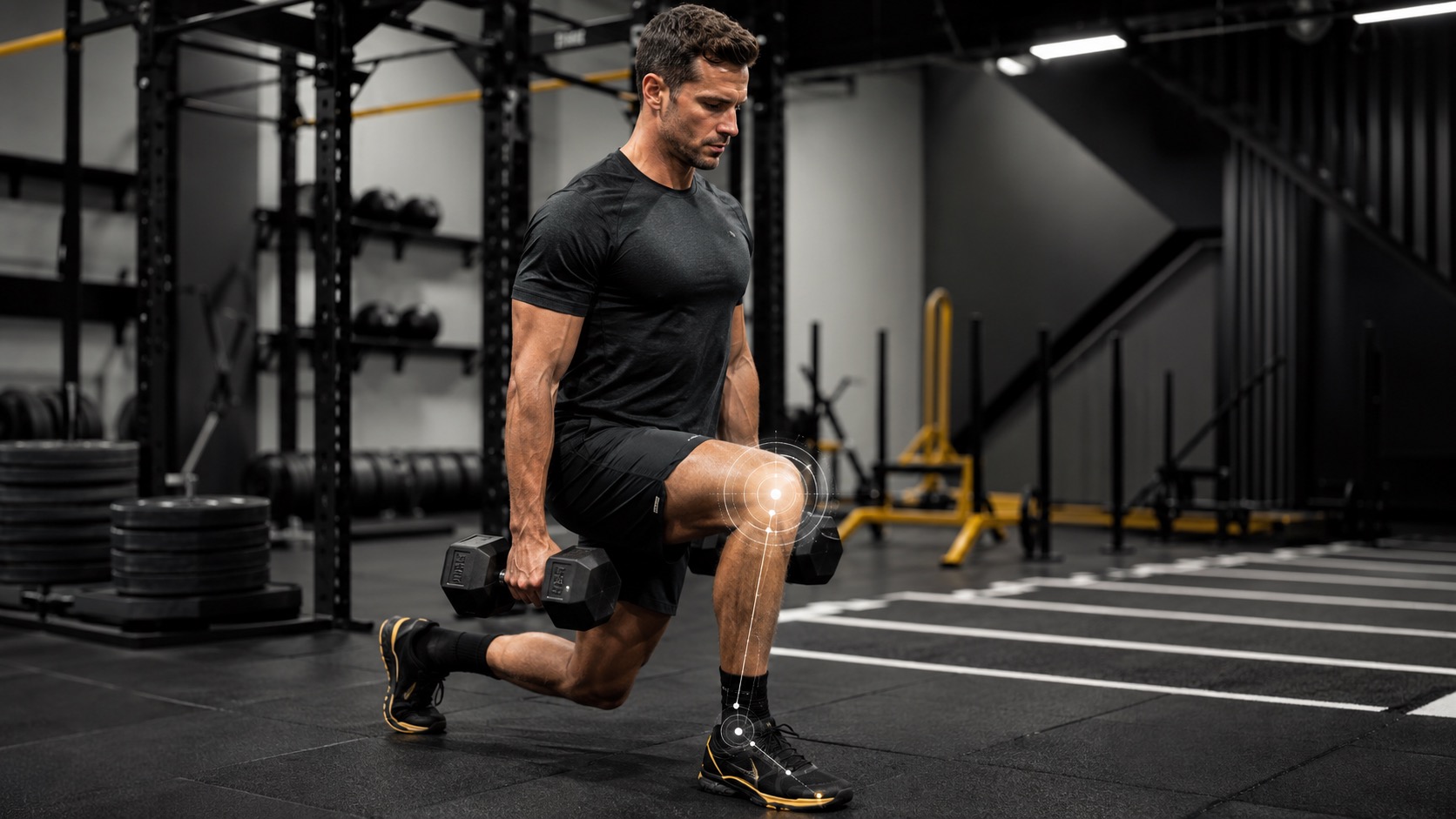
Strength, Load Management and Injury-Smart Training for Runners and HYROX Athletes
Knee resilience is not created by one corrective exercise. It is built by matching training load to current capacity, strengthening the entire lower limb and progressively restoring the exact demands of running, sleds, lunges, jumping and wall balls.
The knee is often blamed for everything that happens around it. Pain appears during running, squats or lunges, and the immediate conclusion is that the joint is “wearing out” or the kneecap is “tracking incorrectly.” The athlete rests until symptoms settle, returns to the same workload with the same capacity—and the cycle begins again.
A better model is capacity. The knee must tolerate repeated running contacts, deep flexion, braking forces, loaded carries, sled forces, lunges and wall balls. When exposure rises faster than the tissues and movement system can adapt, symptoms may emerge. The answer is not automatically complete rest, and it is not automatically more quadriceps work. First determine what type of presentation may be present and what the athlete can safely continue.
Knee Pain Is a Location, Not a Diagnosis
Different problems can produce pain in a similar area. A generic “knee strengthening” plan may be helpful for one athlete and inappropriate for another.
| Common pattern | Typical clues | Why the distinction matters |
| Patellofemoral pain | Pain around or behind the kneecap; often aggravated by running, stairs, squats, prolonged sitting or descending. | Education plus hip- and knee-targeted exercise are central, with load and movement modifications based on the individual. |
| Patellar tendinopathy | More localized pain at the inferior pole of the patella/tendon; often linked with jumping, acceleration, deceleration and high tendon load. | Progressive tendon loading is usually more relevant than generic rest or stretching. |
| Acute internal injury | Traumatic twist or impact, rapid swelling, locking, instability or inability to bear weight. | Requires clinical assessment; a general strengthening article is not an adequate first step. |
| Bone stress concern | Focal pain that worsens with impact, may progress to walking or night pain, and often follows a rapid load increase or low energy availability. | Continuing impact may worsen the problem; timely medical evaluation is important. |
Red Flags and Reasons to Get Assessed
- A significant traumatic event followed by deformity, inability to bear weight or rapid swelling.
- True locking, repeated giving way or a major loss of motion.
- A hot, red, markedly swollen joint, fever or unexplained illness.
- Progressively worsening focal bone pain or pain that begins to affect walking or sleep.
- Calf swelling, unusual warmth or shortness of breath.
- Symptoms that continue to worsen despite an appropriate reduction and rebuild of training load.
MEDICAL SAFETY If a knee injury follows acute trauma or includes major swelling, locking, instability, inability to bear weight or suspected bone injury, seek an appropriate clinical assessment before using a general exercise progression.
What the Evidence Supports
Patellofemoral pain: exercise and education first
The 2024 best-practice guide for patellofemoral pain recommends knee-targeted exercise therapy and education as primary interventions, with supporting options chosen for the individual. Hip-targeted exercise, running retraining, taping or orthoses may be useful in selected presentations, but they should not replace a coherent loading plan.
Running-injury prevention: the program matters
A 2024 randomized trial followed 325 novice recreational runners. A hip-and-core exercise program reduced lower-extremity overuse injuries compared with a stretching control, while the ankle-and-foot program did not produce the same overuse-injury benefit. This supports targeted neuromuscular and strength work—but it does not prove that every runner needs the same exercises.
Other trials have shown that short, generic self-directed strength programs do not always reduce injury rates. The practical lesson is that exercise selection, progression, adherence and the match between the program and the athlete’s risk profile matter.
Patellar tendinopathy: progressive loading beats endless avoidance
In athletes with patellar tendinopathy, progressive tendon-loading exercise produced better clinical outcomes at 24 weeks than pain-provoking eccentric-only exercise in a randomized clinical trial. Tendons need progressive force exposure, but the starting point and rate of progression must reflect irritability and sport demands.
The Five Capacities a Resilient Knee Needs
1. Quadriceps force
The quadriceps absorb and produce force during running, squatting, wall balls, lunges and sled work. Weakness or poor tolerance can increase the relative cost of every repetition. Build from isometrics or supported patterns toward heavier knee-dominant strength and power.
2. Hip and trunk control
The hip and trunk influence how the femur, pelvis and center of mass move over the foot. This does not mean every athlete must force the knee perfectly straight. It means the athlete should possess enough control and strength to manage the positions required by the task.
3. Calf and ankle capacity
The calf complex contributes substantially to running propulsion and shock management. Limited ankle capacity can shift demand up the chain. Both straight-knee and bent-knee calf work can be useful, along with ankle mobility when a meaningful restriction is present.
4. Tendon and impact tolerance
Slow strength work builds force capacity, but running and HYROX also require elastic and impact qualities. A complete progression eventually includes faster contractions, hopping, landing, acceleration and repeated running contacts.
5. Fatigue-resistant mechanics
An athlete may look controlled when fresh and lose position after sleds or lunges. Technique under fatigue is a separate capacity. It should be trained after foundational strength and impact tolerance are sufficient—not by repeatedly practicing poor movement to exhaustion.
A Practical Knee-Strength Progression
Choose exercises based on symptoms, equipment and training age. Two or three lower-body strength exposures per week may be appropriate for many athletes, but total running, HYROX and recovery load must be considered.
Level 1: Reduce irritability and preserve strength
- Wall sit or Spanish-squat isometric: 3–5 × 20–45 seconds.
- Supported split-squat isometric: 3–4 × 20–30 seconds per side.
- Bridge or hip thrust: 2–4 × 8–15 repetitions.
- Straight- and bent-knee calf raise: 2–4 × 8–15 repetitions.
- Low-impact conditioning such as cycling, swimming or a tolerable ergometer when running is temporarily limited.
Level 2: Build controlled strength through range
- Goblet squat, box squat or leg press: 3–4 × 6–12 repetitions.
- Split squat or reverse lunge: 3–4 × 6–10 per side.
- Step-up or controlled step-down: 2–4 × 6–12 per side.
- Romanian deadlift: 3–4 × 6–10 repetitions.
- Hip abduction or lateral band work: 2–3 × 10–15 repetitions.
Level 3: Increase force and single-leg demand
- Heavier squat or leg-press variation: 3–5 × 4–8 repetitions.
- Rear-foot-elevated split squat: 3–4 × 5–8 per side.
- Single-leg RDL or loaded step-up: 3–4 × 6–10 per side.
- Heavy calf raise and seated calf raise: 3–5 × 5–10 repetitions.
- Sled push or backward sled drag at a load and volume that produces a stable next-day response.
Level 4: Restore elastic and race-specific capacity
- Pogo hops and low-amplitude jump-rope contacts.
- Snap-downs, controlled landings and low box jumps.
- Single-leg hops and bounds when appropriate.
- Short running intervals with planned walk or easy-jog recovery.
- Progressive compromised running after controlled station blocks.
PROGRESSION RULE Increase one major variable at a time: load, range, repetitions, speed, impact, density or weekly frequency. Changing several variables simultaneously makes it difficult to identify what exceeded capacity.
A Practical Pain-Response System
A small amount of discomfort during rehabilitation may be acceptable for some non-acute conditions, but pain should not be used as the only guide. Monitor technique, swelling, confidence, function and the following morning’s response.
| Zone | During training | By the next morning |
| Green | Mild, stable discomfort; normal mechanics; no escalation set to set. | Back to usual baseline with no meaningful swelling or loss of function. |
| Amber | Moderate or rising discomfort; compensatory movement; reduced confidence. | Symptoms remain elevated or function is noticeably worse. Reduce the next dose. |
| Red | Sharp pain, instability, locking, sudden loss of force or inability to continue normally. | Stop and obtain appropriate assessment rather than progressing the program. |
Running Load: Avoid the Spike-and-Crash Cycle
Rigid percentage rules cannot guarantee injury prevention. Instead, evaluate the full stress picture: running distance, speed, hills, surface, footwear, station work, strength training, heat, sleep and recovery. A five-kilometer easy run and a five-kilometer compromised run are not equivalent exposures.
- Stabilize frequency first. Establish a repeatable number of weekly runs before aggressively increasing distance or intensity.
- Progress volume and intensity separately when possible. Do not simultaneously add long-run distance, intervals and high-impact HYROX work.
- Keep at least one truly easy running exposure. Every run does not need to be compromised or threshold-based.
- Track next-day response. A session that feels manageable during training may still exceed current capacity if symptoms escalate for 24–48 hours.
- Retest function, not only pain. Step-down quality, strength, hopping, running pace and confidence provide a more complete picture.
HYROX-Specific Knee Demands
Sled push and pull
Sled work can be an excellent strength and conditioning tool, but friction, turf, footwear and technique change the real demand. Record the setup rather than assuming that plate weight alone standardizes the load.
Burpee broad jumps
This station combines repeated floor transitions, landing and horizontal propulsion. Modify jump distance, use a step-back version or reduce total volume while rebuilding elastic capacity. Do not use exhaustion to compensate for missing landing skill.
Sandbag lunges
Train the pattern with controlled split squats and lunges before adding long unbroken distances. Build trunk stability and unilateral leg strength, then progressively introduce sandbag position, fatigue and race cadence.
Wall balls
Wall balls impose repeated knee flexion late in the race. Develop squat strength, local muscular endurance and repeatable depth separately. Then practice intelligent set plans rather than testing failure every week.
Compromised running
Running after a station should be introduced as a dose, not a punishment. Start with short controlled transitions and preserve mechanics. Increase the number of rounds or station demand only when the athlete maintains pace and next-day tolerance.
The Goal Is Capacity, Not Perfection
There is no single “perfect” knee position, foot strike or strengthening exercise that prevents every injury. Resilience comes from adequate strength, progressive impact exposure, sport-specific conditioning, recovery and the ability to adapt when symptoms change.
The most useful question is not, “Which exercise fixes knees?” It is, “What demand can this knee tolerate today, what demand will the race require, and what progression safely closes that gap?” That is the bridge between rehabilitation and performance.
References
1. Neal, B. S., Lack, S. D., et al. (2024). Best practice guide for patellofemoral pain based on a synthesis of systematic review, patient voice and expert clinical reasoning. British Journal of Sports Medicine. https://pubmed.ncbi.nlm.nih.gov/39401870/
2. Leppänen, M., Viiala, J., Kaikkonen, P., et al. (2024). Hip and core exercise programme prevents running-related overuse injuries in adult novice recreational runners: a three-arm randomised controlled trial. British Journal of Sports Medicine, 58, 722–732. https://doi.org/10.1136/bjsports-2023-107926
3. Breda, S. J., Oei, E. H. G., Zwerver, J., et al. (2021). Effectiveness of progressive tendon-loading exercise therapy in patients with patellar tendinopathy: a randomised clinical trial. British Journal of Sports Medicine, 55, 501–509. https://pubmed.ncbi.nlm.nih.gov/33219115/
4. Toresdahl, B. G., et al. (2020). A randomized study of a strength training program to prevent injuries in runners of the New York City Marathon. Sports Health, 12(1), 74–79. https://doi.org/10.1177/1941738119877184
If you're new to HYROX training use the free HYROX guide to identify whether strength, running durability, mobility, technique or recovery is limiting you—then build the missing quality into your weekly training safely.
Free guide: warriorperformancelab.com/free-guide
Editorial Disclaimer
This article is educational and does not diagnose knee pain or replace individualized medical care. Acute trauma, inability to bear weight, major swelling, locking, instability, suspected fracture or systemic symptoms require timely assessment by a qualified health professional.