
Can Women's HYROX Elite 15 Go Sub-53?
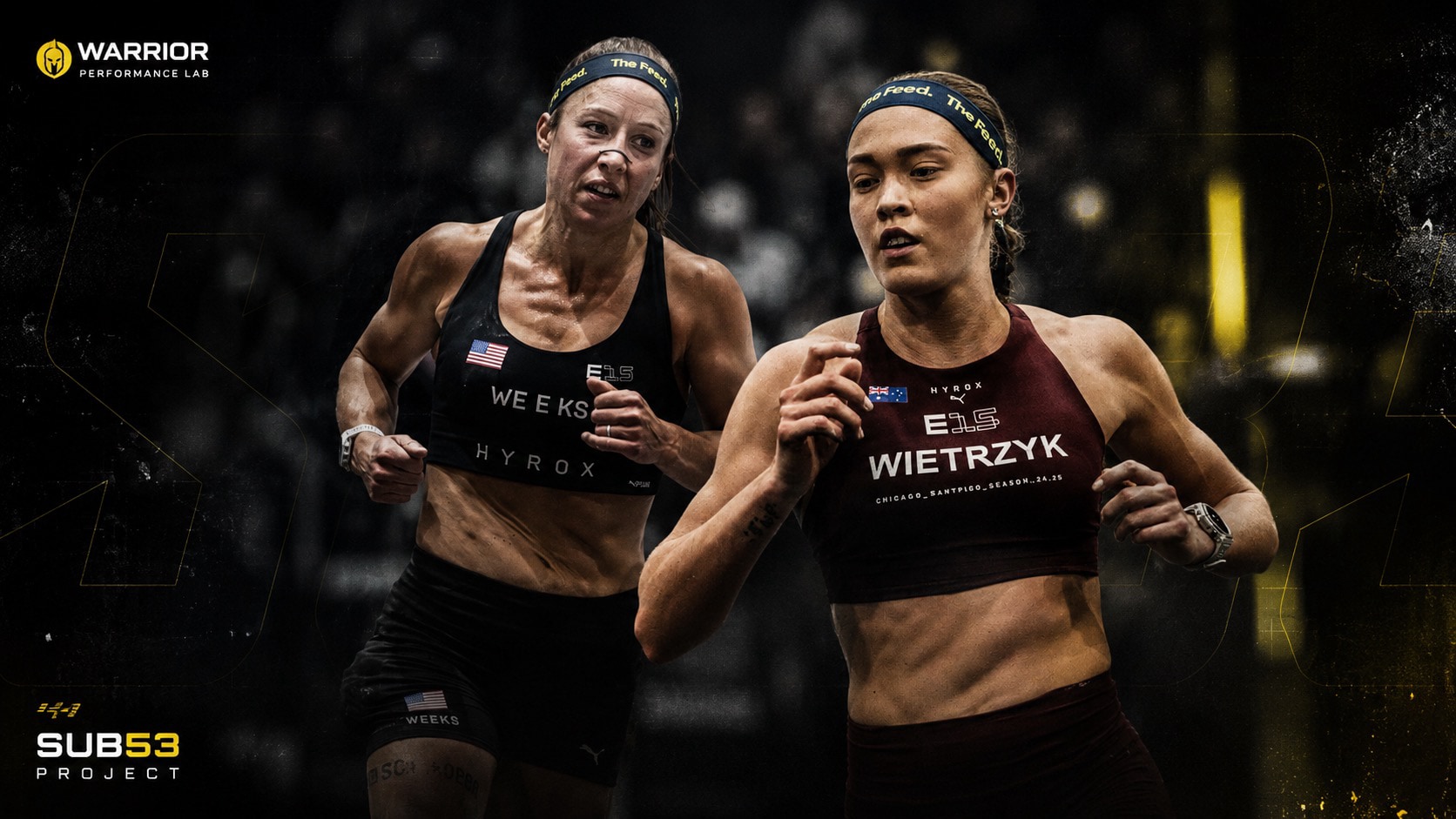
After Warsaw, it is tempting to jump straight to the biggest headline: Can Women’s HYROX Elite 15 go Sub-52? That question is exciting, but for Stockholm it may not be the most useful first question. The more precise question is: can someone break Sub-53 at the 2026 World Championships?
The official Warsaw result for Joanna Wietrzyk and Lauren Weeks, the answer is: Sub-53 is plausible. Sub-52 is still a longer-range breakthrough unless an athlete produces a combined run-and-station profile that is substantially beyond the current top-two split mix. [1]
The logic is simple. Joanna’s Warsaw win in 54:25.08 needs about 85 seconds to become Sub-53 and about 145 seconds to become Sub-52. Lauren’s 54:54.09 needs about 114 seconds to become Sub-53 and about 174 seconds to become Sub-52. At this level, those are very different questions.
The baseline after Warsaw
Warsaw gives us a clean reference point because the current top two athletes show different performance shapes. Joanna owns the more complete station-side profile. Lauren owns the fastest run total and the clearest burpee broad jump edge. The next barrier depends on whether one athlete can compress the other’s advantage without losing her own.
| Warsaw 2026 source metric | Joanna Wietrzyk | Lauren Weeks |
| Official place | 1st | 2nd |
| Official overall time | 54:25.08 | 54:54.09 |
| Official run total | 30:23 | 29:52 |
| Implied non-run total | ~24:02 | ~25:02 |
| Current edge | Station consistency: sleds, carry, lunges, wall balls | Run total and burpee broad jump |
Method note: throughout this article, “run total” means the official HYROX run total shown in the workout summary. “Non-run total” means official overall time minus official run total, so it includes station work, ROXZONE/entry-exit timing, and small split-display rounding effects. Station split tables are rounded to the nearest second from the official summary displays.
Why Sub-53 is the first question to ask?
Sub-53 is not a soft target. It is still a very hard target. But it is the first barrier that can be supported by the current evidence.
The key point: if we build a fantasy profile from the best available Warsaw top-two pieces, the result is still only about 53:34 using rounded official summary splits. That profile takes Lauren’s 29:52 run total, Joanna’s strongest station splits, and Lauren’s burpee broad jump. It is not a real athlete, but it tells us where the current ceiling appears to sit.
| Best current top-two ingredient | Split used | Athlete |
| Run total | 29:52 | Lauren |
| 1000m SkiErg | 4:13 | Joanna |
| 50m Sled Push | 2:11 | Joanna |
| 50m Sled Pull | 3:00 | Joanna |
| 80m Burpee Broad Jump | 2:33 | Lauren |
| 1000m Row | 4:18 | Joanna |
| 200m Farmers Carry | 1:24 | Joanna |
| 100m Sandbag Lunges | 2:43 | Joanna |
| Wall Balls | 3:20 | Joanna |
| Approximate combined result | ~53:34 | Best-of-top-two model |
This is the most important math in the whole discussion. The best-of-current-top-two model is roughly 34 seconds away from Sub-53, but roughly 94 seconds away from Sub-52. That is why Sub-53 is the right Stockholm framing: it is the next reachable threshold before Sub-52 becomes the main question.
| Barrier | Joanna needs | Lauren needs | What it means |
| Sub-53 | ~1:25 faster | ~1:54 faster | Hard, but close enough to model from current splits |
| Sub-52 | ~2:25 faster | ~2:54 faster | Requires a new performance band, not only cleanup |
The Joanna path: run and burpee compression
Joanna’s Sub-53 route is the cleaner route mathematically because her station profile already looks closest to championship-grade. Her problem is not that she lacks a station identity; it is that she needs enough run and burpee compression to bring the total clock under 53 minutes.