Can Women's HYROX Elite 15 Go Sub-53?
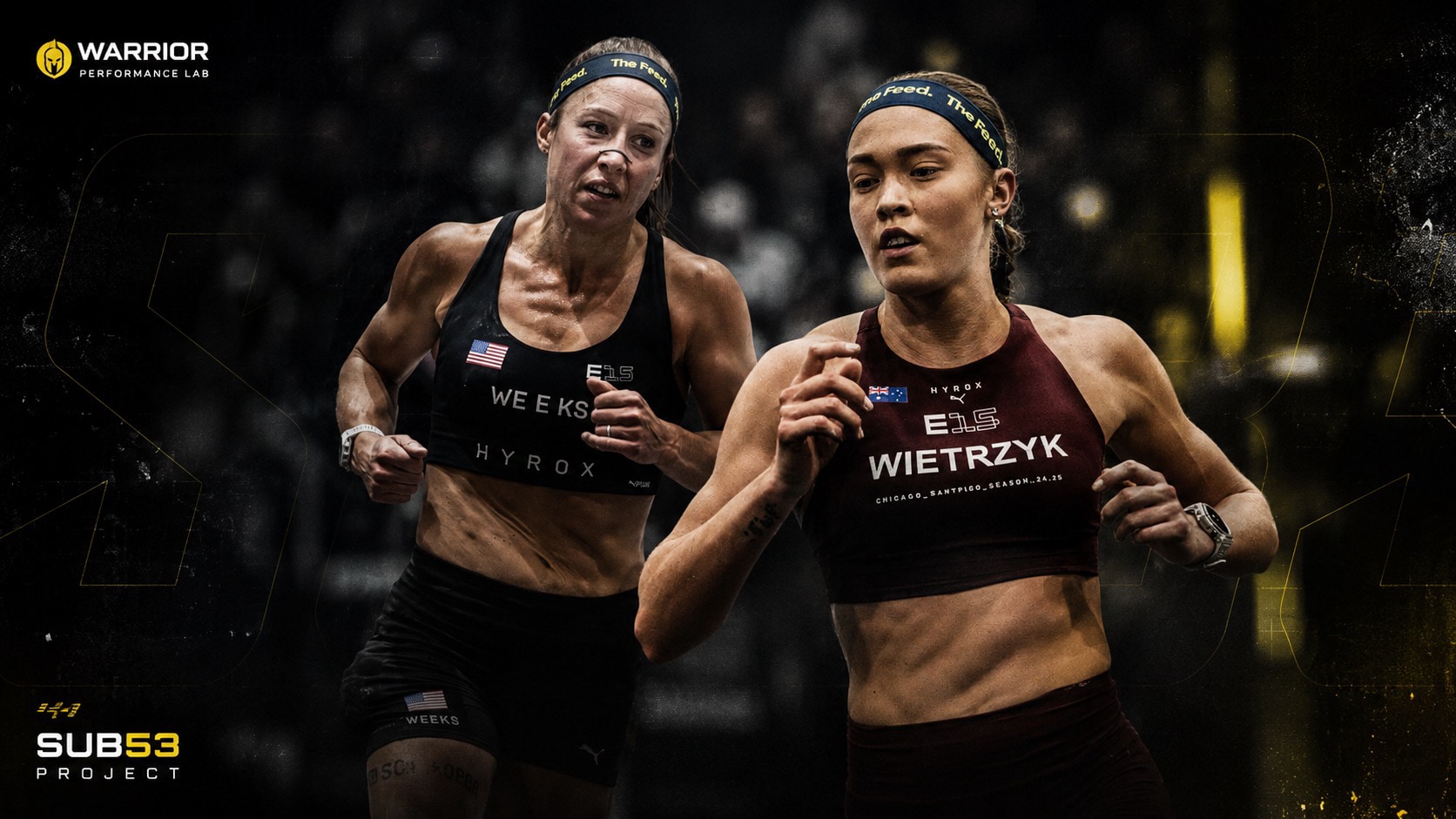
After Warsaw, it is tempting to jump straight to the biggest headline: Can Women’s HYROX Elite 15 go Sub-52? That question is exciting, but for Stockholm it may not be the most useful first question. The more precise question is: can someone break Sub-53 at the 2026 World Championships?
The official Warsaw result for Joanna Wietrzyk and Lauren Weeks, the answer is: Sub-53 is plausible. Sub-52 is still a longer-range breakthrough unless an athlete produces a combined run-and-station profile that is substantially beyond the current top-two split mix. [1]
The logic is simple. Joanna’s Warsaw win in 54:25.08 needs about 85 seconds to become Sub-53 and about 145 seconds to become Sub-52. Lauren’s 54:54.09 needs about 114 seconds to become Sub-53 and about 174 seconds to become Sub-52. At this level, those are very different questions.
The baseline after Warsaw
Warsaw gives us a clean reference point because the current top two athletes show different performance shapes. Joanna owns the more complete station-side profile. Lauren owns the fastest run total and the clearest burpee broad jump edge. The next barrier depends on whether one athlete can compress the other’s advantage without losing her own.
| Warsaw 2026 source metric | Joanna Wietrzyk | Lauren Weeks |
| Official place | 1st | 2nd |
| Official overall time | 54:25.08 | 54:54.09 |
| Official run total | 30:23 | 29:52 |
| Implied non-run total | ~24:02 | ~25:02 |
| Current edge | Station consistency: sleds, carry, lunges, wall balls | Run total and burpee broad jump |
Method note: throughout this article, “run total” means the official HYROX run total shown in the workout summary. “Non-run total” means official overall time minus official run total, so it includes station work, ROXZONE/entry-exit timing, and small split-display rounding effects. Station split tables are rounded to the nearest second from the official summary displays.
Why Sub-53 is the first question to ask?
Sub-53 is not a soft target. It is still a very hard target. But it is the first barrier that can be supported by the current evidence.
The key point: if we build a fantasy profile from the best available Warsaw top-two pieces, the result is still only about 53:34 using rounded official summary splits. That profile takes Lauren’s 29:52 run total, Joanna’s strongest station splits, and Lauren’s burpee broad jump. It is not a real athlete, but it tells us where the current ceiling appears to sit.
| Best current top-two ingredient | Split used | Athlete |
| Run total | 29:52 | Lauren |
| 1000m SkiErg | 4:13 | Joanna |
| 50m Sled Push | 2:11 | Joanna |
| 50m Sled Pull | 3:00 | Joanna |
| 80m Burpee Broad Jump | 2:33 | Lauren |
| 1000m Row | 4:18 | Joanna |
| 200m Farmers Carry | 1:24 | Joanna |
| 100m Sandbag Lunges | 2:43 | Joanna |
| Wall Balls | 3:20 | Joanna |
| Approximate combined result | ~53:34 | Best-of-top-two model |
This is the most important math in the whole discussion. The best-of-current-top-two model is roughly 34 seconds away from Sub-53, but roughly 94 seconds away from Sub-52. That is why Sub-53 is the right Stockholm framing: it is the next reachable threshold before Sub-52 becomes the main question.
| Barrier | Joanna needs | Lauren needs | What it means |
| Sub-53 | ~1:25 faster | ~1:54 faster | Hard, but close enough to model from current splits |
| Sub-52 | ~2:25 faster | ~2:54 faster | Requires a new performance band, not only cleanup |
The Joanna path: run and burpee compression
Joanna’s Sub-53 route is the cleaner route mathematically because her station profile already looks closest to championship-grade. Her problem is not that she lacks a station identity; it is that she needs enough run and burpee compression to bring the total clock under 53 minutes.
A realistic Joanna-style Sub-53 does not require her to become the fastest runner in the field. It asks her to move from a 30:23 run total toward roughly 29:50 to 30:00, while pulling her non-run total from about 24:02 toward roughly 23:00 to 23:10.
| Joanna lever | Current Warsaw marker | Sub-53 target zone | Approximate gain |
| Run total | 30:23 | 29:50–30:00 | 23–33 sec |
| Burpee broad jump | 2:57 | 2:40–2:45 | 12–17 sec |
| Sled pull | 3:00 | 2:50–2:55 | 5–10 sec |
| Lunges + wall balls | ~6:03 | ~5:40–5:50 | 13–23 sec |
| Small station exits / ROXZONE leaks | Folded into total | Rhythm | 10–15 sec |
The Joanna formula is not one giant split. It is five or six moderate wins stacked together. That is why it feels plausible for Stockholm: no single station has to become absurd. But the execution standard is unforgiving. If the run total stays above 30:15, Sub-53 probably requires an unusually sharp station-side race. If the burpees stay near 2:57, she likely needs to find the seconds elsewhere late.
The Lauren path: station compression without losing the run engine
Lauren’s Sub-53 route is different. Her run total is already the benchmark from Warsaw, and her burpee broad jump split was the clearest top-two speed edge. The problem is station-side compression. To go Sub-53, Lauren likely has to take a very large bite out of the non-run total while keeping most of her running advantage.
A Lauren-style Sub-53 could look like a 29:35 to 29:45 run total paired with a non-run total around 23:15 to 23:25. That requires a station-side improvement of roughly 95 to 105 seconds from her Warsaw profile. The biggest levers are sled pull, lunges, wall balls, row, and sled push.
| Lauren lever | Current Warsaw marker | Sub-53 target zone | Approximate gain |
| Run total | 29:52 | 29:35–29:45 | 7–17 sec |
| Sled pull | 3:25 | 2:55–3:02 | 23–30 sec |
| Sandbag lunges | 3:02 | 2:43–2:50 | 12–19 sec |
| Wall balls | 3:29 | 3:10–3:18 | 11–19 sec |
| Sled push + row + carry | ~8:22 | ~7:40–7:55 | 27–42 sec |
This is a harder pathway on paper because it asks for more station-side improvement. But it is not impossible. If Lauren keeps the run/burpee identity and meaningfully closes sled pull, lunges, and wall balls, she can enter the Sub-53 conversation quickly.
The surprise-athlete path
The danger in focusing only on the current top two is that barrier breaking often comes from a profile that does not quite look like either leader. The surprise Sub-53 athlete is probably not a pure runner and not a pure station specialist. She is a hybrid who can run near Lauren’s range while avoiding the station leaks that currently separate Lauren from Joanna.
The surprise profile would likely sit around a 29:30 to 29:45 run total and a 23:10 to 23:25 non-run total. That athlete does not need one world-beating station. She needs no obvious weakness: controlled sleds, fast-but-sustainable burpees, no row drift, no lunge collapse, and wall balls that stay nearly continuous.
| Sub-53 model | Run-side target | Non-run target | Finish range |
| Station-dominant / Joanna-style | 29:55 | 23:00 | ~52:55 |
| Run-biased / Lauren-style | 29:35 | 23:20 | ~52:55 |
| Balanced surprise athlete | 29:45 | 23:10 | ~52:55 |
| Absolute scrape | 30:00 | 22:59 | ~52:59 |
What to watch live in Stockholm
HYROX lists the 2026 World Championships for Stockholm, with Elite 15 Women scheduled for 7:00pm on Thursday, 18 June 2026. The schedule is listed as provisional and subject to change, but as a championship setting it is the correct race to watch for a threshold attempt. [3]
The live split that matters most may not be the opening run. The race probably has to stay controlled early and then arrive at wall balls with enough time in hand. In Warsaw, Joanna reached wall balls at about 51:06 and Lauren at about 51:26. For Sub-53, the athlete likely needs to reach wall balls around 49:45 to 49:55, depending on how fast she can close the final station.
| Checkpoint | Stockholm Sub-53 signal | Why it matters |
| Opening run | Fast but not reckless | A heroic first kilometer can damage sleds and late stations |
| Sled pull out | No major delay or technical struggle | The sled pull is one of the biggest top-two separators |
| After burpees | Still on rhythm, not metabolically blown up | Burpees can win time but also tax the row and late runs |
| Lunges out | Enough time bank for run 8 plus wall balls | Late-race station durability becomes the barrier |
| Wall balls in | Roughly 49:45–49:55 | This gives room for a 3:05–3:20 final station and Sub-53 finish |
Why Sub-52 is still the bigger leap
Sub-53 would not make Sub-52 automatic. It would make Sub-52 real. The difference between 52:59 and 51:59 is another full minute, and that minute probably cannot come from one place. It would need a second compression layer: 15–25 seconds from running, 15–20 seconds from late stations, 10–15 seconds from sleds, and the rest from transitions and final-station discipline.
The first peer-reviewed HYROX physiology study helps explain why the late race matters so much. Brandt et al. reported that faster HYROX completion correlated with higher VO2max, greater endurance training volume, and lower body fat percentage. They also found the highest heart rate, blood lactate, and perceived exertion during wall balls. [5] This supports what the split math already suggests: the decisive athlete is not just fast in the first half. She is still functional at the end.
| Barrier model | Run-side range | Non-run range | Interpretation |
| Current top-two best-of model | ~29:52 | ~23:42 | About 53:34; close to Sub-53, not close to Sub-52 |
| Sub-53 breakthrough | 29:30–30:00 | 22:59–23:25 | A championship-level next step |
| Sub-52 breakthrough | 29:00–29:30 | 22:20–22:50 | A new performance band |
Working prediction
For Stockholm, Sub-53 is the better article frame, the better analyst question, and the better live-race watch. It is difficult enough to matter, but close enough to be credible. Sub-52 remains the larger historical question, but it probably requires either a perfect Joanna-style compression, a large Lauren-style station breakthrough, or a surprise athlete whose profile is already more balanced than the current top two.
My working prediction: a 52:xx performance in Stockholm is plausible if the leading athlete reaches wall balls under roughly 49:55 and closes without major breaks. A 51:xx in Stockholm is still a lower-probability scenario, but a Sub-53 finish would immediately make Sub-52 the defining question of the next season.
Resources:
[1] HYROX official result PDFs for Warsaw 2026 Elite 15 Thursday: Joanna Wietrzyk and Lauren Weeks. results.hyrox.com
[2] HYROX 25/26 Singles Rulebook. Used for official format, stations, distances, and prescribed division loads. Link
[3] HYROX. PUMA HYROX World Championships Stockholm event page. Used for the official 18–21 June 2026 event window and Elite 15 Women schedule listing. Link
[4] HYROX Elite Racing and Elite 15 Qualification pages. Used for official Elite 15 structure and the 2026/27 points-based qualification context. Link
[5] Brandt T. et al. (2025). Acute physiological responses and performance determinants in Hyrox© – a new running-focused high intensity functional fitness trend. Frontiers in Physiology. Used for the endurance-dominant physiology context and late-race wall-ball stress findings. Link
Note
This is independent sports-performance analysis. Time models are hypothetical and use rounded official split displays, so they should be read as performance budgets rather than exact predictions.