How to Pace and Train Your HYROX Burpee Broad Jumps
How to Pace and Train Your HYROX Burpee Broad Jumps
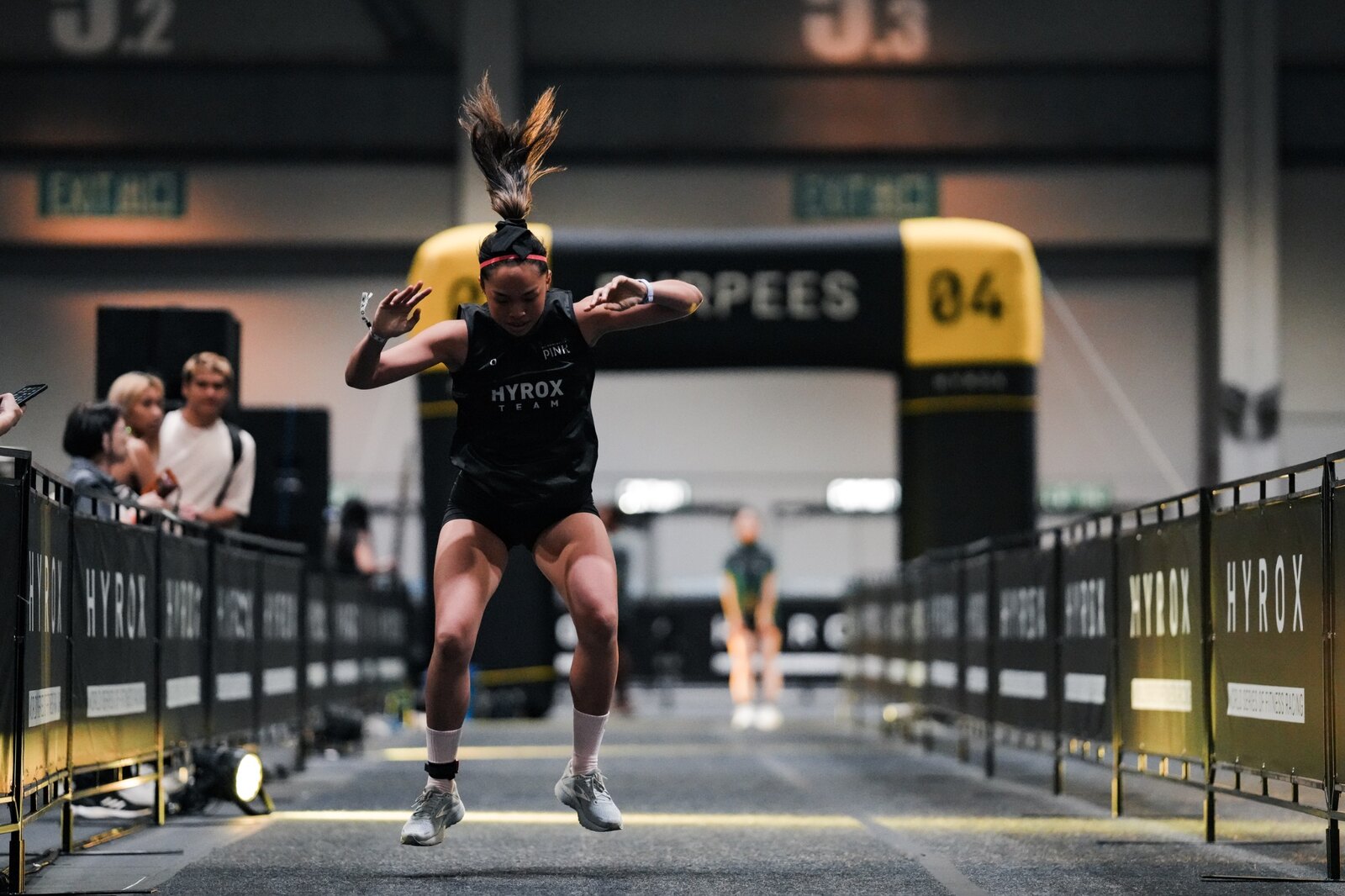
Eighty metres can feel very different once you have to cover them with burpee broad jumps. The first few repetitions may feel comfortable. Then your breathing climbs, your legs become heavier, and the rhythm starts to slip.
The goal is to find a pace you can repeat all the way through—and still run well afterwards. Here is how I would approach your technique, breathing and training.
Why BBJs feel so demanding
Every repetition moves you down to the floor, back up and forward. Your chest, shoulders and triceps help control the floor movement. Your trunk provides support, while your hips, thighs and calves help you rise, jump and absorb the landing. This is whole-body work, even if you mainly feel your breathing or legs.
Aerobic and anaerobic energy pathways work together throughout the station. Your aerobic system is already contributing during the repetitions. A 2025 simulated HYROX study linked higher aerobic capacity with faster overall performance. A separate 2026 study of 29 athletes placed BBJs among the stations producing the greatest cardiorespiratory strain. Neither study identifies one best BBJ technique. [2, 3]
I use a step-back, jump-in technique myself. For me, breathing becomes limiting first, followed by my legs. My shoulders and arms do not feel like the limiting factor. That is useful feedback for my training, but your pattern may be different.
Build a repeatable movement
Think about the complete repetition, from one landing to the next. A longer jump only helps if the extra distance is worth the time and effort it costs.
- Lower with control. Make clear chest contact without crashing onto the floor.
- Bring your feet into a position you can jump from smoothly. Watch for pauses or repeated adjustments.
- Use a comfortable arm swing and travel forward without reaching so far that you lose your balance.
- Land with some bend through your hips, knees and ankles, ready to begin the next repetition.
Know the standard: the 2026–27 Singles rules allow stepping or jumping back and in. The broad jump itself requires simultaneous two-foot takeoff and landing, with no extra steps or shuffles. Returning feet cannot pass your fingertips; on subsequent repetitions, the base of your palms must be within 30 cm ahead of the front foot toes. Both feet must fully clear each section’s finish line. Check the full rulebook for your event. [1]
Choose the technique you can repeat
“In” means returning your feet towards your hands after the floor phase. Every version still finishes with a broad jump. The main muscle groups are similar; the sequence and distribution of effort change.
| Technique | What to notice in practice |
| Jump back and step in | The backward jump makes the entry quick. Stepping in brings one leg forward first, creating a more staggered rise. Check that you can repeat it without twisting or adding foot adjustments. |
| Step back and jump in | The backward steps can make the entry easier to regulate. Jumping both feet in creates a quick return, but needs coordination and enough clearance. Check for an overly deep squat or a pause before takeoff. |
Stepping both ways and jumping both ways are also options. These are practical movement observations, not proof that one variation saves more energy. Choose the style that stays smooth when you are tired, and practise both lead legs if you use a stepped transition. Avoid introducing a new technique on race day.
Breathing and pacing
Start at a rhythm you expect to maintain beyond the opening repetitions. If you have to stop repeatedly to catch your breath, test a slightly slower opening cadence before chasing bigger jumps.
Let breathing continue through the movement. A relaxed exhale as you rise or take off can be a useful cue, but you do not need to force one breath per repetition. Take extra breaths when needed and use your mouth when the effort demands it. Nasal-only breathing is not a requirement.
Notice whether you are holding your breath during the floor transition. Try one small change at a time, then see whether the same pace feels more manageable. Breathing difficulty alone does not tell you exactly which part of your fitness needs work.
How many burpees will 80 metres take
There is no fixed number. It depends on your average net forward progress per complete repetition—not simply how far you can broad jump when fresh.
| Net progress per repetition | Approximate repetitions over 80 m |
| 1.0 m | 80 |
| 1.25 m | 64 |
| 1.5 m | 54 |
| 1.75 m | 46 |
| 2.0 m | 40 |
These are calculations, not athlete averages: divide 80 by your net progress and round up. Lane boundaries, finish-line clearance and fatigue can add repetitions. For a practical estimate, count your BBJs over 20 metres at your intended rhythm and multiply by four. Then check it over a longer distance.
Train the rhythm before adding fatigue
Choose the session that fits your current ability. These are stages to work through, rather than three extra workouts to add to an already full week. Start with shorter distances if needed.
1 Learn the movement
4 × 10 m BBJ, with 60–90 seconds of recovery between sets. Keep the effort comfortable and focus on controlled floor contact, balanced landings and a repeatable transition. This is skill practice, so finish each set before your movement becomes rushed.
2 Extend your repeatable pace
3 × 20 m BBJ, with about 90 seconds of recovery. Use a controlled pace rather than an all-out effort. Record the time and repetition count for each set. If the last set becomes much slower or less coordinated, reduce the distance or increase recovery.
3 Connect the station to running
2 rounds: 400 m run → 20 m BBJ → 200 m run. Recover for 2–3 minutes between rounds. Aim for an effort of six or seven out of ten. The final run shows whether your BBJ pace leaves you able to settle back into running. Scale the distances to your current training.
For someone learning BBJs, one weekly exposure is a sensible starting point. An experienced athlete may use two: a short technique practice and one more demanding session. Count these within your existing running, strength and jumping workload. Increase distance or intensity gradually, rather than changing everything together.
Measure the whole result
Repeat a familiar run–BBJ–run session under similar conditions. Record your BBJ time, repetition count and how the following run feels. Compare your opening and closing rhythm too. A lower burpee count is useful only when the longer repetitions do not cost you more time or fatigue.
Pick one thing to improve next: a calmer opening pace, a smoother return from the floor or more consistent landings. Build that habit, then test it under a little more fatigue. Your best BBJ technique is the one that helps your whole race.
Want the deeper coaching breakdown? Read the BBJ analysis in the Coaches Hub.
References:
[1] HYROX. Singles Rulebook 2026–27, section 8.4.
[2] Brandt et al. (2025). Acute physiological responses and performance determinants in HYROX.
[3] Fernández-Navarrete et al. (2026). Mapping physiological demands of HYROX: Which sections hit hardest?