HYROX® 8 Stations – Walkthrough Guide
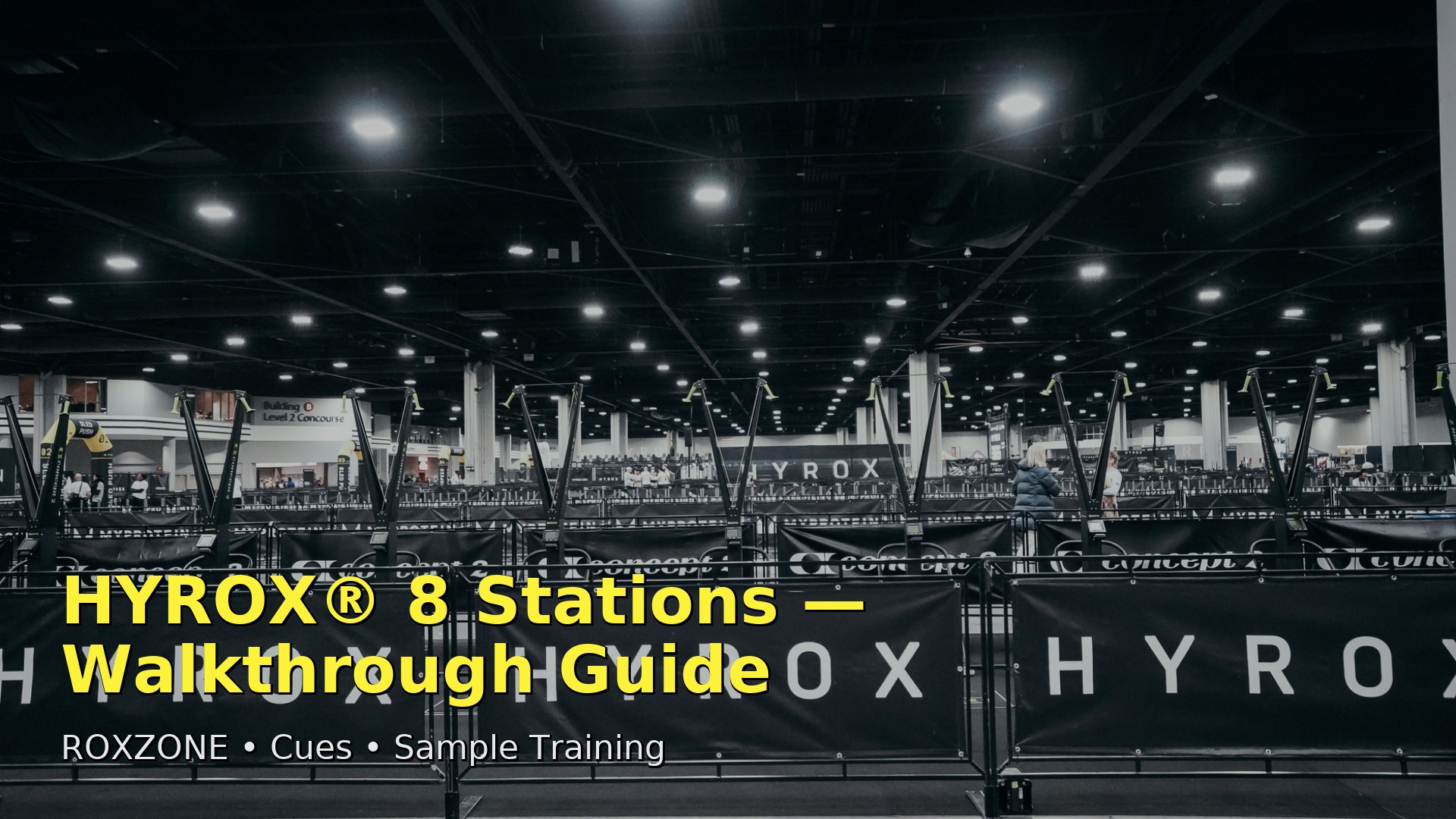
HYROX® performance is less about one monster strength number and more about repeatable station mechanics at race-pace under fatigue, with clean transitions and zero-no-rep risk. Athletes lose the most time on inefficient movement patterns, poor pacing early, sloppy setup/turnarounds, and avoidable judge calls.
HYROX® Race format is 8 x 1 km runs + 8 stations, always in the same order. However, being familiar with the movements, what you need to know, transition tips and at gym alternatives is key. The winners are less about maximal fitness and more about pacing discipline, clean mechanics, and Roxzone skill.
This walkthrough gives you the “how” (key cues) and a simple training menu for each station so you can layer skill → strength-endurance → race specificity without guessing.
How to use it this guide
- Order matters. Practice in race order 1–2x/week to rehearse transitions and breathing. Use skill blocks on other days.
- Pacing lens. Think three gears: Skill (RPE 4–5) to groove technique; Build (RPE 6–7) to add volume; Race (RPE 8–9) to sharpen pace and decision making.
- Judge quality. Every rep meets standard. Count out loud on complex sets; organize plates/sandbags before you start.
- Run economy. Treat the 1 km runs as a metronome; aim for even splits with small surges into/out of stations.
- Breathing & posture. Nose-lead on easy sections, quick mouth exhales on power phases; stacked ribs over pelvis to protect low back.
- Micro-sims. 2–4 station combos (with 400–800 m running) are the sweet spot for most training weeks.
Race structure & pacing philosophy
- Format: Run 1 km → station → repeat × 8 (8 km total + 8 standardized stations).
- Pacing Stations 1–4 = controlled, 5–6 = managed, 7–8 = honest survival with posture.
- Order is always the same, so athletes can compare races across cities and seasons.
- Highest ROI: transitions. Enter tall, breathe 3–5 s, organize equipment, execute the pre-chosen pace plan.
What is the ROXZONE? (your "9th station")
ROXZONE is the clearly marked transition corridor that guides athletes into and out of each workout station. It standardizes flow, keeps athletes in the correct lanes, and gives judges a safe, visible area to brief you and confirm standards. You must enter the appropriate station through the ROXZONE boundaries; skipping or entering the wrong way can result in penalties. Length and layout vary by venue (some are long and curved, others short and direct), so pacing and awareness here matter—your total race time includes all movement through the ROXZONE.
Race‑day checklist for the ROXZONE
• Walk the route during warm‑up. Note where each station's entry/exit is and the judge position.
• Eyes up 20 m out. Read signage early so you don't overshoot the station entrance.
• Control your breathing. Two calm exhales as you enter; posture tall to reset the trunk.
• Set‑and‑go script. Example for sled: hands set → feet set → brace → start. No dithering.
• Mind the lane. Don't block other athletes or drop equipment outside the station boundary.
• Exit clean. Park handles/rope/ball exactly as directed; then accelerate smoothly back to the run.
The Roxzone
Enter → take 3–5 tall breaths.
- Organize the station before touching equipment (avoid mid-set fixes).
- One clear cadence/rep plan; no in-set debating.
- Exit with posture — no folded running.
Official Station Standards
Loads shown for sleds are including sled; friction varies by venue. Wall ball targets: Women/Women Pro 2.70 m, Men/Men Pro 3.00 m.

Station 1 — SkiErg (1,000 m)
What it really tests: Composure and length early; converting nerves into rhythm.
Cues: tall torso, hips slightly back, ‘hips→hands', finish at pockets, soft return. Leaks: early arm pull, over‑flexed spine, yanking to chest/neck.
Common mistakes:
- First 300 m too hard → HR spikes and Run 2 suffers.
- Short, arm-dominant strokes with shrugged shoulders.
- Standing up too fast at the end without 2–3 reset breaths.
How to move:
- First 200–250 m at a calm split to find rhythm.
- Hinge with lats; soft return; breathe every stroke or every second.
- Eyes forward, ribs down; straps neutral (not over-tight).
Roxzone & SMS:
- Enter → 3–4 tall breaths → quick shoulder opener → hands on handles only when breathing is under control.
- Stand up → 2–3 breaths before jogging out.
Pacing cues:
- Open a calm split, hold race split 500–600 m, finish by protecting posture not sprinting.
Practice options:
- 4 × 500 m @ target split, 90 s rest → 100–200 m easy run after each.
- No SkiErg: rower/echo-bike with arms-first cues 4 × 2:00; 1:00 easy.
• Builder: 3 × 600 m @ RPE 7, 90 s easy row/bike between; alternate 100 m smooth/100 m strong.
• Race‑ready: 2 × (400 m Ski @ RPE 8 → 400 m run at race pace), 1 min rest; handle park → step → run in <4 s.
Station 2 — Sled Push (50 m)
What it really tests: Bracing + patient force on variable friction.
Cues: low torso angle, elbows tucked, full‑foot drive, short choppy steps, constant shin angle. Leaks: heels popping, hips too high, big ‘stall' steps, drifting lane.
Common mistakes:
- Resting mid-lane; massive HR spikes early.
- Elbows flared, hips behind feet, big stompy steps.
- Only training on fast turf then racing on sticky carpet.
How to move:
- Angle low, elbows in, long spine, short quick steps.
- Push to the end cone, rest only at the end; exhale with steps.
- If sled is light, slow tempo to increase time under tension.
Roxzone & SMS:
- Finish length → stand tall 5–7 s → shake legs → jog out under control.
Pacing cues:
- Length 1 = diagnostic; 2–4 = controlled grind; avoid panic stops.
Practice options:
- 5 × 15–20 m heavy pushes; 60–90 s between; mix floors if possible.
• Builder: 6–8 × 15 m @ RPE 7, 60–90 s rest; mix handles (high → low).
• Race‑ready: 2–3 rounds: 50 m broken 25 + 15 + 10 m (10–12 s shakeouts) → 400 m run race pace.
Station 3 — Sled Pull (50 m)
What it really tests: Posterior-chain strength with rope control and posture.
Cues: sit into hips, long rope pulls, walk back under tension, lats not biceps. Leaks: rounded low back, slack rope between pulls, tiny steps.
Common mistakes:
- Rounded upper back; arm-only yanks; tripping over loose rope.
- Leaning forward so far the pull is all biceps/upper traps.
How to move:
- Feet planted, lean back, hand-over-hand pulls using legs + hips.
- Walk the rope back as allowed; coil/park rope neatly for clean exit.
Roxzone & SMS:
- Finish → coil rope to side → 3 tall breaths → shoulders down/back before running.
Pacing cues:
- Smooth repeatable pulls beat jerky max efforts. Use posture to save grip.
Practice options:
- Rope + plate pulls; backward sled walks; cable row walks 3–4 × 12.5–15 m.
• Builder: 5 × 20 m continuous (hand‑over‑hand) @ RPE 6–7; 90 s rest.
• Race‑ready: 3 rounds: 20 m pull → 200 m run (brisk) → 20 m pull → 200 m run (race).
Station 4 — Burpee Broad Jumps (80 m ~ about 60 reps)
What it really tests: Rhythm maintenance under rising HR while protecting the next run.
Cues: narrow efficient burpee, feet to power stance, jump from hips, land soft, turn fast. Leaks: wide feet, big vertical jump (wasted), slow turns.
Common mistakes:
- Opening too fast (first 20 at sprint cadence) then collapsing.
- Pausing between jump landings, letting rhythm die.
How to move:
- Target rhythm ~1 rep every 3–4 s; land, turn, step into next burpee without pauses.
- Keep jumps consistent; soft landings; protect shins.
Roxzone & SMS:
- Finish → stand tall (don't fold) → 3–4 breaths → walk 5–10 s before you run.
Pacing cues:
- If the first 20 are ~0:45–0:50 yet total is ~5:00, you opened too hot.
Practice options:
- 2 × 60 BBJ @ 3–4 s/rep → 400–600 m run; 2:00 rest.
- Or 3–4 × 20 BBJ + 150–200 m run @ race rhythm.
• Builder: 6 × 10 m; consistent jump count; walk back recovery @ RPE 6–7.
• Race‑ready: 2 × (20 m BBJ → 400 m run race pace), 2 min rest; match jump count across sets.
Station 5 — Row (1,000 m)
What it really tests: Mid-race aerobic honesty and posture after sitting.
Cues: legs → hips → arms, long stroke, 1:1 recovery, relaxed grip. Leaks: early arm pull, over‑rating short strokes, shrugging.
Common mistakes:
- Buying time with a hard row that ruins the next run/carry.
- Short pull, high rate, rounded back.
How to move:
- 200–300 m 5–10% easier to find length → middle 400–500 m race effort → last 150–200 m is breathe and prep to stand.
- Legs first, then hips/back, then arms; relaxed return.
Roxzone & SMS:
- Off the rower → 3–5 tall breaths before running; reset posture after sitting.
Pacing cues:
- Hold the planned split; avoid last-100 m heroics that wreck the exit.
Practice options:
- 3 × 1,000 m @ race split; 2:00 rest → 100 m run to teach stand-and-go.
• Builder: 3 × 700 m @ RPE 7, 75 s rest, rating cap 24–26 spm.
• Race‑ready: 2 × (500 m row @ RPE 8 → 300 m run slightly faster than race pace), 90 s rest.
Station 6 — Farmer's Carry (200 m)
What it really tests: Late-race posture, grip, and patience.
Cues: ribs down, tall posture, short steps, firm clamp grip, tidy turns. Leaks: lateral sway, over‑stride, dropping handles at turns.
Common mistakes:
- Swingy bells; rounded trunk; frequent random drops.
- Over-striding to hurry the carry.
How to move:
- Pick once, organize, walk. Short stride, shoulders down, bells close; drop only at turnarounds.
- Neutral neck gaze; nasal breaths if possible.
Roxzone & SMS:
- Enter/exit tall to protect low back; keep handles close during transitions.
Pacing cues:
- Should feel like moving recovery; if HR spikes, adjust load/stride.
Practice options:
- 4–5 × 200 m @ race weight; 60–75 s between; optional 200 m run finisher.
• Builder: 4 × 150–200 m @ RPE 6–7; turn every 25–50 m; planned breaks only.
• Race‑ready: 3 rounds: 150 m carry → 400 m run (steady) → 10 controlled box step‑ups/leg.
Station 7 — Sandbag/Walking Lunges (100 m)
What it really tests: Late-race leg strength with trunk posture under load.
Cues: brace, vertical shin, knee kiss‑no‑slam, constant step length, calm hands. Leaks: twisting torso, rushing the stand, uneven steps.
Common mistakes:
- Tiny steps; collapsing chest; bag sitting too far forward.
- Stopping every 2–3 steps instead of micro-resting tall.
How to move:
- Chest proud, ribs down; consistent step length; light knee tap.
- If posture fails, pause 1–2 breaths tall, then continue.
Roxzone & SMS:
- Before lifting bag: breathe, brace, then walk; commit to sections between cones.
Pacing cues:
- Expect honest fatigue; protect cadence rather than chasing speed.
Practice options:
- 3–4 × 25 m loaded lunge; 30–45 s rest → final set add 200 m run to simulate 7 → 8.
• Builder: 3 × 60 m @ RPE 7; 1 s pause at bottom every 5 reps to groove balance.
• Race‑ready: 2 rounds: 50 m lunges → 300 m run race pace → 50 m lunges; even splits.
Station 8 — Wall Balls
Cues: heels down, tall chest, full depth, smooth breathing, steady target lock. Leaks: shallow depth, chasing the ball, massive first set then blow‑up.
What it really tests: Accuracy + squat endurance + mental control at the end.
Common mistakes:
- Opening max set then 30–45 s breaks.
- Losing target focus and missing reps late.
How to move:
- Open 15–25 reps → settle to 10s → finish with 5s.
- Breathe at the top or just after the throw, not in the hole.
Roxzone & SMS:
- Enter → set feet → deliver the first set you planned; micro-breaks ≤ 5 s to keep cadence.
Pacing cues:
- Last block is about cadence and accuracy, not hero sprints.
Practice options:
- EMOM 10: 10 wall balls (race target) → 400 m easy.
- 30 wall balls → 200 m run → 1:00 rest × 3.
• Builder: 3 × 35–45 reps as EMOM clusters @ RPE 7 (e.g., 15s then 10s).
• Race‑ready: 75–100 reps as 10‑10‑10‑10‑10‑10‑10‑5‑5 (or your plan) with 5–8 deep breaths between.
Sample Simulation Workouts:
Warm‑up:
SMS flow: 8/side hip airplanes → 10 cossack squats → 12 hinge pulses with band → 10 shoulder CARs → 10 wall‑ball ‘face‑level' pulses → 2 × 20 s light Ski/Row pick‑ups.
• Erg + Lower Chain: 600 m Ski @ RPE 8 → 25 m Sled Push → 25 m Sled Pull → 400 m run (race). Rest 3–4 min × 2–3.
• Carry + Lunge Finisher: 400 m run (race) → 150 m Farmer Carry → 50 m Sandbag Lunges → 400 m run (steady). Rest 2–3 min × 2.
• Closing Combo: 500 m Row @ RPE 8 → 40 Burpee Broad Jumps → Wall Balls (race set plan). Rest 4–5 min × 2.
At-home or regular-gym swaps
- SkiErg → rower/bike with arms-first pulls.
- Sled push → plate push/prowler/treadmill push.
- Sled pull → rope + plates/cable walk-backs.
- Farmer's → heavy DBs/trap bar carries.
- Lunges → DB front rack or barbell reverse lunge.
- Wall balls → thrusters or med-ball squat-to-press to a fixed target.
How to integrate in a training week
- One simulation or station-cluster day per week (e.g., stations 1–4 focus this week, 5–8 next).
- Keep 80–90% of running volume truly easy (Z1–Z2); include one threshold/VO2 run if recovered.
- Technique primers before each station (30–60 s) beat big warm-up sets that sap energy.
- Log splits and transitions; the goal is repeatability under control.
Simple benchmarks to track progress
- Sled push: 4 × 20 m at race load with no mid-lane stops.
- BBJ: 60 reps at a steady 3–4 s/rep cadence without loss of form.
- Row 1,000 m at race split, stand, and run 200 m with tall posture (repeat × 3).
- Farmer's: 200 m continuous walk at race load with drops only at the turns.
References
- HYROX Official Rulebook
- HYROX FAQ (standards & briefings)
- Concept2 — SkiErg Technique
- Concept2 — Indoor Rowing Technique
- NSCA — Essentials of Strength Training and Conditioning (4th ed.)
- ACSM — Guidelines for Exercise Testing and Prescription (11th ed.)
- Seiler S. (2010). Best practice for training intensity distribution. Int J Sports Physiol Perform.
- Stöggl & Sperlich (2015). Training intensity distribution among well-trained and elite endurance athletes. Front Physiol.
- Petrakos, Morin, Egan (2016). Resisted sled sprint training to improve sprint performance. Sports Med.