New HYROX Running Study Reveals How Pacing and Fatigue Impact Performance
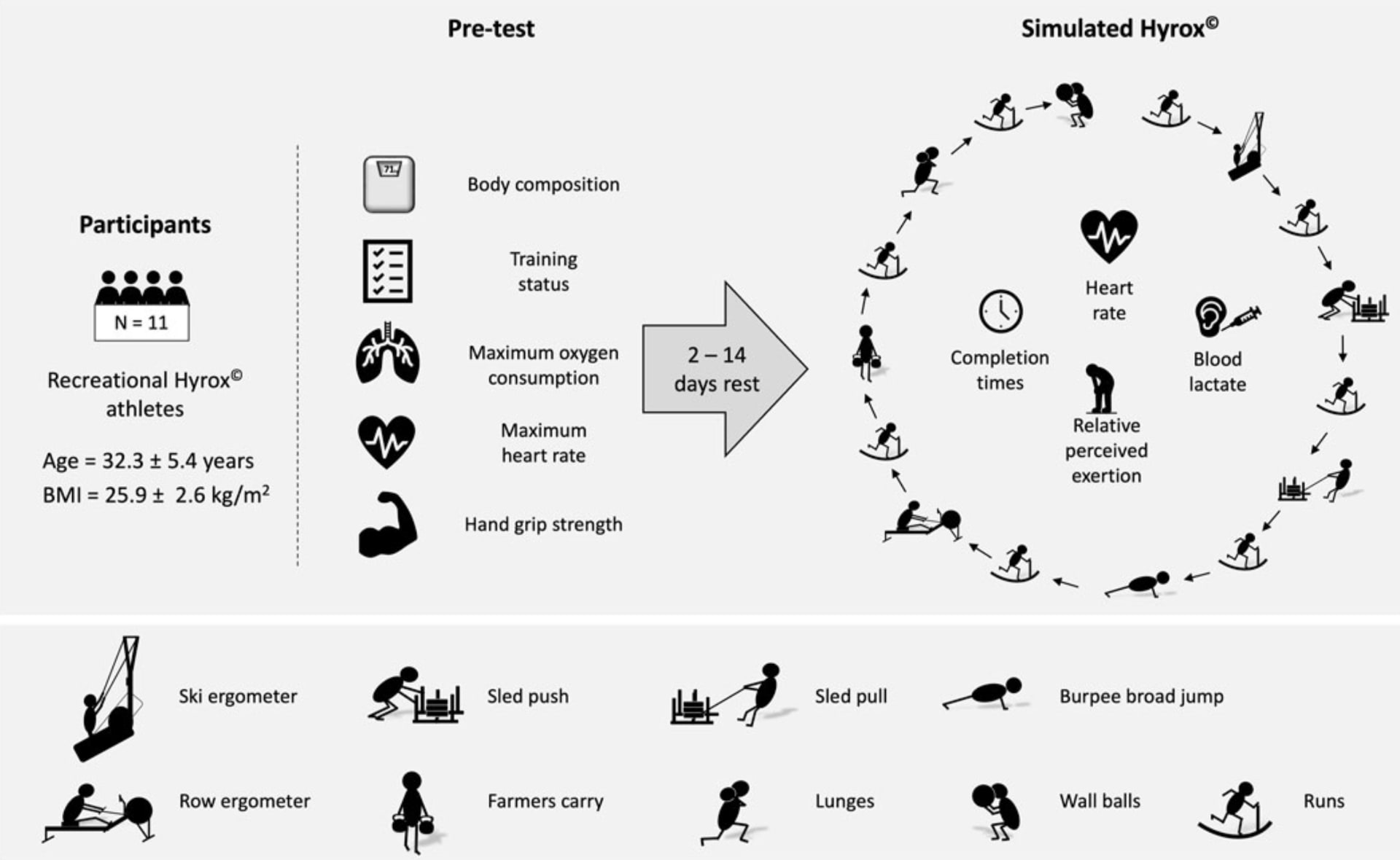
If you're reading this then you probably already know that HYROX is a fitness race that combines eight 1 km runs interspersed with functional exercises (like sled pushes, rowing, lunges, etc.) in a fixed sequence. It's a challenging test of both endurance and strength. A recent scientific study on HYROX demonstrated how athletes pace the runs, how fatigue builds up, and what separates the top performers from the rest. The findings give valuable insights for athletes and coaches on optimizing training and race strategy for better HYROX performance.
What they found? Running Pace, Fatigue, and Performance
Running dominates the race time
On average, running accounted for the majority of the total competition time (~51 out of 86 minutes). This means improving running endurance has a huge impact on overall HYROX performance. Even though there are eight workout stations, the clock is ticking the longest during the runs.
High intensity from start to finish
Athletes performed most of the race at “hard” to “very hard” intensity – about 80% of the time near 90-100% of their maximum heart rate. In other words, HYROX feels like a sustained red-line effort. Heart rates and lactate levels stayed high throughout, and they peaked during the final sections (for example, during the last wall ball exercise) , showing how exhausting the event is by the end.
Running pace slows down as fatigue sets in
The study tracked split times for each of the eight runs. It found that later runs were significantly slower than early ones, indicating accumulating fatigue. In fact, the 5th run (mid-race, after several tough exercises) was the slowest split at a median of ~7.4 minutes. Even the final 8th run still took around 6.8 minutes which is noticeably slower than the early runs and confirming that athletes struggle to maintain pace in the later stages. Fatigue from repeated high-intensity exercises and runs causes this decline in speed.
Last runs feel the hardest
By the last run and exercise, athletes were pushing their limits. It's reporting very high perceived exertion (RPE ~18 out of 20) and blood lactate levels around 8–9 mmol/L. That's the kind of biochemical fatigue where your legs are burning and every step is a challenge. It's no surprise the last kilometer feels like “survival mode” for many.
Aerobic fitness is the key performance driver
Probably the most important finding: athletes with greater endurance capacity performed better overall. Higher VO₂max values, a higher volume of endurance training, and lower body-fat percentages were all strongly correlated with faster HYROX finish times . In contrast, measures of maximal strength (like grip strength or even muscle mass) did not show a strong correlation with finish times. This suggests that as long as you have the basic strength to handle the exercises, your engine (cardio fitness and efficiency) is the real limiting factor in HYROX.
Physiological and Bio-mechanical Implications
Why does running efficiency break down in HYROX?
Imagine sprinting 1 km, then immediately dropping for burpees or hefting a heavy sled, and then trying to run again. The study indicates that the transition from a fatiguing exercise to running can have a significant effect on your running performance. After a heavy upper-body exercise, for example, your body must redistribute blood back to your legs; after a brutal leg exercise, your leg muscles are flooded with lactate and fatigue by-products. Running under these conditions is bio-mechanically less efficient and your stride might shorten, form might break, and pace drops. Essentially, your running economy (how efficiently you run) gets worse when you're exhausted. This helps explain why athletes' running pace in HYROX is much slower than their normal running pace in a fresh road race . The study explicitly noted that HYROX run speeds were relatively low compared to what you'd expect from these athletes in a standalone half-marathon, precisely because of the fatigue and metabolic strain from the exercise stations .
Fatigue impacts mechanics
As you tire, you might notice your changing posture or your legs feeling like concrete. When heart rate is too high and legs are wobbly, it's difficult to maintain proper running form. Technical execution under fatigue is a must! If your form collapses, you waste more energy for each stride. The HYROX study emphasizes that athletes need to focus on maintaining efficient technique despite fatigue. Think of it like the last miles of a marathon — whoever can keep it together technically will slow down less than those who fall apart.
Pacing and strategy matter
The findings also hint that how you pace the early parts of the race can make or break your performance. If you go too fast in the first runs or push the sled and burpee stations “all-out,” you risk spiking your heart rate and lactate too high. That can lead to a cumulative meltdown in later runs, as evidenced by the pronounced slow-down by run 5 in the study. Research in similar multi-modal endurance events supports this: triathletes who swim too hard see their cycling/running suffer, and CrossFit athletes who start a workout all-out end up with worse overall times than those who use a controlled pace .
Avoid the boom-and-bust approach
A steadier, well-distributed effort helps maintain better running mechanics and speed throughout the race.
Training Recommendations for Consistent HYROX Running Performance
Based on these insights, here are practical training tips for HYROX athletes and coaches to improve running performance and delay fatigue.
Build a Big Aerobic Engine
Emphasize endurance training in your program. Since over half the race is running, you need a strong cardiovascular base. Incorporate sustained moderate-intensity runs, tempo runs, and other aerobic workouts to boost your VO₂max and running economy. The study confirms that a higher aerobic capacity directly translates to a better HYROX.
Practice Running Under Fatigue
It's not enough to run on fresh legs. Train your body to run well when you're already tired. For example, do a hard station effort (like a 500 m ski erg or 20 burpees) and then immediately hit a fast 1 km run – repeat this in intervals. Such brick-style workouts (similar to triathlon training) teach you to transition from one modality to another. Research suggests that combining running with other HYROX movements in training should be an integral strategy to improve your running economy in a pre-fatigued. Over time, you'll adapt so that your form and pace hold up better in the later stages of the race.
Include High-Intensity Interval Training (HIIT)
HYROX is high-intensity by nature, so your training should include intervals at race intensity or above. HIIT workouts that mix running and functional exercises are particularly effective. For instance, circuit training that rotates between a run and an exercise (row, sled push, etc.) will simulate HYROX conditions. The study authors recommend HIIT as an efficient way to improve both aerobic and anaerobic capacity while also rehearsing the race-specific. These workouts improve VO₂max, lactate tolerance, and mental toughness, without requiring huge training volume.
Don't Forget Strength Training – but Prioritize Strength-Endurance
Pure strength (one-rep max type) was not a strong performance predictor in this, but you still need enough strength and muscular endurance to handle elements like the sled push, sled pull, and farmer's carry efficiently. Make sure your resistance training covers the basics: squats, lunges, deadlifts, presses so you are strong enough to move the prescribed weights confidently. If you know you're lacking here, do a training block focusing on strength until you meet the standard. However, once you have the necessary strength, shift your focus back to endurance and strength-endurance. Do exercises for higher reps, short rest, and mix in movements that tax your stamina (like wall balls, burpees, etc.) so your muscles can exert force repeatedly over time.
Pace Your Workouts and Race Simulation Runs
Practice holding back a touch at the beginning of hard workouts or simulation races so that you can finish strong. For example, aim to make your later intervals just as fast as your first. This could mean consciously running the first 1–2 km a few seconds slower per km than your max, or slightly easing off on the first sled push. You're training your brain and body to distribute effort evenly. A controlled pacing strategy prevents the severe drop-off in speed that was observed mid-race in the study. It's often said in endurance sports: “Start slow to finish fast.” In HYROX, this translates to not overworking in the early runs or exercises.
Mix Up Endurance Training to Avoid Overuse
Because running is so important, you'll be logging a lot of kilometers. However, be cautious – too much running too soon can lead to injuries (shin splints, knee pain, etc.). The study points out that excessive running mileage is a known injury risk. Incorporate low-impact cardio like rowing, cycling, or ski erg sessions to build endurance with less strain on your body. These modalities mimic some HYROX movements and can improve your aerobic fitness while gives your legs time to recover.
Plan Strength and Cardio Sessions Smartly
To get the most out of concurrent training (doing both strength and endurance), be smart in scheduling. Ideally, separate your heavy lifting sessions and intense running sessions on different days, or at least different times of day, so each can be done with quality. When you must do them in one session, do the one that is more important for you first. For example, if running endurance is your weakness, run intervals first then lift after; if strength is your weakness, lift first then do shorter cardio after. This may minimizes interference effects so you get the best adaptation from each type.
Work on Running Form and Efficiency
Dedicate some time each week to drills or intervals that focus on your running mechanics, especially under fatigue. This could be as simple as doing strides or short hill sprints at the end of an easy run when you're a bit tired, concentrating on good form (look to the horizon, with an efficient arm swing). The goal is to train neuromuscular memory to hold form when exhausted. Especially, good running technique will conserve energy in the race. The study's implication is that those who maintain their running economy under fatigue will outperform those who don't.
This HYROX running study provides clear evidence that running performance is the key of success in HYROX, and that performance is heavily influenced by fatigue management. The best athletes keep a more consistent pace through all 8 runs, supported by a strong aerobic engine and smart pacing strategy. Fatigue will inevitably hit during the race, but how you prepare for it makes the difference thus train your body to handle transitions, maintain form under duress, and build the endurance to sustain a hard effort for over an hour.
Lastly, follow the correct training plan so that you can balance your workouts, improve endurance and practice race-like intensity. Also, don't miss strength training workouts and always pay attention to pacing and recovery. With these insights and training approaches, HYROX athletes and coaches can work toward more consistent running splits, less performance decline mid-race, and ultimately faster overall times on competition day.
If you's like to see more article like this or connect with me then please check https://warriorperformancelab.com/research
See you at the next HYROX Race!
References:
Frontiers in Physiology. "Acute physiological responses and performance determinants in Hyrox© – a new running-focused high intensity functional fitness trend". https://www.frontiersin.org/journals/physiology/articles/10.3389/fphys.2025.1519240/full
National Library of Medicine. "Acute physiological responses and performance determinants in Hyrox© – a new running-focused high intensity functional fitness trend". https://pmc.ncbi.nlm.nih.gov/articles/PMC11994925/
University of Jyväskylä. "Combined strength and endurance exercise induced fatigue and recovery". https://jyx.jyu.fi/jyx/Record/jyx_123456789_37852
The Journal of Strength and Conditioning Research. "Effects of Combined Strength and Endurance Training on Body Composition, Physical Fitness, and Serum Hormones During a 6-Month Crisis Management Operation". https://cris.tuni.fi/ws/portalfiles/portal/44318443/Effects_of_Combined_Strength_and_Endurance.94126.pdf
Frontiers in Physiology. "Intensity- and Duration-Based Options to Regulate Endurance Training". https://www.frontiersin.org/journals/physiology/articles/10.3389/fphys.2017.00337/full