Rich Ryan's 55:22 at HYROX Ottawa: A WPL Test-Train-Analyze Breakdown
Do not copy the pace. Copy the logic.
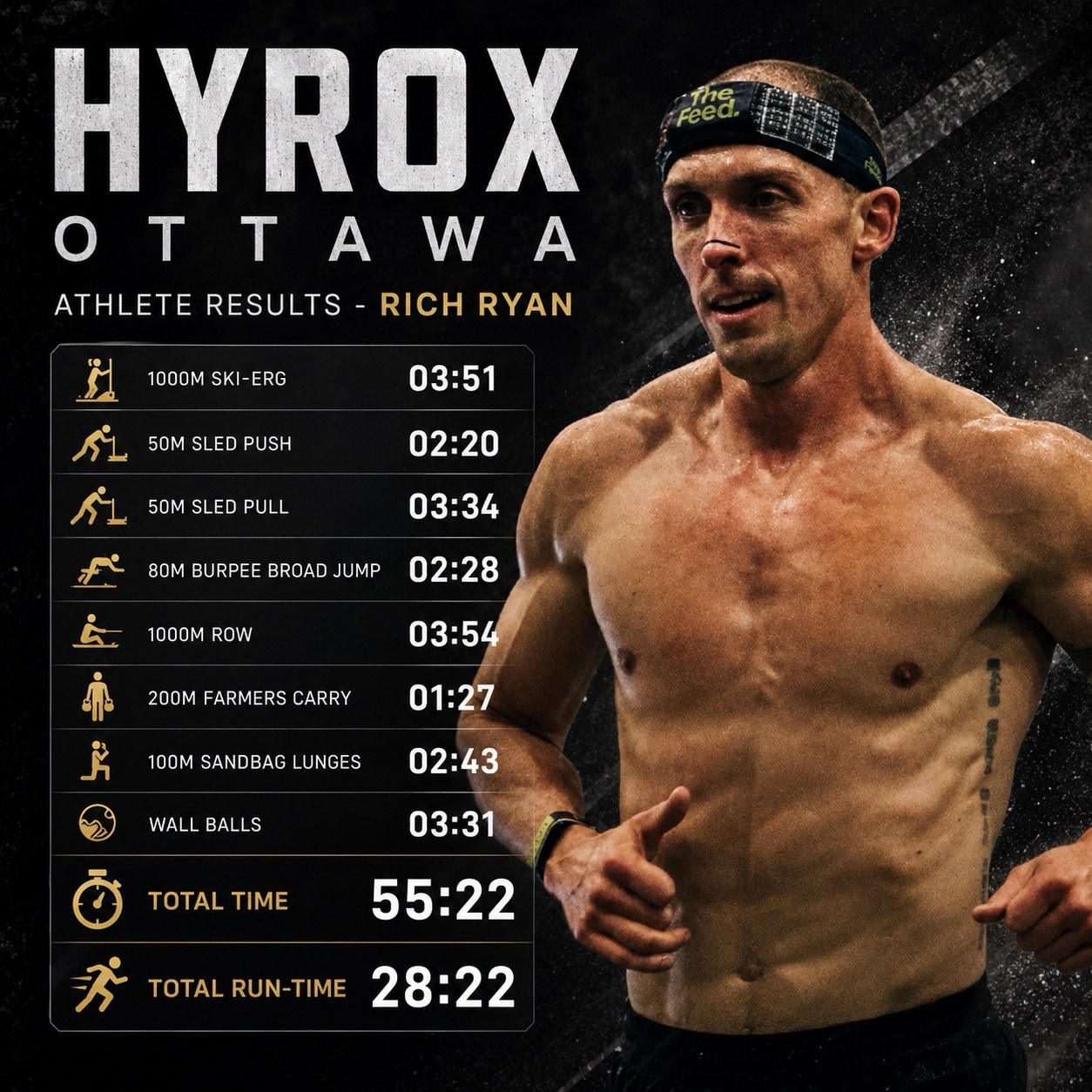
At HYROX Ottawa in Canada, Rich Ryan's 55:22 in HYROX PRO Men gave coaches a clean case study in how elite hybrid racing is built. The headline is the win. The deeper lesson is the split profile: repeatable running, station control, transition discipline, and no obvious single point of collapse.
For Warrior Performance Lab, this is exactly why HYROX should be coached through a Test -> Train -> Analyze model. You do not start with random suffering. You test where the athlete loses the race, train that limiter with bias, and then analyze whether the next result proves adaptation.
HYROX is not run-only. It is not strength-only. It is repeatability under interference.
The WPL lens: HYROX is won by earning the next run
Every HYROX station creates a different kind of stress. The SkiErg and row challenge pacing and trunk control. The sleds test force output and positions. Burpees, lunges, carries, and wall balls test movement economy while fatigue is rising. But the race keeps returning to the same question: can the athlete absorb that stress and run again?
That is the missing-link principle. For most mixed-profile athletes, the goal is not simply to add more hard mixed sessions. The goal is to identify the limiter. Once the athlete can handle race-standard loads, the next major separator is often how well they preserve running quality under fatigue.
Ryan's Ottawa race shows the elite version of that principle. His stations were strong enough not to become the limiter, and his engine was durable enough to keep returning to pace.
Key race data
| Metric | Value |
| Athlete | Rich Ryan |
| Event | HYROX Ottawa 2026, Canada |
| Division | HYROX PRO Men |
| Finish time | 55:22 |
| Overall result | #1 overall in public result databases |
| Running total | 28:22 |
| Workout total | 23:48 |
| Roxzone | 3:29 |
The run splits: controlled repeatability, not one heroic kilometer
The first seven run splits ranged from 3:29 to 3:35. That six-second spread is the coaching story. This was not a fast first kilometer followed by survival. It was repeatable output under repeated interference.
| Segment | Split | Rank shown |
| Run 1 | 3:31 | 2nd |
| Run 2 | 3:29 | 3rd |
| Run 3 | 3:35 | 1st |
| Run 4 | 3:34 | 1st |
| Run 5 | 3:30 | 1st |
| Run 6 | 3:29 | 1st |
| Run 7 | 3:30 | 1st |
| Run 8 | 3:47 | 1st |
The final run slowed, as expected after the cumulative load of the full race, but the split graphic still shows it as first in the field. That is the point: the engine did not disappear when the work got messy.
The station splits: this was not engine-only dominance
The lazy takeaway would be, 'Rich won because he can run.' That misses the coaching lesson. The station profile shows six first-place station splits, a second-place row, and a fourth-place SkiErg. That is not a run-only performance. It is task-specific strength and movement economy supporting a durable engine.
| Station | Split | Rank shown |
| SkiErg | 3:51 | 4th |
| Sled Push | 2:20 | 1st |
| Sled Pull | 3:34 | 1st |
| Burpee Broad Jumps | 2:28 | 1st |
| Row | 3:54 | 2nd |
| Farmer's Carry | 1:27 | 1st |
| Sandbag Lunges | 2:43 | 1st |
| Wall Balls | 3:31 | 1st |
TEST: What did Ottawa actually test?
Ottawa did not only test whether Ryan could run a fast kilometer. It tested whether he could keep running after eight different disruptions. That is a very different demand.
A WPL test asks better questions:
- Can the athlete run after the SkiErg without over-breathing early?
- Can they recover enough after sled push and sled pull to avoid a pace collapse?
- Can they hold posture after burpees, carries, and lunges?
- Can they reach wall balls with enough control to finish clean instead of surviving?
- Can they move through Roxzone without leaking free time?
Ryan's split profile answers those questions at an elite level. The stations did not create a major run collapse, and the runs did not force him to give time back on the stations.
TRAIN: What should athletes actually copy?
Athletes should not copy Ryan's exact pace. They should copy the logic. The goal is not to train like an Elite 15-level athlete on day one. The goal is to identify what breaks first in your own race and bias training toward that missing link.
- If the athlete can complete stations well enough but run splits collapse, bias toward base, threshold, and compromised running.
- If the athlete runs well but sleds, carries, lunges, or wall balls destroy position, bias toward task-specific strength and station skill.
- If running and stations are both unstable, build skill, aerobic base, and density tolerance before big race simulations.
For advanced athletes, the Ottawa profile points toward controlled threshold running, compromised running after specific station stressors, and enough task-specific strength that stations never become near-max efforts.
ANALYZE: What should coaches review after the race?
The post-race review should not stop at total time. The better analysis is pattern-based.
- Did run splits fade, hold, or rebound across the race?
- Which station disrupted the next run the most?
- Did station reps stay economical, or did they become near-max efforts?
- Did Roxzone leak time between tasks?
- Was the athlete under-recovered before the race or simulation?
Ryan showed the ideal version: fast stations, durable running, controlled movement, and minimal transition leakage. Most athletes will not show all four. That is why WPL starts with the limiter rather than the trendiest workout.
The coaching takeaway
Rich Ryan's HYROX Ottawa result does not tell every athlete to chase a 55-minute race. It tells every coach to stop guessing.
Test the limiter. Train with bias. Analyze the next result. Then repeat.
That is the difference between random hybrid suffering and intelligent HYROX programming.
The station is not truly finished when the reps are done. It is finished when the athlete can run again.