Starting Strength and Endurance Training After 65
What genetics can tell us about older athletes
An older adult learning to lift, run or train for HYROX raises a compelling question: what allows someone to take on a new physical challenge at 70, 80 or even 90? As a coach and Nutrigenomix practitioner, I want to understand where genetic information can help us—and where we still need to measure the person in front of us.
The evidence supports substantial capacity to adapt in later life. Genetic variation can contribute to differences between individuals. In the evidence reviewed here, I found no validated commercial-panel method for predicting which older beginner will excel at hybrid racing or determining that person’s training dose. The useful research question is whether genetic information improves decisions beyond a thorough health, nutrition and performance assessment. [3–14,19]
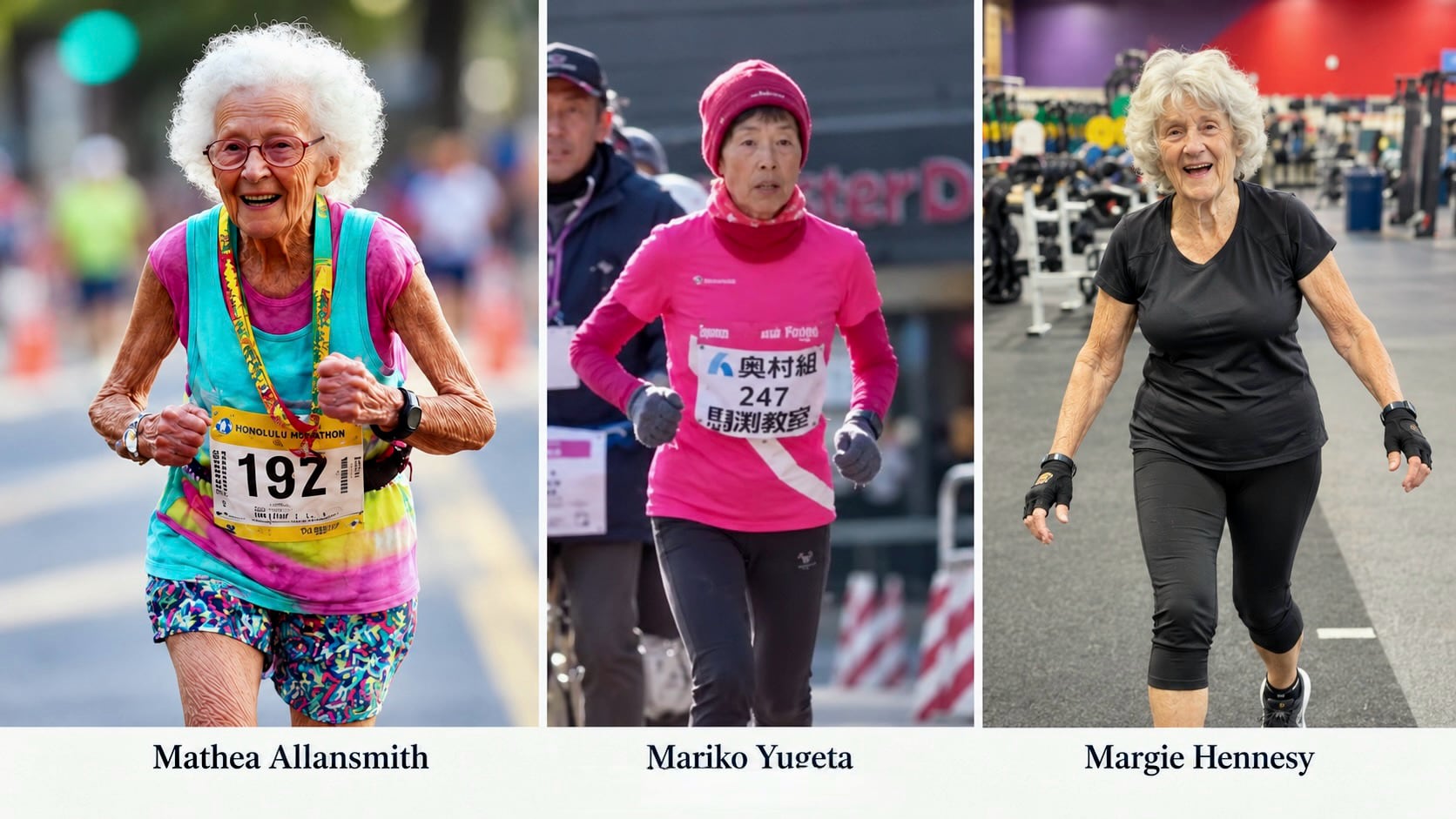
Margie Hennesy’s first-person account in Women’s Health describes beginning consistent gym training at 90 after a lifetime of recreational activity and regular walking, with more demanding household and yard work from age 83. Her daughter-in-law, Becky, programs and supports her training. Becky’s public posts describe their plan to enter women’s doubles at HYROX Dallas. These accounts describe preparation, not a completed race or genetic investigation. [1,2]
That distinction gives us a better starting question. How much capacity has an individual maintained through daily activity, and how much additional capacity can structured training develop? A first race does not necessarily mark a first exposure to physical work. Equally, a long period without formal training should not automatically close the door to improvement.
Direct research shows that substantial adaptation remains possible. In a 12-week resistance-training study, 12 healthy participants aged 85 or older, averaging 87, increased quadriceps muscle cross-sectional area by approximately 11% and leg-extension strength by 46%. Their responses were not statistically different from those of 17 participants aged 65–75. The sample was small and selected for health; absence of a detected difference does not prove that all age groups respond identically. [3]
An earlier study enrolled ten frail institutionalized adults averaging age 90. Among nine completers, eight weeks of supervised resistance training produced large relative gains in strength and improvements in muscle size and mobility. Those results demonstrate retained trainability from a low baseline; they do not establish readiness for demanding competition. [4]
Late starters also appear in athlete case studies. A female world champion powerlifter studied at 71 had started structured resistance training at 63. An 81-year-old endurance record holder studied in a paper published in 2026 began running at 66 and competing at 70; his measured running VO₂max was 52.8 mL/kg/min. These exceptional examples show what has been observed, not what every beginner should expect. Neither establishes a genetic explanation for success. [5,6]
Genetics is one layer of this story. Most people share the same genes, while carrying different versions of many of them. Researchers study whether these variants are associated with traits such as muscle function, metabolic responses or survival to older ages. A group-level association, however, does not automatically provide an accurate prediction for one person.
| Genetic example | Biological relevance | Interpretation for an older beginner |
| ACTN3 R577X | Influences production of α-actinin-3 in fast muscle fibres. | XX carriers lack this protein, but still have fast fibres. Genotype does not supply a personal strength ceiling. [7–10] |
| ACE insertion or deletion | Involves a pathway studied in blood-pressure regulation and exercise traits. | Older-adult strength and function findings are inconsistent. It does not establish a preferred sport. [7–9] |
| FOXO3 variants | Associated with longevity and cellular stress-related biology. | Survival associations do not establish running, jumping or race-recovery capacity. [11] |
| CYP1A2 variants | Relevant to caffeine metabolism and possible performance responses. | Exercise findings vary. Results in young adults do not establish caffeine advice for an 80-year-old athlete. [12,13] |
The older-adult literature illustrates both possibility and uncertainty. A study of 139 women averaging 65.5 years reported some ACE- and ACTN3-related differences after power training. Conversely, research in 41 adults aged 90–97 found no significant relationship between those variants and the measured strength and functional traits. A separate sample averaging 82.8 years did not show robust associations after statistical correction. These small studies examine different outcomes and cannot validate a commercial HYROX prediction algorithm. [7–9]
A September 2026 study adds a timely example. Among 682 community-dwelling adults aged 65 or older, researchers reported an exploratory relationship between activity and chair-stand performance in women with ACTN3 XX. Because the study was cross-sectional and activity was self-reported, it cannot establish that more exercise caused poorer function. The authors state that the proposed threshold is not a clinical cutoff. It should not become an exercise ceiling in a coaching report. [10]
Age, sex, ancestry, starting fitness and exercise history also affect how findings can be applied. An association in younger male competitors is not automatically transferable to a woman beginning training in her 80s. Small genotype subgroups, multiple statistical comparisons and limited external replication increase uncertainty. The outcome matters too: a genetic association with a blood marker is different from predicting strength gain, injury or race completion.
Training-induced changes in gene activity are a different part of the science. A standard genotype panel measures selected inherited variants. It does not measure which genes an athlete’s muscle is expressing today, how many functional mitochondria it contains or how the tissue has adapted over the past month. In a randomized study including adults aged 65–80, 12 weeks of exercise altered muscle gene transcripts, protein abundance and mitochondrial function. That is evidence of biological adaptability; it is not a genetic screening result. [14]
Nutrigenetics asks how inherited variation relates to responses to nutrients or dietary patterns. Nutrigenomics, used more broadly, also encompasses how nutrition affects gene activity and related molecular processes. For practitioners, the distinction matters because a cheek-swab result and an assessment of current physiology answer different questions.
Nutrigenomix’s public Sport materials describe a panel of 70 genetic markers spanning nutrition and sport-related topics. The value of any recommendation depends on more than accurate laboratory measurement. We also need evidence that the result predicts an outcome in comparable people and that acting on it improves care or coaching. A product description establishes what is offered; it does not independently establish those outcomes. [15]
Nutrition intervention evidence is mixed and deserves careful reading. A 2014 trial in 138 healthy adults aged 20–35 found a greater reduction in reported sodium intake in one genetically advised subgroup. The authors explicitly described their objective as testing the behavioural effect of disclosure, rather than validating the clinical efficacy of the variants. The study did not test older athletes or training adaptations. [16]
The 140-person NOW weight-management trial reported benefits for some longer-term dietary changes and adherence with nutrigenomic guidance. In Food4Me, personalised dietary advice improved eating behaviour, but adding the tested genetic information did not improve effectiveness beyond the other personalisation approaches. These findings leave room for targeted applications while showing why evidence must be assessed recommendation by recommendation. Neither trial validates a training prescription for adults beginning HYROX at 80 or 90. [17,18]
In practice, I would use genetic information to generate a specific, testable question rather than a fixed athlete label. A nutrition-related result could prompt a closer review of habitual intake, tolerance or a clinically relevant concern. It would need to be interpreted alongside health history, medications and appropriate measurements. It would not justify assuming a present nutrient deficiency, setting a supplement dose automatically or interpreting a normal result as proof that nutrition needs are met.
For an older beginner, progress should be visible in meaningful outcomes: greater strength, easier movement, improved walking or running tolerance, better confidence and recovery that supports the next session. Baseline assessment and repeated measurements provide information that can guide the next training decision. Current ACC guidance emphasises tailoring exercise to health, physical function, symptoms, goals and preferences; chronological age alone does not mandate maximal exercise testing. [20]
For HYROX preparation, my coaching approach would add progressively introduced station skills and monitoring of load tolerance. Getting up from the floor, controlling a lunge, carrying a load and tolerating repeated efforts are practical questions to assess. A brief video or an impressive sled load cannot establish race readiness. The Australian Institute of Sport states that evidence does not support genetic testing for athletic performance improvement, sport selection or talent identification. [19]
Clinical genetic testing is a separate pathway when medical or family history suggests an inherited condition. Potentially actionable health findings from consumer testing need qualified interpretation and, where appropriate, clinical confirmation. A favourable sports-related result cannot replace assessment of symptoms or known disease. [21]
There is a worthwhile research opportunity here. Studies could distinguish lifelong exercisers from people beginning structured training after 65, include more adults over 80, and evaluate outcomes that matter to them. The decisive question would be whether genetic guidance adds benefit when both groups already receive equally good, individualised nutrition and training support. Until that evidence develops, our responsibility is to stay curious, measure carefully and help each older athlete discover what progressive training can make possible.
Disclosure: Ayda Page is a Nutrigenomix practitioner. This article presents her educational interpretation of the evidence and is not a statement issued by Nutrigenomix.
Evidence note: This is a selective narrative review of primary research, official guidance and clearly identified first-person reporting, reviewed through October 26, 2026. It is not a systematic review or an individual medical or exercise prescription.
References
1. Hennesy M. First-person account of beginning consistent strength training at 90. Women’s Health. October 12, 2026. Source
2. Hennesy B. Public training update describing women’s doubles at HYROX Dallas. Accessed October 26, 2026. Source
3. Marzuca-Nassr GN, et al. Muscle Mass and Strength Gains Following Resistance Exercise Training in Older Adults 65–75 Years and Older Adults Above 85 Years. Int J Sport Nutr Exerc Metab. 2024;34:11–19. Source
4. Fiatarone MA, et al. High-Intensity Strength Training in Nonagenarians. JAMA. 1990;263:3029–3034. Source
5. Fuchs CJ, et al. Becoming a World Champion Powerlifter at 71 Years of Age. Int J Sport Nutr Exerc Metab. 2024;34:223–231. Source
6. Pilotto AM, et al. Exploring the physiological limits of aging: a case study of the male 50-km world record in the 80+ age category. Front Physiol. Published January 12, 2026. Source
7. Bustamante-Ara N, et al. ACE and ACTN3 genes and muscle phenotypes in nonagenarians. Int J Sports Med. 2010;31:221–224. Source
8. Garatachea N, et al. Single and combined influence of ACE and ACTN3 genotypes on muscle phenotypes in octogenarians. Eur J Appl Physiol. 2012;112:2409–2420. Source
9. Pereira A, et al. ACE I/D and ACTN3 R/X polymorphisms as potential factors in modulating exercise-related phenotypes in older women in response to a muscle power training stimuli. Age. 2013;35:1949–1959; online 2012. Source
10. Hsu HC, et al. Sex-specific physical activity thresholds influencing muscle function in older adults with XX genotype of ACTN3 R577X. Sci Rep. 2026;16:27560. Source
11. Torigoe TH, et al. Novel protective effect of the FOXO3 longevity genotype on mechanisms of cellular aging in Okinawans. npj Aging. 2024;10:18. Source
12. Guest N, et al. Caffeine, CYP1A2 Genotype, and Endurance Performance in Athletes. Med Sci Sports Exerc. 2018;50:1570–1578. Source
13. Carswell AT, et al. The effect of caffeine on cognitive performance is influenced by CYP1A2 but not ADORA2A genotype, yet neither genotype affects exercise performance in healthy adults. Eur J Appl Physiol. 2020;120:1495–1508. Source
14. Robinson MM, et al. Enhanced Protein Translation Underlies Improved Metabolic and Physical Adaptations to Different Exercise Training Modes in Young and Old Humans. Cell Metab. 2017;25:581–592. Source
15. Nutrigenomix. Sport consumer information brochure. Public product description; not an independent validation study. Source
16. Nielsen DE, El-Sohemy A. Disclosure of Genetic Information and Change in Dietary Intake: A Randomized Controlled Trial. PLoS One. 2014;9:e112665. Source
17. Horne J, et al. Enhanced long-term dietary change and adherence in a nutrigenomics-guided lifestyle intervention: results from the NOW randomised controlled trial. BMJ Nutr Prev Health. 2020;3:49–59. Source
18. Celis-Morales C, et al. Effect of personalized nutrition on health-related behaviour change: evidence from the Food4Me European randomized controlled trial. Int J Epidemiol. 2017;46:578–588. Source
19. Australian Institute of Sport. Genetics position statement and linked guidance. Accessed October 26, 2026. Source
20. American College of Cardiology. Exercise Prescriptions for Cardiovascular Health in Adults: 2026 ACC Scientific Statement. J Am Coll Cardiol. 2026. Source
21. Hull LE, et al. Direct-to-Consumer Genetic Testing for Cardiovascular Disease: A Scientific Statement From the American Heart Association. Circulation. 2025;151:e905–e917. Source