What should your HYROX SkiErg damper be set to?
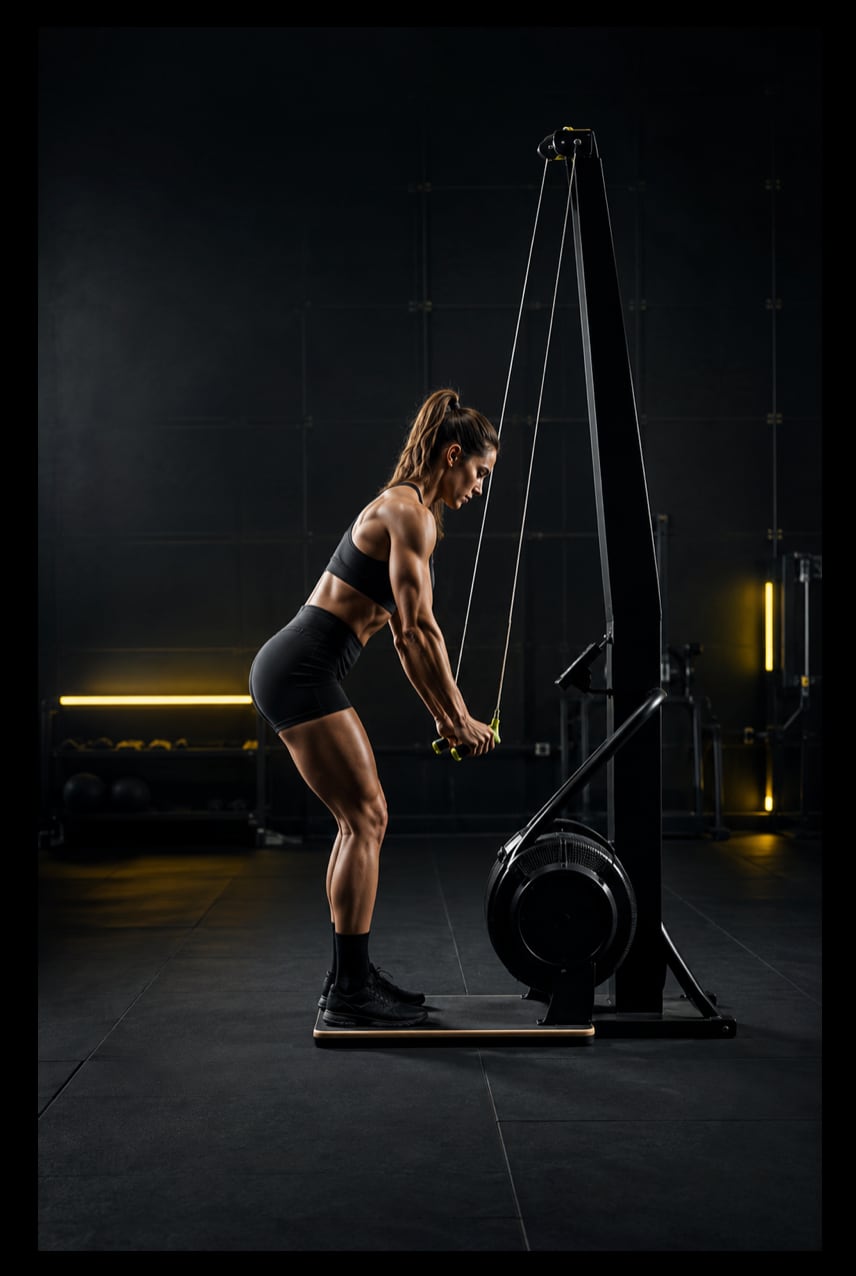
Picture the beginning of a HYROX. You have completed the opening run, stepped onto the SkiErg and reached for the handles. Then you notice the numbered lever beside the flywheel. Should you move it? Is a higher number stronger? Is the setting used by an elite athlete also right for you?
The first station is a difficult place to discover that your usual answer was only a guess.
The damper matters—but not because a bigger number automatically makes the workout better. It changes how the flywheel behaves between pulls. You still create the effort, and your best setting must help you reach the pace without spending energy you will need for the next run and sled push.
THE BETTER QUESTION
At your target SkiErg pace, which lever setting and pulling rhythm let you stay connected, move well and finish station one ready to continue racing?
Four Terms to Understand Before You Test
| Term | What it means in everyday language |
| Damper setting | The numbered lever on the SkiErg flywheel housing. It changes how much air enters the fan. |
| Drag factor | The PM5 monitor’s measurement of how quickly that flywheel slows between pulls. It describes the machine’s actual response better than the lever number alone. |
| Cadence / SPM | How many pulls you complete each minute. |
| Work per pull | How much of your total output is concentrated into each pull at a given pace. |
A higher damper allows more air into the fan, so the flywheel tends to slow more quickly between pulls. A lower setting lets it retain speed for longer. That changes the feel of the next acceleration, but it does not choose the intensity for you.
Two SkiErgs can also feel different at the same lever number because dust, altitude, airflow and machine condition affect the response. Open Display Drag Factor on the PM5 and record that number if you want to reproduce your test elsewhere.
The SkiErg Is a Whole-Body Pull
The handles begin overhead, but a good pull is not simply an arm exercise. Body mass, trunk and hip action, lats and arms work together, while the legs support force transfer and rhythm. You do not need to turn every pull into a deep squat.
That is why cadence cannot be judged alone. A number that looks smooth for one athlete may make another athlete collapse, yank the cords or rush the return. Height, limb length, movement experience, local muscular endurance and breathing all influence what feels economical.
Same Pace. Different Work per Pull.
A SIMPLE EXAMPLE
At approximately 2:00/500 m, the SkiErg reports about 202.5 watts. At 36 SPM, that is roughly 338 joules per pull. At 42 SPM, it is about 289. At 48 SPM, it is about 253. The pace is the same; the work is distributed differently.
You do not need to calculate joules during every workout. The practical lesson is simple: slower cadence usually means fewer, heavier pulls, while faster cadence means more frequent pulls with less work in each one.
Neither side is automatically better. Too slow can overload the lats, triceps, abdominals or low back. Too fast can shorten the pull, elevate the shoulders and increase breathing demand without creating more speed.
| TOO HEAVY Every pull feels like a restart. You yank, drop too deeply or pause long enough for the wheel to lose too much speed. | YOUR MATCH ZONE The cords load smoothly, the pull feels productive, the return stays tall and the rhythm remains repeatable late in the interval. | TOO RUSHED The hands move fast but do not load the wheel well. The pull shortens and SPM rises while watts stay flat or fall. |
A Simple Way to Feel What the Numbers Mean
I recently listened to erg specialist Jane Erbacher explain two simple learning drills: compare controlled damper settings so you can feel flywheel deceleration, then build a cadence ladder to find the rhythm that gives you the best return.
The idea is excellent because athletes often try to solve the SkiErg by staring harder at the monitor. Jane’s drills bring your attention back to the sound of the wheel, tension in the cords, timing of the pull and how the movement feels.
WPL adds three controls so that feeling becomes useful information: hold output steady, record drag factor and repeat the leading result.
Part 1: Learn What the Damper Changes
- Warm up for 8–10 minutes. Open Display Drag Factor on the PM5 and take several normal pulls.
- Record the drag factor at your usual lever position. Create two nearby candidates—approximately 10 drag-factor points below and 10 above, provided each option remains comfortable and technically safe.
- Complete 60–90 seconds at each condition at a controlled 5/10 effort. Keep your target pace steady and recover for 60–90 seconds between stages.
- Listen to the flywheel and feel how quickly the cords lose tension at the top. Does the next pull connect smoothly, or feel as though you are restarting a stopped object?
- Record lever position, drag factor, pace or watts, SPM, local muscular effort and breathing effort. You are learning the machine—not choosing the final race setup yet.
Part 2: Find Your Most Productive Pulling Rhythm
Choose one promising drag factor and keep it unchanged. Now adjust only cadence while holding the target pace or watts steady.
- Choose a controlled pace you can repeat and note the SPM you naturally settle into.
- Complete four 60–75-second stages in three-SPM steps around your normal cadence. An athlete who settles near 42 SPM might explore 36, 39, 42 and 45 SPM. This is an example—not a universal prescription.
- Keep the target pace or watts steady. Recover for 60–90 seconds between stages.
- After each stage, score connection, sequencing, useful pull range, return control and sustainability from 1–5.
- Repeat the two best stages. If one result disappears on the repeat, it was probably not your stable match zone.
WHAT “RIGHT” SHOULD FEEL LIKE
The cords load without a yank. Body mass and trunk action lead the pull while the arms finish rather than dominate. You can stand tall on the return, maintain the target pace and still recognize your technique near the end.
Ask Yourself These Five Questions
- Did the cords load immediately without a yank?
- Did my body and trunk lead while my arms stayed connected?
- Was the pull complete without collapsing into a deep squat or exaggerated crunch?
- Could I stand tall and return without rushing the handles upward?
- Could this rhythm survive the final 250 m and the next run?
Use This Quick Training Log
| Stage | DF / SPM | Pace / watts | Local / breathing RPE | Movement 1–5 |
| 1 | ________________ | ________________ | ________________ | ________________ |
| 2 | ________________ | ________________ | ________________ | ________________ |
| 3 | ________________ | ________________ | ________________ | ________________ |
| 4 | ________________ | ________________ | ________________ | ________________ |
| Repeat best | ________________ | ________________ | ________________ | ________________ |
The Best SkiErg Result Must Survive HYROX
SkiErg is station one, but it is not the whole race. A setup that produces a beautiful fresh split can still be too expensive if your next kilometer deteriorates or your legs arrive at the sled push already flat.
Once you have two promising combinations, confirm them on separate, well-matched days. Keep your machine, warm-up, fueling, footwear and pre-fatigue as consistent as possible.
- Complete a controlled 1 km run at your planned race intensity.
- Ski 1,000 m using one candidate and record each 250 m segment.
- Complete the following standardized kilometer.
- Include the sled push—or a safe standardized lower-body substitute—when it is appropriate for the athlete and session.
- Compare SkiErg fade, cadence drift, movement, local versus breathing effort and what happened afterward.
THE FASTEST ISOLATED SKI MAY NOT WIN
A setup that is one or two seconds slower on the SkiErg can still be the better HYROX choice if it protects the following run and sled push.
What Your Result May Change in Training
| What you notice | What it may tell you to train |
| SPM rises while pace or watts fall | Improve cord connection, sequencing and cadence control rather than simply moving the hands faster. |
| Low cadence reaches pace but local effort explodes | Build relevant strength endurance, but do not force the heavy combination as the race setup. |
| Fresh skiing looks good; compromised skiing collapses | Prioritize movement and output transfer under race-specific fatigue. |
| The ski stays stable but the next run or sled worsens | Reduce total station cost through pacing, cadence/drag adjustment or better fatigue distribution. |
| No option feels connected | Use movement and technique analysis before adding more conditioning. |
What the Evidence Can—and Cannot—Tell Us
SkiErg and double-poling research supports controlled performance testing and shows that performance reflects several physiological and technical contributors. It also shows that movement and muscle involvement change as speed rises and that experience influences economy.
Those studies are not identical to a HYROX SkiErg station, and there is no validated universal drag-factor and cadence cutoff for every HYROX athlete. WPL therefore uses the evidence to shape a repeatable coaching test—not to pretend one number has been scientifically proven for everyone.
Furthermore;
Your best SkiErg damper is not automatically the number used by an elite athlete or the number printed in a generic training plan.
It is the range that lets you create your target pace with connected movement, acceptable muscular and breathing cost, and enough reserve to run and push the sled well.
Learn what the lever changes. Keep the pace steady while you explore cadence. Notice the sound, tension and rhythm. Then prove that your choice still works when HYROX asks for more.
FIND YOUR PERFORMANCE LIMITER
A SkiErg split shows what you produced. Warrior Performance Lab helps identify what it cost, what may be limiting you and what to train next. Explore WPL Erg Intelligence at warriorperformancelab.com/erg-intelligence-
Evidence & Further Reading
1. Concept2: All About Damper Setting and Drag Factor. A clear explanation of airflow, lever position and drag factor.
2. Concept2: SkiErg. Machine overview and technique resources.
3. O’Brien et al. (2025): Reliability and Criterion Validity of the Concept2 SkiErg. A one-athlete case study examining repeatability and validity.
4. Gjerløw et al. (2025): Physiologic Variables and 800 m SkiErg Performance. Research on physiological contributors to SkiErg performance.
5. Zhu et al. (2024): Double-Poling Economy and Kinematics. A comparison of movement and economy in novice and experienced skiers.
6. HYROX Rulebooks. Check current station and Doubles requirements before using a race strategy.
7. HYROX ERG Technique, Race Mindset and Performance with Jane Erbacher. The conversation containing the damper-familiarization and rate-ladder coaching ideas.
Educational coaching information only. Begin with a controlled, technically safe effort and adjust for your health, experience, movement tolerance and current readiness.