What The Science Says About HYROX
First Official Study Breaks Down the Race
"Acute physiological responses and performance determinants in Hyrox – a new running-focused high intensity functional fitness trend"
by Brandt T. et al., published in Frontiers in Physiology (2025).
If you've ever wondered how hard HYROX really is — or what makes someone perform well in it — the first scientific study on HYROX has the answers. Published in Frontiers in Physiology (2025), this study analyzed what actually happens to your body during a full HYROX competition. It's tough, it's sweaty, and success is more about endurance than strength.
This was the first scientific investigation of HYROX, aiming to analyze acute physiological responses, perceived exertion (RPE), and key performance determinants during a simulated HYROX competition. The goal was to better understand HYROX's physiological demands and to provide training insights for both competitive and general fitness applications.
Participants & Methods
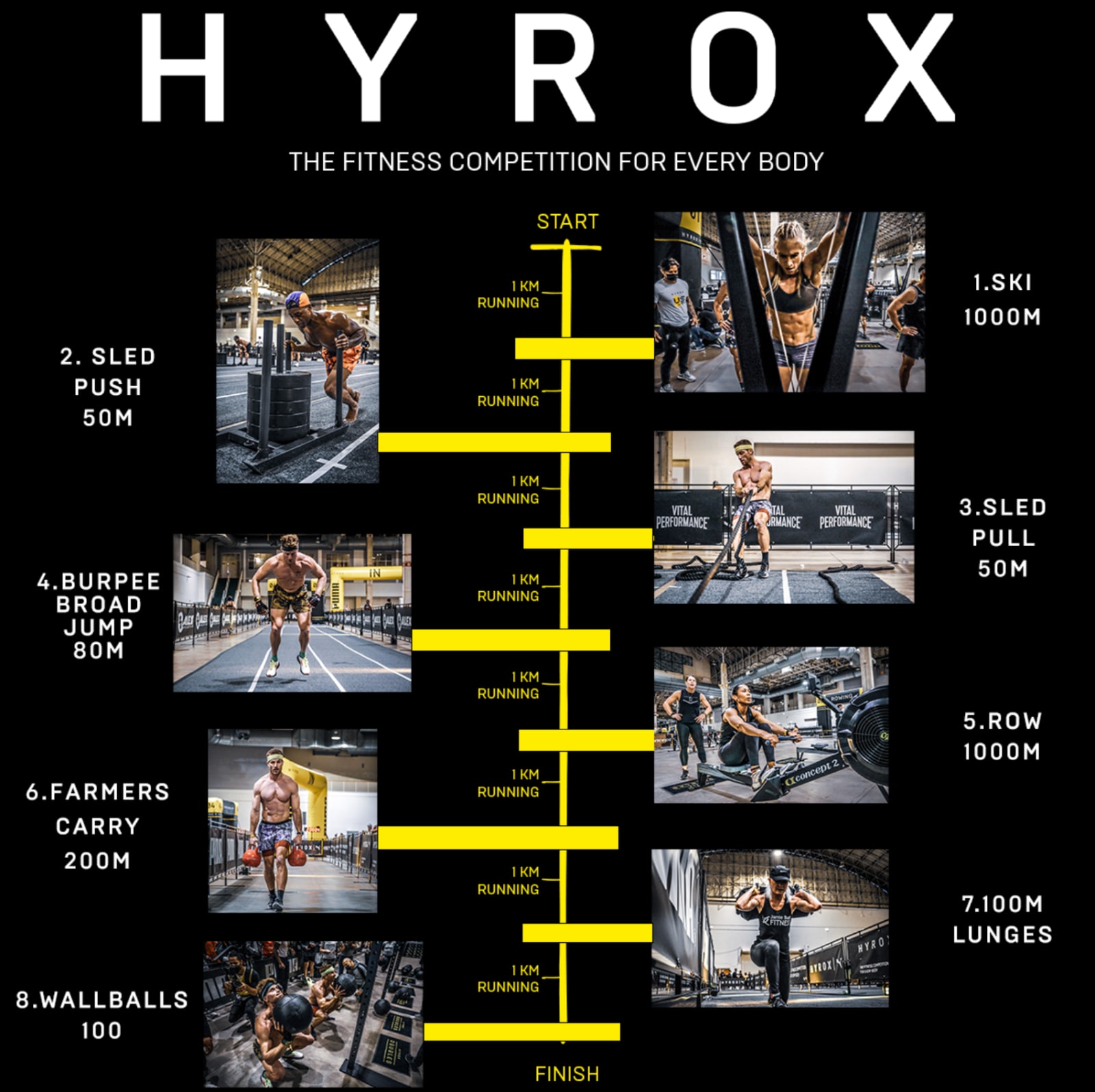
Researchers took 11 recreational HYROX athletes and had them perform a full HYROX Individual Open simulation: 8 times 1K runs, each followed by one of the official HYROX functional workouts. During the entire event, they tracked heart rate, blood lactate, and perceived exertion — and they also looked at what fitness traits predicted performance.
- 11 recreational HYROX athletes (27% women, 73% men), median experience: 18 months.
- Baseline testing measured:
- VO₂max (median: 51 mL/kg/min)
- Body composition
- Hand grip strength
- Endurance & resistance training volume
- Participants completed a full simulated HYROX Individual Open competition (8 x 1K runs + 8 functional workouts) in a gym setting.
- Measured throughout:
- Heart Rate (HR)
- Blood Lactate (BL)
- Relative Perceived Exertion (RPE)
Results
Completion Time
- Total HYROX time: 86.5 min (median)
- Running time: 51.2 min
- Exercise time: 32.8 min
- (Significantly longer run time, p = 0.003)
Intensity Markers
- Heart Rate:
- 79.5% of time spent at very hard intensity
- HRmax reached 185 bpm during exercises (higher than during runs)
- Blood Lactate:
- Max BL: 8.5 mmol/L (higher after exercises than runs; p = 0.006)
- Perceived Exertion:
- RPE during workouts: 18 (vs. 16 during runs; p = 0.003)
Toughest Segment
- Wall Balls (final station) showed the highest HR, BL, and RPE values, confirming maximal fatigue.
Performance Determinants
- Faster HYROX times correlated with:
- Higher VO₂max (ρ = -0.71, p = 0.01)
- Higher endurance training volume (ρ = -0.68, p = 0.04)
- Lower body fat percentage (ρ = 0.67, p = 0.03)
- No significant correlation with hand grip strength or resistance training volume
Interpretation
Physiological Demands
- HYROX is a hybrid high-intensity functional training (HIFT) event, but distinct from CrossFit:
- Longer duration (~85 min)
- Greater emphasis on endurance, especially running (60% of event time)
- High metabolic stress with reliance on both aerobic and anaerobic systems
- Anaerobic glycolysis is particularly important during sled push/pull, which were completed quickly despite heavy loads
Energy System Engagement
- Runs: Primarily aerobic, moderate HR and lactate values
- Exercise stations: Mixed aerobic/anaerobic, higher HR, lactate, and RPE
Endurance Matters Most
Athletes with higher VO₂max, more weekly endurance training, and lower body fat had significantly faster finish times. Pure strength (like grip strength or even resistance training volume) didn't predict much. In other words, if you want to get faster in HYROX, you need a better engine.
Running is the Real Workload
Although the race includes eight exercise stations, the bulk of the time (~60%) is spent running. Average HYROX finish time was about 86.5 minutes, with more than 50 minutes of that spent on the runs. That makes running efficiency one of the top performance factors.
High Intensity, High Fatigue
The majority of the race is spent at very hard intensity—about 80% of the time close to 90–100% of max heart rate. Blood lactate levels peaked at 8.5 mmol/L, and perceived exertion reached 18 out of 20 — especially during the final wall balls, which were the most fatiguing.
Fatigue Slows You Down
As the race progressed, running splits got slower — especially around the 5th run (the midpoint). This was likely due to cumulative fatigue from sleds, lunges, and carries. The more tired the athlete, the slower the runs, especially in the second half of the race.
How This Should Change Your Training
- Prioritize endurance development, especially VO₂max and lactate tolerance
- Use HIIT, compromised running, and hybrid conditioning sessions to replicate race stress
- Include strength work to handle sleds and sandbag carries—but endurance is the limiting factor
- Training should rotate between movement types to simulate metabolic transitions (such as, upper- to lower-body fatigue)
Build Your Aerobic Engine
Cardio capacity was the best predictor of performance. If you're serious about improving your HYROX time, train like an endurance athlete: zone 2 runs, tempo work, threshold intervals. Don't rely on brute strength alone.
Train Transitions
The hardest part of HYROX isn't the individual runs or workouts—it's doing them back-to-back. Transitioning from sled push to run or from lunges to farmer's carry taxes your body differently. Incorporate brick-style workouts into your week (e.g., row → run → wall balls) to get used to the shift in muscle recruitment.
Do More Running Under Fatigue
Since most athletes get slower in the second half of the race, practice running after intense exercise. Start your interval session with wall balls, burpees, or sled pulls, then go into a 1K run. This trains your body to maintain form and speed under fatigue.
Strength Still Matters — But Build Strength-Endurance
You need to be strong enough to move sleds and carry loads, but beyond that, it's more about how long you can repeat efforts. Train lifts like squats, lunges, rows, and presses in moderate rep ranges (8–15), with short rests, to improve your muscular endurance.
Watch Your Pacing
Don't sprint the first few runs. The study found the fifth run was often the slowest—meaning many athletes likely went out too hot. Learn to hold a pace you can sustain and negative split the back half.
Study Limitations
- Small sample size (N = 11)
- Simulated race lacked real competition environment and official sleds
- Only tested Individual Open division
- No direct lower-body strength tests (e.g., squat or deadlift max)
Lastly
This first official HYROX study proves what elite coaches have long suspected: HYROX is an endurance race with functional training. If you want to perform better, build your aerobic capacity, condition yourself to run when tired, and train transitions. Whether you're new to HYROX or chasing a sub-75 minute finish, this study-backed training insight can help you race smarter and finish stronger.
Want the full breakdown or need help applying this to your plan? Reach out — this is what Warrior Performance Lab does it! https://warriorperformancelab.com/research
References:
Frontiers in Physiology. "Acute physiological responses and performance determinants in Hyrox© – a new running-focused high intensity functional fitness trend". Available at https://www.frontiersin.org/journals/physiology/articles/10.3389/fphys.2025.1519240/full