Why HYROX Got So Popular - and How the Race Structure Evolved Since 2017
HYROX did not just go viral. It solved two problems at once: fitness needed a finish line, and coaches needed a repeatable test.
That is why this story is bigger than popularity. HYROX became successful because it gave gym-goers a clear goal, a scoreboard, a community, and a reason to train like athletes. But it became a sport because the core race format stayed stable while the structure around it became more standardized, measurable, scalable, and coachable.
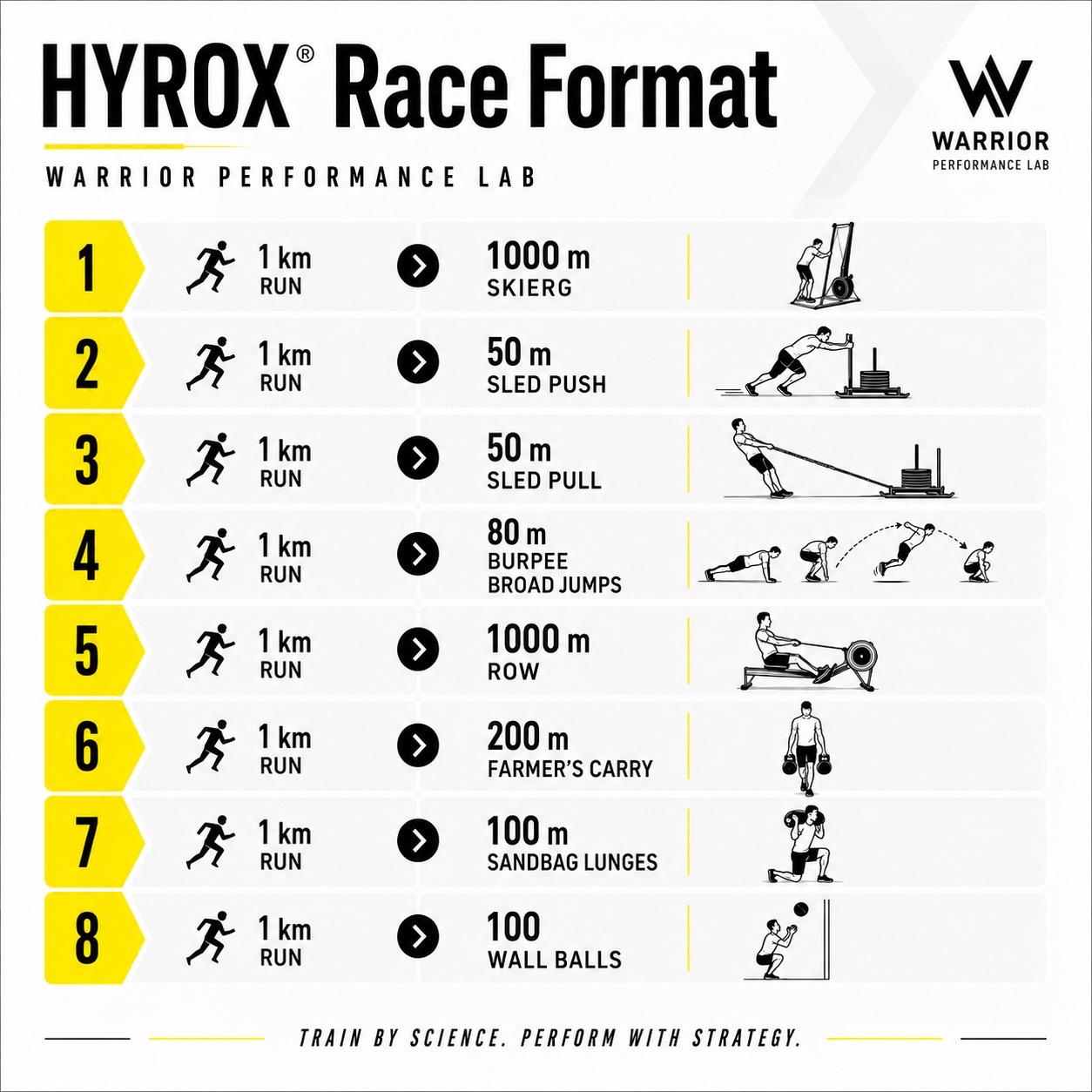
The most interesting part is that HYROX improved by not constantly changing the workout. The basic promise stayed recognizable: run 1 km, complete one workout station, repeat that sequence eight times. That stability made the race easy to explain, easy to benchmark, and very hard to master. [1]
The race barely changed. The sport around it changed everything.
| "The quick version |
| HYROX got popular because it made fitness purposeful, measurable, social, and repeatable. Since 2017, the biggest evolution has not been a new workout format. It has been the ecosystem around the race: divisions, rulebooks, official timing, results platforms, Roxzone execution, Elite 15, Majors, World Championships, gym affiliations, and a more data-driven qualification pathway." |
The format that made it work
HYROX is simple enough to understand in one sentence and demanding enough to build an entire training year around. Athletes complete a 1 km run followed by one functional workout station, repeated eight times. Each race is hosted indoors, which creates a stadium-style environment where spectators can see athletes throughout the event. [1]
That structure is one of the reasons HYROX scaled. It is fixed enough to be marketable, repeatable enough to be measurable, and varied enough to expose weaknesses across endurance, strength endurance, grip, trunk control, pacing, and composure under fatigue.
| Round | Run | Workout station |
| 1 | 1 km | 1000 m SkiErg |
| 2 | 1 km | 50 m Sled Push |
| 3 | 1 km | 50 m Sled Pull |
| 4 | 1 km | 80 m Burpee Broad Jumps |
| 5 | 1 km | 1000 m Row |
| 6 | 1 km | 200 m Farmers Carry |
| 7 | 1 km | 100 m Sandbag Lunges |
| 8 | 1 km | 100 Wall Balls |
Part 1: Why HYROX got so popular
1. It gave gym-goers a finish line
A lot of people love training, but they do not always have a reason to train. HYROX solved that problem. It gave gym-goers a deadline, a race-day environment, a finish time, and a clear identity: you are not just working out anymore - you are preparing to perform.
That shift matters. Aesthetic goals can motivate someone for a while, but performance goals create momentum. When an athlete has a race on the calendar, every run, strength session, recovery day, nutrition choice, and mobility block has a purpose. The gym stops feeling like a collection of random exercises and starts feeling like preparation.
HYROX also sits in a useful psychological space. It is serious enough to feel meaningful, but not so specialized that the average active person immediately rules themselves out. You do not need advanced gymnastics. You do not need Olympic lifting. You do need to run, push, pull, carry, lunge, row, and finish under fatigue. That is demanding, but it feels possible.
2. The fixed format makes progress addictive
One of HYROX's smartest features is that the race does not change every event. The same stations appear in the same order. That consistency turns the race into a measurement tool.
If your first race exposes your wall balls, you know exactly what to fix. If the sled destroys your next run, you can train sled-to-run transitions. If your rowing split holds up but your burpees collapse, your next training cycle has direction. The format creates a feedback loop: race, analyze, improve, repeat.
This is where HYROX starts to feel more like a sport than a class. A finish time becomes a personal benchmark. Station splits become data. The leaderboard becomes context. Your next race becomes the chance to prove that your training actually worked. That measurability is addictive for athletes and incredibly useful for coaches.
3. It arrived at the perfect time for hybrid training
The fitness world had already been moving toward hybrid training. Runners wanted to be stronger. Lifters wanted better conditioning. Functional fitness athletes wanted a race that was measurable without being random. HYROX gave all of them a shared language.
The format rewards the athlete who can blend aerobic capacity with strength endurance. A fast runner with no sled strength will struggle. A strong lifter with no engine will suffer between stations. A highly skilled gym athlete who cannot pace may burn out before the second half. HYROX rewards the athlete who can move well, recover quickly, and keep working when fatigue starts changing the body.
That is why the term hybrid athlete became such a strong part of the HYROX conversation. The race makes the idea visible. It is not just about looking fit. It is about being able to do something with that fitness.
4. It feels accessible without feeling easy
HYROX grew quickly because people can enter at different levels. Open, Pro, Doubles, and Relay pathways make the sport more approachable while still preserving a serious performance challenge. Open lowers the intimidation barrier, Pro increases the loading, Doubles lets partners share stations, and Relay allows a team of four to experience the event together. [1]
Accessibility is not the same as easy. The race still demands preparation. Eight kilometers of running alone requires a baseline engine, and the stations add loaded movement, grip demands, trunk fatigue, and repeated transitions. Still, the entry points make HYROX feel less intimidating than many competitive fitness events.
HYROX also promotes a high completion rate and a race format without a finishing time restriction, which helps everyday athletes see the event as a real challenge they can train for rather than a test reserved only for elites. [3]
5. It is built for community and social proof
HYROX is not just a workout on a competition floor. It is an experience. The events are indoors, loud, visible, and spectator-friendly. Athletes are not disappearing onto an outdoor course for hours; they are racing in a venue where the whole event feels alive. [1]
That environment travels well on social media. Sleds, rowing machines, wall balls, finish-line photos, medals, crowd noise, pacing pain, and team moments all create content people want to share. Mainstream media coverage has increasingly framed HYROX as a visible social fitness trend, not just a niche endurance event. [10]
Modern fitness is not only about the session. It is also about identity and belonging. HYROX gives people a community they can join, a story they can post, and a goal their friends can understand.
6. It turned gyms and coaches into part of the product
The real growth engine is not only race day. It is everything that happens before race day: classes, coaching programs, training partners, gym affiliations, practice events, nutrition planning, and repeat entries.
HYROX's official site reported more than 80 global races in 2025, with more than 550,000 athletes and 350,000 spectators. [2] Infront, a sports marketing company connected to participation sports, reported that HYROX reached more than 750,000 athletes in 2025, expanded to 80 events across 31 markets, and grew to more than 10,000 gym affiliations globally. [8] The exact numbers vary by source and counting window, but the direction is clear: HYROX scaled from event to ecosystem.
That ecosystem is powerful for gyms and coaches. A gym can run HYROX-style sessions. A coach can build a 12-week race plan. Training partners can prepare together. Athletes can race solo, in doubles, or as a relay. The sport keeps people engaged long before the ticket scan and long after the medal photo.
7. The race rewards strategy, not just effort
This is one of the most important points for serious athletes: HYROX is not won by simply doing more work. It rewards smart work.
Every station changes the next run. The SkiErg can tax shoulders and trunk. The Sled Push loads the legs before the athlete has settled into the race. The Sled Pull demands glutes, back, trunk control, rope management, and patience. Burpee Broad Jumps attack breathing and rhythm. The Row starts the second half. Farmers Carry tests grip and posture. Sandbag Lunges punish poor trunk position. Wall Balls ask for composure when there is almost nothing left.
That is why HYROX is so coachable. Athletes need pacing, movement efficiency, transition practice, fueling strategy, and recovery management. The race punishes chaos. It rewards the athlete who can stay smooth when the course becomes uncomfortable.
Part 2: What changed since 2017
The biggest change since 2017 is not that HYROX reinvented the race. The biggest change is that HYROX built a sport operating system around a stable race.
HYROX says it launched in Hamburg, Germany in 2017 and had more than 90,000 athletes in the 2022/23 season. [3] By 2025, HYROX reported more than 80 global races, more than 550,000 athletes, and 350,000 spectators. [2] That is more than a sixfold increase in athlete participation from the official 2022/23 figure to the official 2025 figure alone.
If you use Infront's broader 2025 participation figure of more than 750,000 athletes, the scale becomes even larger. [8] Either way, the growth story is obvious: HYROX moved from a German launch concept into a global fitness racing ecosystem.
| Area | Early HYROX / launch era | 2025/26 structure | Why it matters |
| Core race | A gym-friendly fitness race concept built around running plus functional work. | Still 8 x 1 km runs and 8 workout stations in a fixed sequence. | The stable format lets athletes compare results across events and seasons. |
| Scale | Launched in Hamburg, Germany in 2017. Official history later reported 90,000+ athletes in the 2022/23 season. | Official site reports 80+ global races in 2025, 550,000+ athletes and 350,000 spectators; Infront reports 750,000+ athletes in 2025. | The race became a global participation ecosystem, not a one-off event. |
| Entry points | Initially easiest to understand as individual racing. | Open, Pro, Doubles, Relay, Adaptive Invitational and age-group pathways are now part of the wider structure. | More athletes can enter without diluting the elite pathway. |
| Data | Finish time was the obvious headline. | Official results, station splits, Run Total, Roxzone time, rankings, penalties and race replay data are now central. | Athletes and coaches can identify exact performance leaks. |
| Elite pathway | No fully mature global professional narrative at launch. | Elite 15, Majors, Regional Championships, World Championships and prize-money racing build a clearer top tier. | The sport now has storylines, qualification pressure, and professional context. |
| Qualification | Performance comparison existed, but the elite system was less developed. | Majors qualify top podium athletes; 2026/27 Elite 15 qualification uses rolling points and counted best results. | The best athletes are rewarded for repeatable season-long performance, not only one peak race. |
| Recognition | A new fitness race in a crowded event market. | Fitness Racing has been approved under the World Triathlon umbrella. | External recognition supports the move from trend to sport category. |
1. Standardization became the advantage
Most fitness competitions change constantly. Different workouts, different scoring systems, different movements, different event demands. That creates novelty, but it makes long-term comparison difficult.
HYROX did the opposite. It kept the format recognizable. The same race concept appears across cities, which means an athlete can race Berlin, Warsaw, London, Chicago, Melbourne or Stockholm and still understand what the result means. That standardization is not boring. It is the reason the race is coachable.
For coaches, a stable race format creates repeatable testing. Repeatable testing creates better training decisions. Better training decisions create better athletes.
2. Results became more than a finish time
A finish time tells you who won. Split data tells you how.
The modern HYROX result profile can show Run Total, best run lap, Roxzone time, station splits, station ranks, race replay and penalty status. The current rulebook also ties race execution to official timing chips, correct order, Roxzone routing, penalties and results systems. [4]
That matters because the athlete no longer has to guess what went wrong. Was the limiter the run? The sleds? Grip? Wall Balls? Roxzone? Late-race collapse? A well-read result can turn a race into a coaching report.
3. Roxzone became part of race craft
At first glance, HYROX looks like 8 km of running and eight stations. Modern race analysis shows that the space between those stations matters.
Roxzone is not dead time. It is race time. It includes entry, equipment approach, setup, exit route, and the speed at which the athlete returns to running rhythm. Elite athletes now treat transitions as trainable skills because seconds disappear quickly when small inefficiencies repeat eight times.
This is one of the biggest structural improvements in how athletes understand the race. They do not just train Sled Push. They train the run into Sled Push, the setup, the station execution, the exit, and the return to pace.
4. Divisions turned one race into a full ecosystem
The modern participation structure is one of the clearest reasons HYROX kept growing. Different categories allow athletes to enter the sport at different levels without losing the identity of the race.
Open makes the race accessible. Pro increases the load. Doubles creates a shared experience. Relay lowers the entry barrier for teams. Age groups give athletes fairer comparison. Adaptive racing broadens inclusion. Together, those layers turn one race into an ecosystem.
This is one of the most important business and coaching lessons in the sport: the same event can serve beginners, serious amateurs, elite contenders, gyms, training communities, sponsors, spectators and media.
5. Elite 15 changed the top of the sport
The Elite 15 layer helped HYROX move from mass-participation event to professional sport narrative. The current rulebook describes Elite 15 as a separate start wave for the fastest Pro racers leading into Worlds; only athletes in the Elite 15 wave have the opportunity to become the overall World Champion of Fitness Racing and win prize money at Worlds. [4]
The 2025/26 Majors structure adds more storyline. HYROX lists four Majors - Hamburg, Melbourne, Phoenix and Warsaw - with each Major hosting a male and female Elite 15 race where the top three finishers earn automatic qualification for the World Championships. [5]
For 2026/27, HYROX has also described a points-based Elite 15 qualification system using a rolling 365-day window. Singles athletes count their best five results, and Doubles teams count their best three. [6] That makes consistency part of the elite game.
6. World Championships became the peak stage
The World Championship gives the whole season a destination. For 2026, HYROX lists the PUMA HYROX World Championships in Stockholm, Sweden from 18-21 June, with Elite 15 Women and Elite 15 Men scheduled on Thursday evening. [7][9]
That matters because sport needs a calendar. Athletes need qualifying targets. Fans need storylines. Coaches need peaking windows. A fixed race format plus a World Championship pathway creates a proper season arc.
7. Fitness Racing gained wider recognition
A final sign of evolution is external recognition. In October 2025, World Triathlon announced that its Congress approved Fitness Racing and Swimrun as new disciplines under the World Triathlon umbrella, describing Fitness Racing as the multisport competition format developed and pioneered by HYROX. [9]
This does not mean every HYROX event suddenly becomes a triathlon event. It means the category HYROX popularized is being treated as a legitimate multisport format. That is a major shift from novelty race to recognized sport category.
The missing link: why this matters for coaches
For Warrior Performance Lab, the growth of HYROX is not just a marketing story. It is a coaching story.
HYROX is powerful because it gives coaches a repeatable test. The athlete races or simulates the same structure. The data exposes the performance profile. Training targets the missing link. The next event validates whether the intervention worked.
| Race data point | What it tells the coach | Actionable training response |
| Run Total | Whether the athlete has the engine to support the race. | Build threshold, race-pace 1 km repeats, and compromised running after stations. |
| Roxzone time | Whether transitions are leaking seconds. | Practice station entry, setup, exit and return-to-pace routines. |
| Station split and rank | Where the athlete loses time against the field. | Train the primary station debt under race-like fatigue. |
| Late run fade | Whether the athlete loses durability after the second half. | Add late-race simulations and pacing discipline, not random extra volume. |
| Break count | Whether failure is pacing, breathing, grip, skill or strength endurance. | Create planned mini-sets, station rhythm targets, and technical standards. |
| Penalty/no-rep risk | Whether execution quality is costing time. | Train standards under fatigue, not only faster reps. |
What athletes should take away
- Stop treating HYROX like random circuits. The race is a repeatable structure, so training should be specific.
- Know your Run Total. HYROX is not only a station race; running still drives the whole performance profile.
- Track Roxzone. Slow transitions are not personality traits - they are trainable race leaks.
- Identify one main station debt. Trying to fix every weakness at once usually creates noise, not progress.
- Train stations after running. Your ability to lunge, wall ball, pull, push or carry when fresh is not the same as doing it after repeated 1 km efforts.
- Analyze after every race. The question is not just, Did I work hard? The better question is, Which split changed?
What coaches should take away
- Build the plan from the athlete's profile, not from a generic HYROX template.
- Separate engine debt, station debt, Roxzone debt and execution debt.
- Protect the athlete's strengths while targeting the limiter with precision.
- Use mini-tests every two to four weeks rather than waiting for the next full race.
- Do not mistake brutality for specificity. A harder session is not automatically a better intervention.
- Turn every race into a report. The athlete should leave with a clearer next block, not just a medal and a photo.
| "WPL coaching framework |
| TEST: collect the race profile. TRAIN: target the biggest split debt. ANALYZE: compare the next result. Repeat the loop with better data and better decisions." |
Final thought
HYROX got popular quickly because it gave modern fitness a missing piece: a clear, repeatable, measurable event that turns training into a mission.
It became stronger because it did not abandon that core idea. Instead, HYROX built a bigger structure around it: divisions, timing, splits, rules, rankings, Elite 15, Majors, World Championships, gym affiliation, and a coaching ecosystem.
That is the real lesson. The race works because the test is stable. The sport grows because the system around the test keeps improving.
For athletes, HYROX gives purpose. For coaches, it gives evidence. For gyms, it gives community. For the sport, it gives a global benchmark.
Better data. Better athletes.
Ready to train for HYROX with a smarter plan? Warrior Performance Lab helps athletes build the engine, strength, strategy, and race-day confidence to perform when it matters.
References
Use these as linked references in your blog CMS. The numbered citations in the article correspond to the sources below.
[1] HYROX. The Fitness Race. https://hyrox.com/the-fitness-race/ Accessed May 25, 2026. Used for the official race format, 1 km + station structure, indoor venue experience, and divisions.
[2] HYROX. The Fitness Competition for Every Body. https://hyrox.com/ Accessed May 25, 2026. Used for official 2025 figures: 80+ global races, 550,000+ athletes, and 350,000 spectators.
[3] HYROX. The History. https://hyrox.com/the-history/ Accessed May 25, 2026. Used for the 2017 Hamburg launch and 90,000+ athletes in the 2022/23 season.
[4] HYROX. 25/26 HYROX Rulebook Singles. https://hyrox.com/wp-content/uploads/2025/07/25_26_HYROX_RulebookSingles_EN.pdf Accessed May 25, 2026. Used for rulebook context, official race execution, results systems, Elite 15 and prize-money pathway.
[5] HYROX. Majors. https://hyrox.com/majors/ Accessed May 25, 2026. Used for 2025/26 Majors, Elite 15 races, and top-three automatic qualification.
[6] HYROX. Elite 15 Qualification. https://hyrox.com/elite-15-qualification/ Accessed May 25, 2026. Used for 2026/27 points-based qualification, rolling 365-day window, and best-results count.
[7] HYROX. HYROX World Championships. https://hyrox.com/hyrox-world-championships/ Accessed May 25, 2026. Used for 2026 World Championships context and Stockholm qualification references.
[8] Infront. Keeping the world moving: Exciting growth across our Active Lifestyle portfolio in 2025. https://www.infront.sport/news/keeping-the-world-moving-exciting-growth-across-our-active-lifestyle-portfolio-in-2025 Accessed May 25, 2026. Used for 2025 ecosystem growth context: 750,000+ athletes, 80 events across 31 markets, and 10,000+ gym affiliations.
[9] World Triathlon. October Congress approves new disciplines and addresses governance discussions. https://triathlon.org/news/octobers-world-triathlon-congress-in-wollongong-approves-new-disciplines-and-addresses-governance-discussions Accessed May 25, 2026. Used for Fitness Racing approval under the World Triathlon umbrella.
[10] The Guardian. What I learned after a week of HYROX classes. https://www.theguardian.com/wellness/2026/mar/27/hyrox-classes-fitness-social-media Accessed May 25, 2026. Used for mainstream social-media visibility and consumer trend framing.
[11] Health. HYROX Is the Viral Workout Everyone Is Doing. https://www.health.com/hyrox-11944941 Accessed May 25, 2026. Used for consumer-facing popularity and accessibility context.
[12] Business Insider. HYROX founder interview/category context. https://www.businessinsider.com/hyrox-founder-races-separate-normal-people-greek-statues-2025-10 Accessed May 25, 2026. Used for public popularity and category framing.