Why Your Arms Give Up First During Wall Balls - and How to Fix It
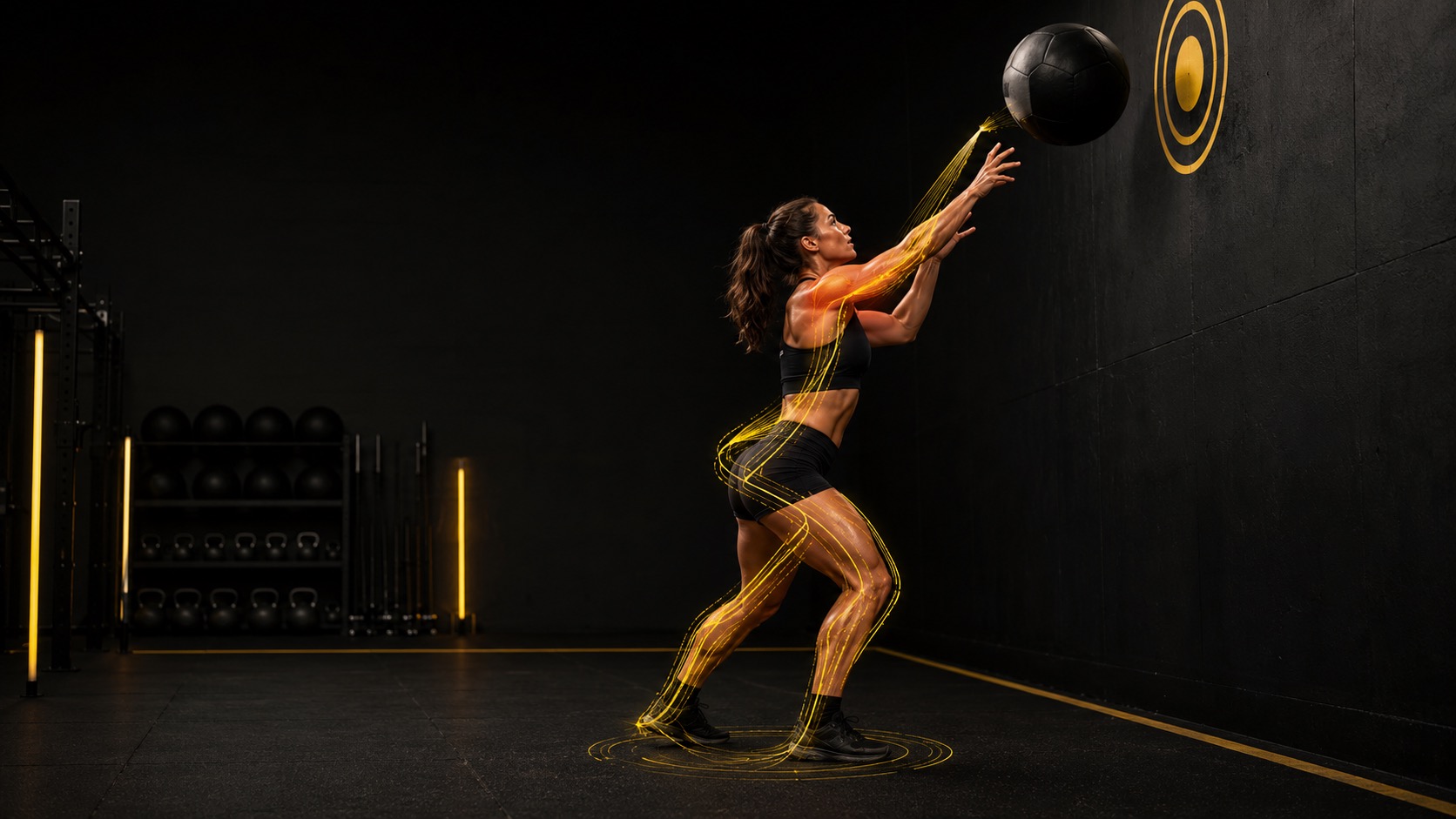
Your shoulders may be where you feel the failure, but they are often not where the failure begins.
You reach the final HYROX station. Your legs are tired, but they are still moving. Then your shoulders and triceps begin to burn, the ball stops reaching the target cleanly, and every catch feels heavier than the last.
It is easy to decide that your arms are simply weak. Sometimes they are underprepared. But very often, the arms are the place where an earlier problem finally becomes visible.
A wall ball is a full-body transfer of force: the floor supports the feet, the ankles, knees, and hips extend, the trunk transfers that force, and the hands guide the ball to the target. When that sequence loses power or timing, the upper body has to finish more of the job.
Why wall balls feel uniquely brutal
In Singles, every athlete completes 100 valid wall balls after the eighth 1-kilometer run. The current 2026/27 standard requires a below-parallel squat and contact with the correct target. The ball is 4 kg for Women Open, 6 kg for Women Pro and Men Open, and 9 kg for Men Pro; target height is 2.70 meters for women and 3.00 meters for men. [HYROX 2026/27 Singles Rulebook]
In Brandt and colleagues' small simulated-race study, the highest heart rate, blood lactate, and perceived exertion values occurred at the wall-ball station. That finding does not tell us which local muscle fails first, but it confirms the obvious race reality: wall balls arrive at the point of greatest accumulated physiological stress. [Brandt et al., 2025]
Science honesty: Direct research measuring local muscle activation and fatigue during HYROX wall balls is still limited. The explanations below combine current HYROX evidence, medicine-ball research, general throwing biomechanics, and applied coaching observation. They are plausible mechanisms to test in the athlete, not diagnoses from one sensation.
1. You are pressing the ball instead of throwing it
When the legs create too little upward momentum, the shoulders and triceps must turn the final part of the repetition into a strict press. You may see the elbows flare, the ball drift far in front of the face, or the release occur before the body has finished standing.
Think: legs launch, hands guide. The arms still work, but they should finish force that started below them rather than create the entire throw.
2. Your timing is leaking force
Wall balls are not a squat followed by a separate shoulder press. They are one connected action. If you pause on the way up, lose trunk stiffness, or throw before the hips and knees contribute, the ball receives less useful momentum and the arms compensate.
The opposite mistake also happens: an athlete stands fully, waits, and then presses. The movement should feel like a smooth acceleration from the bottom of the squat through release.
3. The catch is too far away from your body
A ball caught with extended arms creates a longer lever at the shoulder. You then spend extra energy decelerating it before the next squat even begins. Over dozens of repetitions, that repeated braking cost accumulates.
Receive the ball close to the upper chest or face with soft elbows, then travel into the next squat with it. Do not hold it away from you and do not fight the ball at the top.
4. Your distance from the target is wrong
Too close and the ball may rebound sharply or force you to lean back. Too far away and the throw becomes longer and more horizontal, increasing the work demanded from the arms and making the catch less predictable.
There is no universal toe line for every athlete. Height, limb length, ball behavior, and target setup matter. Find the distance that allows a mostly vertical path, clean target contact, and a return to your normal catch position without stepping.
5. Your squat position is making the upper body work harder
Limited ankle motion, poor hip control, or insufficient squat strength can increase forward trunk lean at the bottom. The athlete then has to redirect the torso and ball before throwing, often creating a late upper-body rescue.
The answer is not to cut the squat high - that becomes a no-rep. Improve the position you need: ankle mobility, hip control, front-loaded squat strength, and comfort below parallel.
6. Grip, breathing, and pacing are amplifying the fatigue
A death grip stiffens the forearms and can spread tension into the shoulders. Breath-holding raises the sense of urgency and makes it harder to settle into a repeatable cadence. An oversized opening set may feel impressive for 20 seconds and then turn the remaining station into survival.
Use enough hand pressure to control the ball, not crush it. Pair the rep rhythm with a breathing pattern you can repeat. Break before technique fails, not after you miss the target twice.
The hidden factor: your arms were working before station eight
Wall balls do not occur in isolation. The shoulders, elbows, forearms, and trunk have already contributed to the SkiErg, sled pull, rowing, farmer's carry, burpee broad jumps, and every running arm swing. The final station exposes the fatigue debt created across the race.
That is why performing 100 easy wall balls while fresh may not solve a race-day problem. The athlete needs both clean technical practice and carefully dosed work under relevant fatigue.
A five-point video check
- At the bottom, are the hips clearly below the knees without the chest collapsing toward the floor?
- Does the ball begin accelerating as the hips and knees drive upward, or only after the athlete is already standing?
- Does the ball travel close to the face and finish over the center of mass, or drift far forward?
- Does the catch return close to the body with soft elbows, or land on nearly straight arms?
- When fatigue begins, which change appears first: shallower depth, slower leg drive, a longer ball arc, breath-holding, or missed targets?
How to fix arm-dominant wall balls
Layer 1: Rebuild the pattern while fresh
Use a lighter ball for 5-6 sets of 5 clean repetitions. Pause long enough to repeat the same depth, timing, path, and catch. This is skill practice, not conditioning.
A useful cue is: smooth down, fast up, soft catch. Keep only the cue that changes the athlete's movement; too many cues create another kind of fatigue.
Layer 2: Build force and power
- Front squat: 3-5 sets of 3-6 repetitions to build force in a front-loaded squat pattern.
- Split squat: 3-4 sets of 6-10 per side for single-leg strength and pelvic control.
- Medicine-ball squat throw: 4 sets of 4-6 explosive repetitions with full recovery. Use a safe open space or appropriate high wall.
- Landmine press or push press: 3-4 sets of 6-10 to support overhead force without relying only on high-repetition wall balls.
Medicine-ball studies using different throw patterns show that throwing performance reflects combined upper- and lower-body power. Those tests are not identical to HYROX wall balls, but they reinforce the value of whole-body force transfer rather than isolated arm strength. [Mayhew et al., 2005]
Layer 3: Build repeatable wall-ball density
Try an 8-10 minute EMOM using a repetition number that leaves approximately 15-20 seconds to breathe and reset. For many athletes that may begin around 8-12 reps, but the correct starting point is the number that preserves legal, repeatable reps.
Progress one variable at a time: slightly more reps, slightly less rest, or the next ball load. Do not increase all three in the same week.
Layer 4: Add controlled race fatigue
Every 7-14 days during the specific phase, use 3-4 rounds of 800 meters of running followed by 15-25 wall balls at race standard. The purpose is to test whether the technique survives the transition, not to create maximum exhaustion.
Record how many valid reps you can perform before the first obvious technical change. That number is more useful for race planning than a fresh unbroken personal best.
Wall-Ball Article: Diagnose Why Your Arms Fail
This table would be extremely useful because athletes can quickly recognize their own pattern.
| What You Notice | Likely Limiter | Technique Focus | Training Drill |
| Arms burn while legs still feel fresh | Insufficient leg drive or pressing too early | Finish the leg drive before completing the throw | Squat-to-toss: 4 × 6–8 |
| Every catch feels heavy | Ball drifts away from the body | Receive close to the face and upper chest | Catch-and-reset: 5 × 5 |
| Ball repeatedly hits below the target | Late release or incomplete extension | Finish tall and direct force vertically | Controlled target throws: 4 × 6 |
| Breathing becomes chaotic | No repeatable breathing rhythm | Exhale on release; inhale during the catch and descent | 10-minute EMOM: 8–10 reps |
| Technique collapses after running | Poor compromised durability or starting too fast | Use planned sets before failure begins | 4 rounds: 400 m run + 15 wall balls |
| Shoulders or wrists become painful | Mobility, position or load problem—not ordinary fatigue | Stop forcing painful repetitions and assess the position | Mobility and technique screen |
Four-layer wall-ball progression
- Skill: 10-minute EMOM × 6–10 perfect repetitions at RPE 5–6
- Force: 4 × 6–8 controlled thrusters plus 4 × 6 explosive medicine-ball throws
- Density: Accumulate 50–75 wall balls using repeatable, pre-planned sets
- Compromised: 4–6 rounds of 400 m running + 15 wall balls at RPE 7–8
A smarter race-day set strategy
Do not choose your wall-ball plan from your ego or from someone else's race. Choose it from your best compromised test.
If 30 clean reps are possible after running but the last five become slow and arm-dominant, opening with 18-22 may protect the rest of the station. Use short, predictable breaks before failure. Keep the ball near the station, take controlled breaths, and begin the next set before the break becomes a full shutdown.
The best set plan is the one that minimizes total time while preserving valid repetitions. An unbroken attempt is not faster if it creates repeated no-reps, long recovery, and missed targets.
Fatigue is not the same as pain
A diffuse muscle burn that settles with rest is different from sharp pain, sudden weakness, numbness, or focal pain in the front of the shoulder, biceps groove, elbow, or neck. Do not treat pain as a technique challenge to push through. Stop, assess the movement, and seek an appropriate health professional when symptoms are persistent or concerning.
The bottom line
When your arms give up first, do not automatically prescribe more shoulder work. First ask why the arms are carrying so much of the repetition.
Improve the leg drive. Connect the timing. Shorten the catch. Find the correct distance. Breathe before panic takes over. Build wall-ball capacity under the fatigue you will actually face.
Your arms are often the endpoint of the problem - not the starting point.
References:
- HYROX Singles Rulebook 2026/27
- Brandt T, Ebel C, Lebahn C, Schmidt A. Acute physiological responses and performance determinants in HYROX. Frontiers in Physiology. 2025.
- Gutierrez-Hellin J et al. Performance Trends and Pacing Evolution in Elite HYROX: A Seven-Season Analysis of Top 50 PRO Men (2018-2024). Applied Sciences. 2026.
- Mayhew JL et al. Comparison of the backward overhead medicine ball throw to power production in college football players. Journal of Strength and Conditioning Research. 2005.