XENOM vs HYROX: Decathlon of Fitness, CrossFit 2.0, or the Next Hybrid Sport?
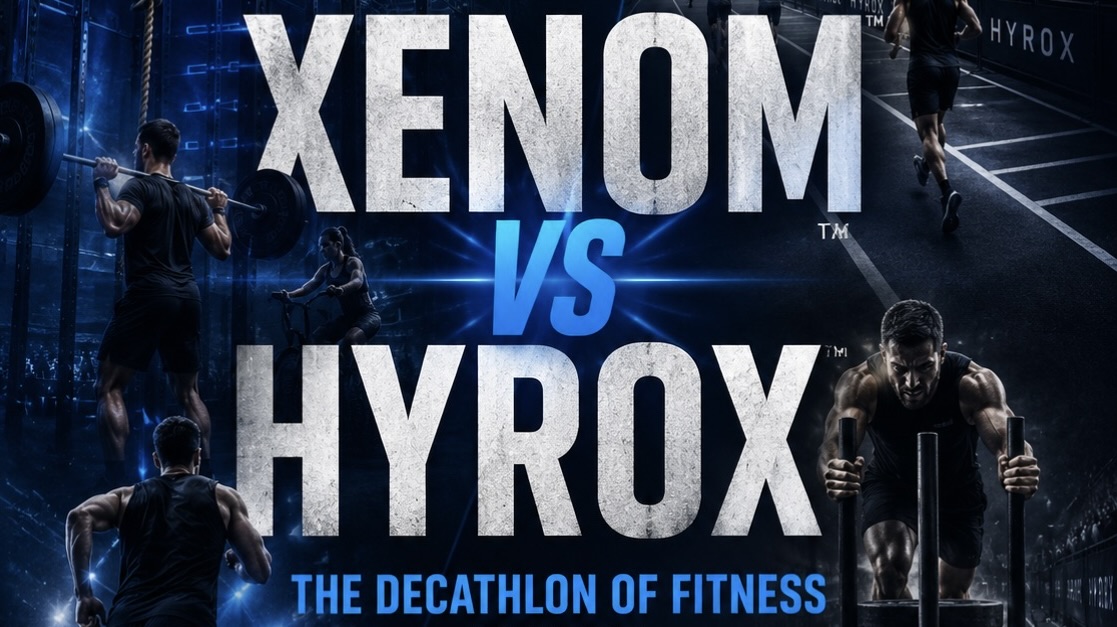
Standardized fitness is having a moment - and for coaches, that is a good thing.
When the test stays the same, training gets smarter. We can periodize toward a known demand, benchmark progress, and compare performances across seasons. HYROX already proved how powerful that model can be. Now XENOM is entering the arena with a different promise: not one continuous finish time, but a multi-event weekend scored like a fitness decathlon.
After our XENOM vs HYROX post sparked a major discussion across the Warrior Performance Lab community, the same questions kept coming up: Is XENOM just CrossFit again? Is a 1RM snatch too technical for mainstream hybrid athletes? Can HYROX athletes transfer successfully? And will standards make or break the sport?
Those questions are exactly why this comparison matters.
Editor's update: Since this article was first published, XENOM has released a clearer 10-event overview across Day 001 and Day 002. We have updated the event list, corrected the Event 006/Event 007 details, added the XENOM scoring discussion, and included the community debate now happening around whether XENOM is CrossFit 2.0 or a new category of hybrid competition.
Quick comparison: XENOM vs HYROX
| Category | HYROX | XENOM | Coach view |
| Format | 8 x 1 km runs plus 8 workout stations in one continuous race. | 10 fixed events across 2 days. | HYROX is a race. XENOM is a multi-event test. |
| Outcome | Fastest finish time wins. | Highest total EPI score/ranking across events. | HYROX rewards time efficiency. XENOM rewards points across broad capacities. |
| Skill barrier | Lower to moderate: simple, repeatable movement patterns. | Higher: Olympic lifting, gymnastics, ergs, running, mixed-modal work. | HYROX is more accessible. XENOM may be more exposing. |
| Primary stress | Compromised running and station efficiency under fatigue. | Strength, skill, power, engine, repeatability, and Day 2 recovery. | Different formats reward different athlete profiles. |
| Big question | How fast can you race under fatigue? | How complete is your athletic profile? | This is why the debate is getting attention. |
What is XENOM?
XENOM describes itself as the "Decathlon of Fitness": a stadium-scale, 2-day competition made up of 10 standardized events and scored through a points-based index called the Elite Performance Index, or EPI.
The official positioning is bold: same events, same scoring, global ranking. That gives athletes something they can train toward year after year, rather than constantly adapting to unknown workouts.
In simple coach language: XENOM is trying to become a repeatable benchmark for complete athletic capacity. Not just your engine. Not just your barbell. Not just your gymnastics. The whole profile.
What is HYROX?
HYROX is the most recognizable standardized fitness race in the world. The format is clean: athletes run 1 km, complete one functional workout station, and repeat that pattern eight times.
The stations are SkiErg, sled push, sled pull, burpee broad jump, row, farmers carry, sandbag lunges, and wall balls. The structure stays consistent across the globe, which is a major reason HYROX has grown so quickly.
That simplicity is HYROX's superpower. Athletes understand the race. Coaches can program for it. Spectators can follow it. Results are easy to compare.
The 10 events of XENOM: updated event list
XENOM now lists 10 fixed events across two competition days. Here is the current event overview from the official XENOM event pages.
Day 001: the first 5 events
| Event | Official event name | Main demand |
| 001 | 1RM Snatch | Max strength, Olympic lifting skill, mobility, speed under pressure. |
| 002 | Ascending Ladder - Wall Walk + Rope Climb AMRAP | Gymnastics capacity, upper-body pulling, shoulder stamina, skill under fatigue. |
| 003 | 60 seconds Max Cal Echo Bike | Anaerobic power, pain tolerance, high-output repeatability. |
| 004 | Barbell Cycling | Strength endurance, barbell efficiency, pacing under load. |
| 005 | 2K Echo Ski + 3K Run | Aerobic engine, pacing, ski-to-run transition, longer mixed output. |
Day 002: the final 5 events
| Event | Official event name | Main demand |
| 006 | T2B + DB Hang Snatch + MU | Core stamina, dumbbell cycling, bar muscle-ups, ring muscle-up capacity. |
| 007 | 5RM Rhino Pull | Heavy pulling strength and posterior-chain power. |
| 008 | AMRAP - Burpees + Echo Ski + Echo Bike | Mixed-modal fatigue, transitions, output management, repeat power. |
| 009 | Heavy Clean Ladder | Barbell strength, clean efficiency, confidence under increasing load. |
| 010 | HSPU + C2B + DB Lunge | Gymnastics pressing/pulling, loaded lunging, shoulder and grip endurance. |
Coach takeaway: this event list explains why the reaction has been so strong. HYROX is built around repeatable race output. XENOM is built around a wider profile: max strength, Olympic lifting, gymnastics, ergs, running, pulling strength, barbell cycling, and recovery across two days.
The real debate: is XENOM just CrossFit?
This has been the loudest reaction so far, and it is a fair question.
XENOM includes movements that immediately remind people of functional fitness: snatches, cleans, wall walks, rope climbs, muscle-ups, handstand push-ups, chest-to-bar pull-ups, dumbbells, ergs, running, and mixed-modal fatigue.
So yes - the movement language looks familiar.
But the better question is not whether XENOM looks like CrossFit. The better question is: what does this format reward?
HYROX rewards repeatable race output: running economy, pacing discipline, station efficiency, and the ability to keep moving under fatigue.
XENOM appears to reward a wider athletic profile: max strength, Olympic lifting skill, gymnastics competency, mixed-modal power, aerobic capacity, pulling strength, and the ability to recover across two competition days.
That distinction matters. HYROX became popular because it is simple, accessible, and easy to understand. XENOM may attract attention because it creates a different challenge: athletes cannot hide as easily behind one dominant strength.
Coach take: CrossFit-style movement language does not automatically mean the same sport. XENOM will separate itself only if the fixed-event format, scoring system, movement standards, judging, and spectator experience are clear enough to create its own identity.
The 1RM snatch debate
The 1RM snatch may be the most controversial XENOM event.
For many HYROX athletes, the appeal of HYROX is that the movements are simple, repeatable, and accessible. You can build your engine, practice your stations, improve your transitions, and race without needing years of Olympic lifting experience.
A 1RM snatch changes the entry point. It adds mobility, speed, technical skill, confidence, and much higher coaching demand. That makes the test less accessible for some athletes - but potentially more revealing if the goal is complete athletic capacity.
That is the tradeoff: HYROX keeps the movement barrier lower and grows the participation base. XENOM raises the athletic barrier and may create a more complete, but less mainstream, test.
Why XENOM scoring matters
The most interesting part of XENOM may not be the events. It may be the scoring.
XENOM uses the Elite Performance Index, or EPI, as a single points-based system across the 10 events. The idea is that your score becomes your global ranking, not just a placement against the athletes who happened to be at the same event on the same weekend.
That changes coaching strategy.
In a placement-only system, your result depends heavily on the field. In an absolute or benchmarked points system, your improvement can be tracked across time, across events, and across competitions. If your snatch improves but your engine drops, the scoring conversation becomes more specific. If your EPI goes up while your placement goes down because the field got stronger, you may still be improving.
This is why coaches should care: a standardized score can expose training tradeoffs.
Movement standards will make or break XENOM
The concept is exciting. But the more complex the test, the more important the standards.
With movements like snatch, wall walks, rope climbs, muscle-ups, handstand push-ups, chest-to-bar pull-ups, dumbbell lunges, and heavy cleans, judging clarity becomes central to the sport.
HYROX has an advantage here. Simpler movements are easier to explain, easier to judge, and easier for spectators to follow. XENOM has a bigger challenge: make complex athletic performance feel standardized, fair, and watchable.
The format will get attention. The standards will decide credibility.
HYROX athlete vs XENOM athlete
A strong HYROX athlete will not automatically dominate XENOM. A strong XENOM athlete will not automatically dominate HYROX.
A HYROX athlete needs running economy, compromised running ability, station efficiency, pacing discipline, and the ability to keep moving when fatigue is high.
A XENOM athlete may need a wider profile: max strength, Olympic lifting skill, gymnastics, pulling strength, mixed-modal power, aerobic capacity, barbell efficiency, and Day 2 recovery.
Neither test is automatically better. They are different. HYROX asks, "How fast can you race under fatigue?" XENOM asks, "How complete are you across multiple athletic domains?"
Which XENOM event would expose you?
This is the most useful self-audit for athletes and coaches.
| If your weakness is... | The XENOM events most likely to expose it |
| Max strength | 1RM Snatch, 5RM Rhino Pull, Heavy Clean Ladder. |
| Skill and gymnastics | Wall Walk + Rope Climb, T2B + Muscle-Up, HSPU + C2B. |
| Engine | 2K Echo Ski + 3K Run, Echo Ski/Bike AMRAP, 60 sec Max Cal Echo Bike. |
| Power and pacing | Barbell Cycling, Echo Bike sprint, Burpee/Ski/Bike AMRAP. |
| Recovery | The full two-day structure: five events on Day 1, five more on Day 2. |
A race can expose your engine. A broader test can expose your entire athletic profile. That is why the XENOM conversation is getting so much traction.
Training implications: how programming should change
If you are coaching HYROX athletes
- Build a large aerobic base and make compromised running non-negotiable.
- Practice station efficiency under fatigue, not just isolated station fitness.
- Use sleds, lunges, wall balls, carries, and ergs in combinations that preserve running mechanics.
- Train transitions and pacing plans until they are boring, repeatable, and automatic.
If you are coaching XENOM athletes
- Build max strength without sacrificing engine work.
- Treat Olympic lifting and gymnastics as skills that need year-round exposure.
- Program mixed-modal fatigue that includes ergs, running, barbell work, and gymnastics.
- Train power outputs on both ends: 60-second maximal work and longer 30-40 minute efforts.
- Prepare for Day 2: recovery between events becomes part of performance, not an afterthought.
So, who wins: HYROX or XENOM?
Wrong question.
HYROX made standardized fitness racing mainstream. It is simple, repeatable, globally comparable, and accessible enough for everyday athletes while still being brutal at the elite level.
XENOM is aiming at a different lane: a fixed-event, decathlon-style test of broader athletic capacity. It may not attract the exact same athlete for the exact same reason. And that is what makes it interesting.
HYROX rewards the athlete who can race fast under fatigue. XENOM may reward the athlete with fewer holes across strength, skill, power, engine, and recovery.
For coaches, this is a gift. Different formats create different training problems. Different training problems create smarter athletes.
Join the debate
This article update came directly from the community reaction to our XENOM vs HYROX post. The biggest questions athletes are asking right now:
- Is XENOM just CrossFit with a new name?
- Will the 1RM snatch make XENOM too technical for mainstream hybrid athletes?
- Can HYROX athletes transfer successfully to XENOM?
- Will movement standards make or break the sport?
- Which XENOM event would expose the most athletes?
See what athletes are saying in the Warrior Performance Lab Facebook discussion.
Also see the Instagram post and carousel discussion here.
XENOM does not need to replace HYROX to matter. It only needs to create a clear, credible, repeatable test that athletes want to prepare for.
The attention is already there. The next question is execution: standards, scoring, judging, athlete experience, and whether the sport can be easy enough to understand while still being broad enough to test complete athletic capacity.
That is why coaches should keep watching.
If you are a HYROX or hybrid athlete, use this conversation as a self-audit. Are you strong enough? Skilled enough? Durable enough? Fast enough? And most importantly - where is the weak link that would show up first?
FAQ
Is XENOM just CrossFit?
Not exactly, but the comparison is understandable. XENOM uses functional fitness movements such as Olympic lifting, gymnastics, ergs, running, and mixed-modal conditioning. The difference is that XENOM is positioning itself around 10 fixed events, 2 days, and one EPI score rather than constantly varied competition programming.
How is XENOM different from HYROX?
HYROX is a continuous race built around 8 x 1 km runs and 8 workout stations, with the fastest finish time winning. XENOM is a two-day, 10-event competition scored through a points-based index, so it rewards a broader athletic profile.
What is the XENOM EPI score?
EPI stands for Elite Performance Index. It is XENOM's points-based scoring system that combines results across all 10 events into one score and ranking.
Why is the 1RM snatch controversial in XENOM?
A 1RM snatch raises the skill barrier. It requires mobility, speed, coordination, Olympic lifting technique, and confidence under pressure. That may make XENOM less accessible for some HYROX athletes, but more revealing as a complete athletic test.
Can HYROX athletes do well in XENOM?
Some can, especially if they already have strength, Olympic lifting, and gymnastics capacity. HYROX athletes may bring a strong engine and pacing discipline, but XENOM may expose gaps in max strength, technical skill, gymnastics, and recovery across two days.
Which XENOM event would expose athletes most?
It depends on the athlete. Strength athletes may struggle with the engine events. Endurance athletes may struggle with the snatch, clean ladder, and Rhino Pull. Athletes without gymnastics capacity may be exposed by wall walks, rope climbs, muscle-ups, HSPU, and C2B.
References and official sources
XENOM - Elite Performance Index / Scoring
Warrior Performance Lab - Facebook discussion post
Warrior Performance Lab - Instagram discussion post
Disclaimer: This article is for educational purposes only. CrossFit, HYROX, Rogue, and XENOM are trademarks of their respective owners. Warrior Performance Lab is not affiliated with or endorsed by these brands unless otherwise stated.