Berlin HYROX Pro Men Analysis
Berlin HYROX Pro Men - podium analysis through a coaching lens
Do not just train harder. Test the athlete. Train the limiter. Analyze the result. Then repeat with better precision.
RACE PROFILE
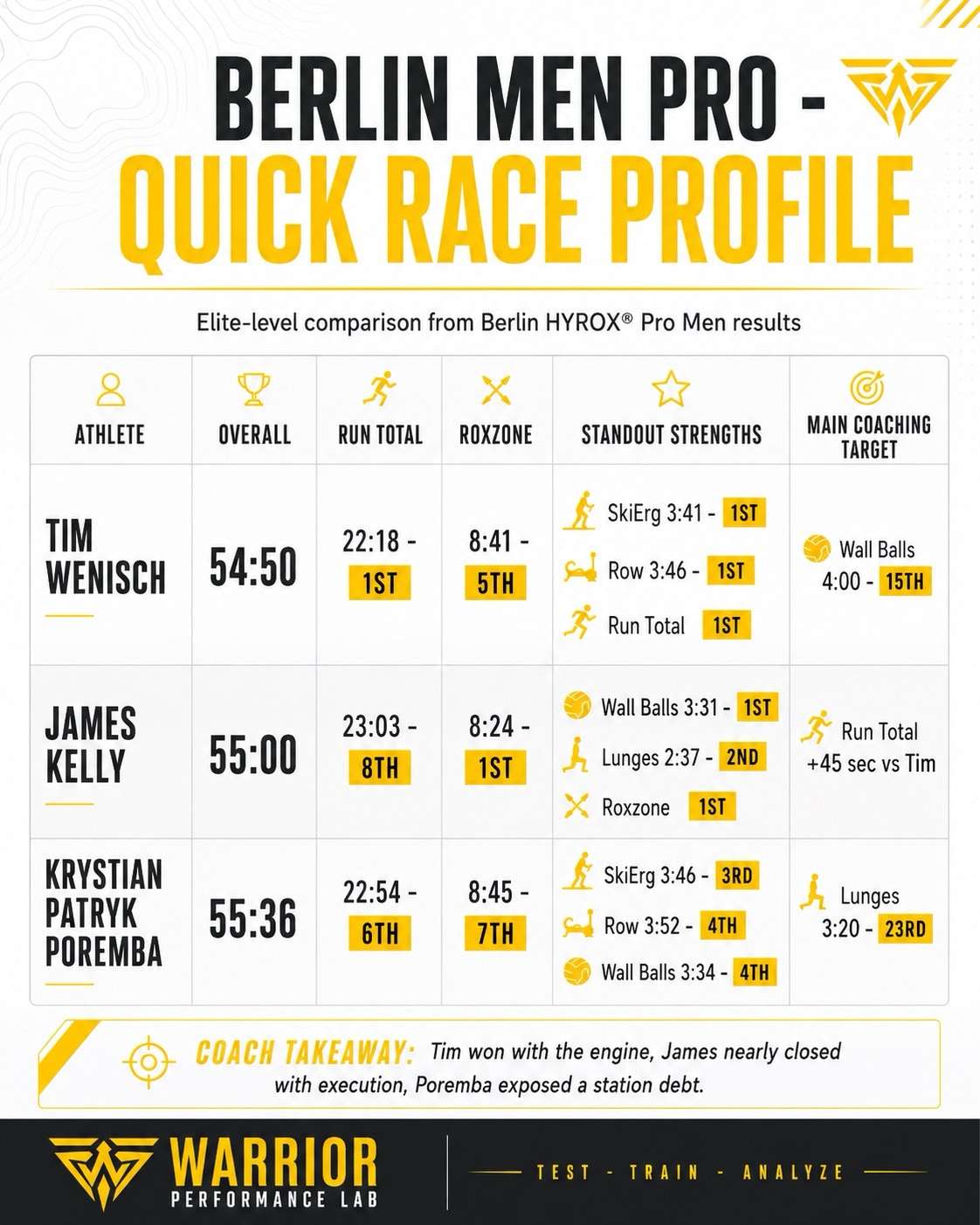
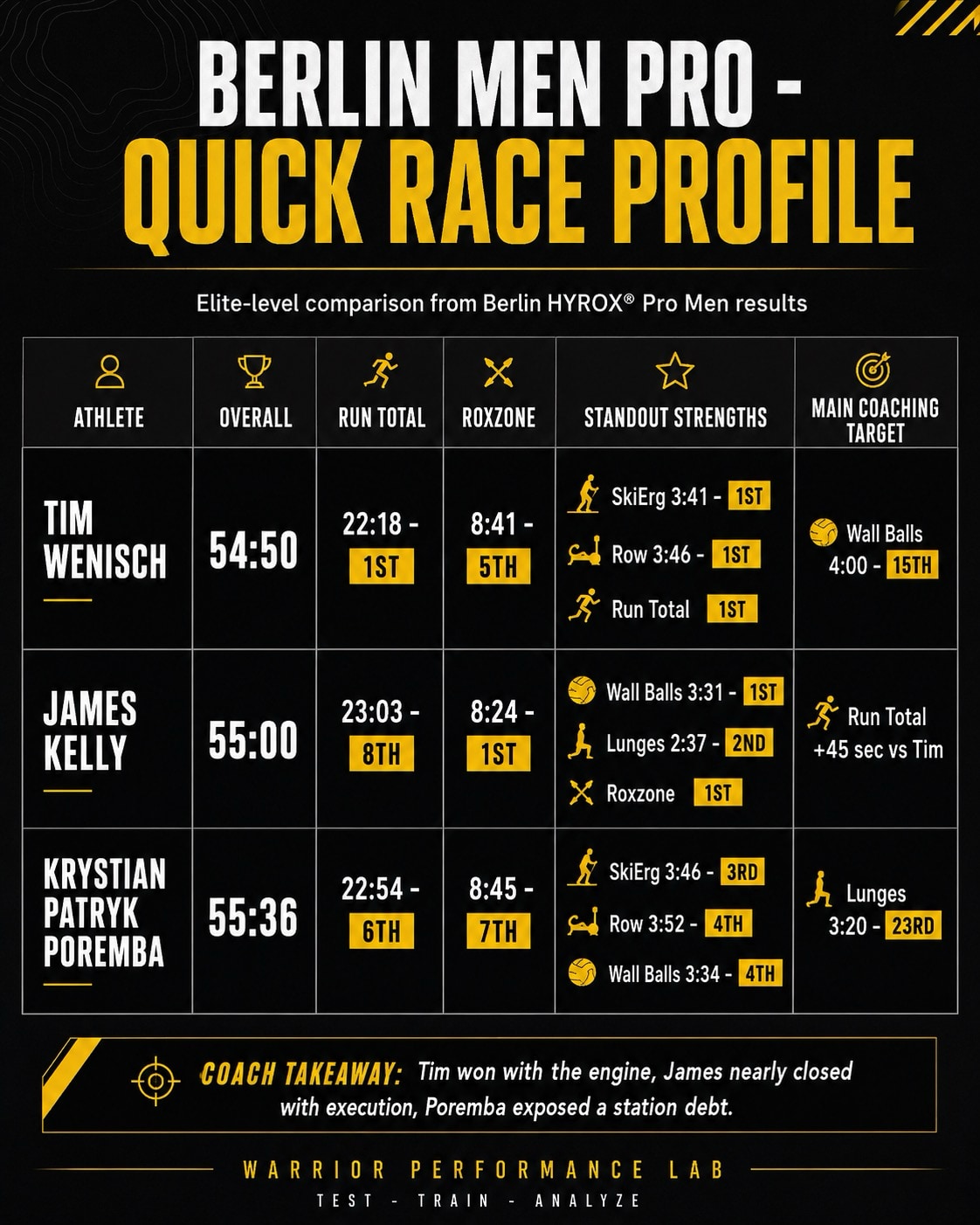
| Athlete | Overall | Run Total | Roxzone | Standout strengths | Main coaching target |
| Tim Wenisch | 54:50 Rank 1 | 22:18 Rank 1 | 8:41 Rank 5 | SkiErg rank 1; Row rank 1; Run Total rank 1 | Wall Balls ranked 15th - improve closing output without sacrificing engine |
| James Kelly | 55:00 Rank 2 | 23:03 Rank 8 | 8:24 Rank 1 | Wall Balls rank 1; Lunges rank 2; Roxzone rank 1 | Run Total gap vs Tim was 45 seconds; improve run economy while protecting execution |
| Krystian Patryk Poremba | 55:36 Rank 3 | 22:54 Rank 6 | 8:45 Rank 7 | SkiErg rank 3; Row rank 4; Wall Balls rank 4 | Sandbag Lunges ranked 23rd - highest-value station debt |
Top-three station comparison
| Station | Tim Wenisch | James Kelly | Poremba | Coaching read |
| 1000m SkiErg | 3:41 (1st) | 3:51 (10th) | 3:46 (3rd) | Tim created early machine separation. |
| 50m Sled Push | 2:16 (5th) | 2:23 (9th) | 2:19 (6th) | All three stayed competitive; no podium-deciding leak here. |
| 50m Sled Pull | 3:20 (8th) | 3:12 (4th) | 3:26 (12th) | James gained useful time through station execution. |
| 80m Burpee Broad Jump | 2:29 (12th) | 2:35 (18th) | 2:15 (9th) | Poremba had the fastest podium BBJ split. |
| 1000m Row | 3:46 (1st) | 3:54 (6th) | 3:52 (4th) | Tim reinforced the engine profile after mid-race fatigue. |
| 200m Farmers Carry | 1:31 (11th) | 1:35 (22nd) | 1:29 (6th) | James had a rank debt here, but compensated later. |
| 100m Sandbag Lunges | 2:51 (4th) | 2:37 (2nd) | 3:20 (23rd) | This was Poremba's biggest visible station debt. |
| Wall Balls | 4:00 (15th) | 3:31 (1st) | 3:34 (4th) | James closed strongest; Tim won despite this limiter. |
| Run Total | 22:18 (1st) | 23:03 (8th) | 22:54 (6th) | Tim won through the engine and protected the race lead. |
Key deltas against the winner
| Metric | Tim Wenisch | James Kelly vs Tim | Poremba vs Tim |
| Overall time | 54:50 | +0:10 | +0:46 |
| Run Total | 22:18 | +0:45 | +0:36 |
| Roxzone | 8:41 | -0:17 | +0:04 |
| Sandbag Lunges | 2:51 | -0:14 | +0:29 |
| Wall Balls | 4:00 | -0:29 | -0:26 |
| Best run lap | 2:34 | +0:02 | +0:06 |
The big coaching insight
Tim won the race through the engine. Run Total, SkiErg, and Row gave him enough separation to absorb a weaker Wall Ball finish.
James almost won through execution. He was 45 seconds slower than Tim on Run Total, but clawed time back through Roxzone, Lunges, and Wall Balls. That shows that race craft is not a bonus skill. It is a performance category.
Poremba shows how one station can swing the result. He was 46 seconds off the win, and his Lunges were 43 seconds slower than James. That does not mean the whole program is broken. It means the next block needs a precise intervention.
Berlin Men Pro Case Study - Race Data to Training Plan
The Missing Link in HYROX Coaching: What Berlin Men Pro Taught Us
The Berlin HYROX Pro Men race gave coaches and athletes a perfect reminder: the final leaderboard only tells us who won. The splits tell us why.
Tim Wenisch won in 54:50. James Kelly finished ten seconds behind in 55:00. Krystian Patryk Poremba rounded out the podium in 55:36. On paper, that looks like a simple podium. But when we break the race down station by station, it becomes a coaching case study.
The most important lesson is this: elite HYROX athletes do not all win the same way.
Tim's win was built on race-speed control. His Run Total was the fastest in the field, and he also ranked first on SkiErg and Row. That combination gave him a powerful platform. He did not need to dominate every station because his running and machine work created enough separation to hold the race.
But that does not mean his race was perfect. His Wall Balls ranked 15th. That is the kind of detail coaches need to pay attention to. A win can hide a limiter. If the only review is "he won, everything worked," the next training block misses the opportunity to sharpen the weakest part of the winning profile.
James Kelly's race tells a different story. He was not the fastest runner in the top three. His Run Total ranked eighth. But he was first in Roxzone, first in Wall Balls, and second in Sandbag Lunges. That is not random. That is execution. That is transition quality, station setup, breathing control, and closing strength under fatigue.
James almost overcame a large run deficit through the parts of the race many athletes under-train: Roxzone efficiency, station setup, breathing control, and closing strength. For coaches, that matters. Roxzone should not be treated as in-between time. It is a station. It is a repeatable skill. It can win or lose a race.
Poremba's race shows the other side of performance analysis. He had a strong podium result and several impressive splits, including a top-four Row and Wall Balls performance. But his Sandbag Lunges ranked 23rd. In a race decided by seconds, that one station became a major performance debt.
This is where the coaching philosophy becomes clear: Test. Train. Analyze.
Testing gives us the data. Training creates the intervention. Analysis tells us whether the intervention worked.
Most athletes train. Some athletes test. Very few complete the loop properly.
The missing link is the loop.
A coach should be able to look at a race result and create a specific plan. Not a generic plan. Not a harder plan. A more precise plan.
For Tim's profile, the goal is not to sacrifice the run engine chasing Wall Balls. The goal is to maintain the running and machine advantage while improving Wall Ball output under late-race fatigue.
For James' profile, the goal is not to change the thing that made him dangerous. His Roxzone, Lunges, and Wall Balls were elite. The next step is to bring the Run Total closer to the leaders without losing the execution quality that nearly won him the race.
For Poremba's profile, the priority is obvious: late-race lunge capacity. Not just lunges in isolation. Lunges after running. Lunges after grip fatigue. Lunges when breathing is compromised. Lunges when the athlete still has to run again and finish with Wall Balls.
That is the difference between training movements and training the race.
The best coaches are not just writing sessions. They are reading evidence. Every split is feedback. Every rank is a clue. Every station tells us whether the athlete needs more speed, more strength, more efficiency, more composure, or better recovery between efforts.
The takeaway from Berlin is simple: the podium is not built by guessing. It is built by testing, training, analyzing, and repeating.
Better data creates better decisions. Better decisions create better athletes.
What Coaches and Athletes Should Take Away
Actionable observations
A win can still expose a limiter
Insight: Tim won the race, but Wall Balls ranked 15th. That is not criticism. That is useful information. The coach's job is to protect the winning strengths while closing the obvious leak.
Coaching action: Keep the run and erg/row work at maintenance-plus quality. Add late-race Wall Ball exposure two times per week, but do not let it compromise the engine that won the race.
Roxzone is not dead time
Insight: James ranked first in Roxzone. That was a major reason he was within ten seconds of the win despite a slower Run Total.
Coaching action: Add Roxzone efficiency drills. Time entry, setup, station start, station finish, and exit. Athletes should know their transition habits the same way they know their run pace.
One station can be the race
Insight: Poremba's lunge split was the biggest visible performance debt. He did many things well, but one late-race station created a major gap.
Coaching action: Do not train every weakness equally. Identify the one weakness with the biggest race-time cost and give it a focused four-week block.
Run speed still matters
Insight: James' execution was excellent, but Tim's run advantage was too large to fully overcome. In HYROX, station skill is essential, but the race is still heavily shaped by running.
Coaching action: Track Run Total, not just individual station performance. Athletes should know whether they are losing because of engine, station strength, Roxzone, or late-race collapse.
Analyze the profile, not just the placement
Insight: A second-place finish can have a better station profile than a winner. A first-place finish can still have a glaring limiter. A third-place finish may only need one surgical correction.
Coaching action: After every race, create a split debt table and select one primary limiter, one secondary limiter, and one strength to maintain.
What questions to ask?
- What was the athlete's overall rank and where did the station ranks fall below that standard?
- Which split created the largest time debt compared with the winner, the podium, or the athlete's target?
- Did the run pace fade after sleds, after lunges, or before Wall Balls?
- Did Roxzone support the race result or quietly damage it?
- Which limiter deserves the next four-week block, and which strengths must be protected?
The Split Debt System
A repeatable post-race framework for coaches
The Split Debt System is a simple way to move from race result to training decision. It prevents coaches from chasing every weakness at once and keeps the next block focused on the highest-value limiter.
| Framework step | How to use it |
| Step 1 - Test | Collect overall time, overall rank, run total, best run lap, each station split and rank, Roxzone time and rank, plus no-reps, breaks, setup errors, grip failure, and breathing failure. |
| Step 2 - Analyze | Create three scores: Time Debt, Rank Debt, and Fatigue Debt. |
| Step 3 - Train | Choose one primary limiter, one secondary limiter, and one strength to maintain. Do not chase eight problems at once. |
| Step 4 - Re-test | Every two to four weeks, re-test the limiter under race-like fatigue. The question is not whether the athlete worked hard. The question is whether the target split improved without damaging the rest of the race. |
Three scores to calculate
| Score | Definition | Example from Berlin |
| Time Debt | How many seconds slower is this split than the athlete's target, the winner, the podium benchmark, or the station leader? | Poremba's Lunges were 43 seconds slower than James. |
| Rank Debt | How far is this station rank from the athlete's overall rank? | Tim finished 1st overall but ranked 15th on Wall Balls. |
| Fatigue Debt | How much performance drops after the middle of the race or after a specific load? | Watch the run after Lunges and the final Wall Ball split. |
Split debt examples from the podium
| Athlete | Overall rank | Visible debt | Coaching interpretation |
| Tim Wenisch | 1st | Wall Balls rank 15 | A winning profile can still carry a closing limiter. Maintain the engine; sharpen the finish. |
| James Kelly | 2nd | Run Total rank 8; Farmers Carry rank 22 | Execution nearly overcame the run gap. Improve run economy without losing station sharpness. |
| Krystian Patryk Poremba | 3rd | Sandbag Lunges rank 23 | One late station created the major visible performance leak. Build a focused lunge block. |
Athlete-Specific Action Plans
How the data turns into training decisions
Tim Wenisch profile: protect the engine, sharpen the close
Strengths to preserve: Run Total, SkiErg, Row. Primary target: Wall Balls under fatigue. Training focus: late-race breathing, squat endurance, shoulder endurance, and wall ball rhythm.
Session idea
- 3 rounds: 800m run at race effort + 30 Wall Balls; rest 90 seconds.
- Then finish with 100 Wall Balls for time.
- Track total time, breaks, no-reps, breathing control, and final 25 reps.
James Kelly profile: keep execution, improve run economy
Strengths to preserve: Roxzone, Lunges, Wall Balls. Primary target: Run Total. Training focus: controlled race-pace running without losing station quality.
Session idea
- 6 x 1km at target HYROX race pace.
- After reps 2, 4, and 6, add one station primer: 20 Wall Balls, 20m Sled Push, or 20 Burpee Broad Jumps.
- Track run split drift. Goal: keep final reps within 10-15 seconds of early reps.
Krystian Poremba profile: fix the lunge debt
Strengths to preserve: SkiErg, Row, Wall Balls. Primary target: Sandbag Lunges under fatigue. Training focus: trunk stiffness, breathing under load, stride consistency, and quad endurance.
Session idea
- 4 rounds: 600m run + 25m Sandbag Lunges; rest 60-90 seconds.
- Then finish with 100m Sandbag Lunges for time immediately into 50 Wall Balls.
- Track lunge time, stops, step consistency, and wall ball quality after lunges.
Four-Week Missing Link Training Block
Use one primary limiter, one secondary limiter, and one strength to maintain
| Week | Primary goal | Coach execution |
| Week 1 | Test and identify the limiter | Run a controlled benchmark, not a full race every time. Use 1km run + station segments + fatigue checkpoints. Track biggest time debt and biggest breakdown point. |
| Week 2 | Train the limiter | Two key sessions only. One isolates the limiter. One places it under fatigue. Example: if lunges are the limiter, use controlled lunge mechanics plus run -> lunges -> wall balls. |
| Week 3 | Race-specific compression | Make the work look more like HYROX. Use shorter recoveries, Roxzone practice, transitions, grip fatigue, and breathing fatigue. |
| Week 4 | Re-test and analyze | Repeat the original test. Ask: Did the target split improve? Did run pace stay stable? Did another station get worse? Did Roxzone improve or drift? |
Benchmark example
- 1km run
- Sled push segment
- 1km run
- Sled pull segment
- 1km run
- Sandbag Lunges
- 1km run
- Wall Balls
Weekly structure example
| Day | Focus | Purpose |
| Day 1 | Run quality | Threshold or race-pace intervals. |
| Day 2 | Station strength and skill | Sled, lunges, wall balls, or the athlete's primary limiter. |
| Day 3 | Easy aerobic + mobility | Keep the engine fresh and maintain recoverability. |
| Day 4 | Compromised running | Run intervals with station interference. |
| Day 5 | Strength endurance | Posterior chain, trunk, grip, loaded movement. |
| Day 6 | HYROX-specific simulation | Shorter than a full race, but specific enough to test decisions. |
| Day 7 | Rest or very easy recovery | Protect adaptation. |
Programming principle
The key is not more volume. The key is better feedback.
Source
This analysis is intended as a coaching interpretation and content asset, not an official HYROX publication.
More data & research studies available in the Warrior Performance Lab Research Library. Also check out the Warrior Lab app.