HYROX Pacing Strategies: How to Master Race Flow and Finish Strong
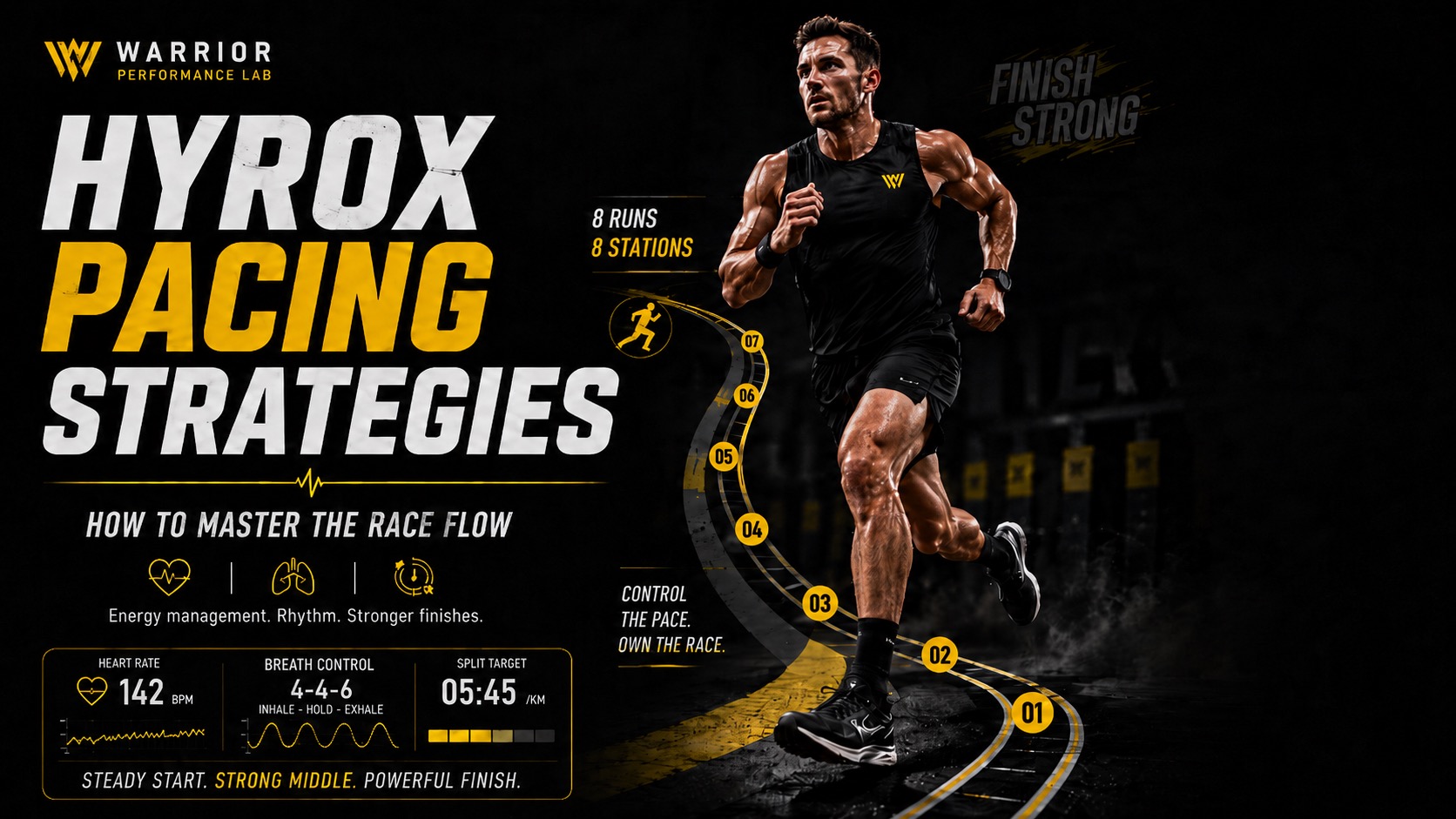
Master the Art of Energy Management for Stronger Training and Efficient Racing
Understanding your Pacing you can help you hit your personal best!
HYROX pacing is not about holding back because you are afraid to work hard. It is about spending your effort where it actually buys you time.
That distinction matters because HYROX is not a normal running race and it is not a random conditioning workout. The official format is simple on paper: run 1 km, complete one functional workout station, and repeat that sequence eight times. But simple does not mean easy. The race asks you to control speed, breathing, muscle fatigue, grip, transitions, and decision-making while your body keeps receiving a new kind of stress every few minutes.
This is why pacing is one of the biggest separators in HYROX. You do not win the race in the first run, the first SkiErg, or the first sled lane. But you can absolutely lose your race there.
Core idea: The athlete who can repeat smart outputs under fatigue will almost always beat the athlete who only knows how to start fast.
What HYROX pacing really means
Most athletes hear pacing and immediately think about 1 km run speed. That is part of it, but HYROX pacing is bigger than your watch pace. It is the complete rhythm of the race.
- Run pacing: how fast you move between stations without destroying your station quality.
- Station pacing: how you break up reps, manage cadence, and avoid unnecessary spikes.
- Transition pacing: how quickly you move through the Roxzone while still entering the next task composed.
- Breathing pacing: how well you control exhale rhythm and panic breathing.
- Mental pacing: how you prevent emotion, adrenaline, and comparison from hijacking the plan.
A recent Frontiers in Physiology study on simulated HYROX found that participants spent more total time running than performing stations, while stations produced higher peak physiological stress. In that study, faster completion was associated with higher VO2max and greater endurance training volume, and the hardest perceptual stress appeared late in the race, especially around wall balls. That is the pacing lesson in one sentence: HYROX is endurance-dominant, but station stress is what changes the way you run.
The HYROX race-flow map
Instead of thinking about HYROX as eight separate workouts, think of it as four connected phases. Each phase asks for a different decision.
| Race phase | Where it happens | Main pacing job |
| Phase 1: Control | Run 1 + SkiErg | Stay calm, establish rhythm, avoid early oxygen debt. |
| Phase 2: Absorb the shock | Sled Push + Sled Pull | Move heavy loads without redlining your legs, trunk, and grip. |
| Phase 3: Find repeatability | Burpee Broad Jumps + Row + Farmers Carry | Settle into repeatable cadence and protect posture. |
| Phase 4: Decide | Sandbag Lunges + Wall Balls | Use the energy you saved, but keep rep quality high. |
Phase 1: Control before the race controls you
The first run is where many athletes accidentally write the ending of their race. The room is loud. Everyone is fresh. Your watch may show a pace that feels easy because adrenaline is doing half the work. That is exactly why the first run should feel slightly too controlled.
A smart opening goal is not to prove fitness. It is to arrive at the SkiErg with your breathing organized, shoulders relaxed, and mind clear. If you are already fighting for air in the first few minutes, your body will keep charging interest for the rest of the race.
Phase 2: Respect the sleds
The sled push and sled pull are not just strength stations. They are pacing traps. They can spike local muscular fatigue, trunk tension, and breathing demand in a way that changes your next run immediately. This is where many strong athletes get punished, because strength makes it tempting to attack too hard.
Your goal is to move the sleds with intent, not panic. Break the lane into chunks if needed. Use short resets before form collapses. A five-second reset can be faster than thirty seconds of survival breathing after you cooked your legs.
Phase 3: Make the middle boring
The middle of HYROX is where rhythm matters. Burpee broad jumps, rowing, and farmers carry reward athletes who can repeat simple, efficient movement. This is not the glamorous part of the race, and that is the point. The less dramatic your middle race looks, the more dangerous you become later.
Phase 4: Finish with the plan, not emotion
By sandbag lunges and wall balls, everybody is tired. Your goal is not to magically feel fresh. Your goal is to be tired with structure. That means your lunge steps still look like lunges, your wall ball sets are planned, and your breathing is still connected to movement.
Use RPE as your pacing language
Heart rate is useful, but HYROX creates lag and spikes. Your heart rate may not tell the whole story when you are switching from running to sleds to wall balls. RPE gives you a practical language for what your body is experiencing right now. Research on session-RPE supports it as a simple way to monitor internal training load across different forms of exercise.
| Race segment | Target feel | Coaching cue |
| First 2 runs + SkiErg | RPE 6-7 | Smooth enough that you could say a short phrase. |
| Sled Push + Pull | RPE 8, controlled | Hard work, but no panic breathing and no form collapse. |
| Runs 4-6 | RPE 7-8 | Repeatable pace; do not chase one fast split if it ruins the next station. |
| Farmers + Lunges | RPE 8-9 | Stay tall, stay rhythmic, protect grip and trunk. |
| Wall Balls + finish | RPE 9-10 | Empty the tank with planned sets and clean reps. |
Station-by-station pacing cues
You do not need a complicated race plan. You need simple cues you can still remember when your legs are loud.
- SkiErg: Settle before you attack. Keep the first 250 m smooth, then hold your planned split. Avoid turning the opening station into a max-effort pull test.
- Sled Push: Drive with short, strong steps. Keep your torso organized. If speed drops hard, take a short reset before mechanics become messy.
- Sled Pull: Use the whole body, not just the arms. Step, brace, pull, breathe. Keep the rope organized so you are not wasting time untangling fatigue.
- Burpee Broad Jumps: Choose a cadence you can repeat. The winning move is not the biggest jump; it is the rhythm that prevents long standing breaks.
- Row: Do not revenge-row because the burpees hurt. Find a strong but controlled split and use the row to rebuild breathing rhythm.
- Farmers Carry: Grip before you lift, stand tall, and move. Plan whether you are going unbroken or using one fast break before your grip forces three slow ones.
- Sandbag Lunges: Small posture leaks become expensive. Keep the ribs down, steps consistent, and breathing matched to the step pattern.
- Wall Balls: Use planned sets. Make your rest short and deliberate. No wandering. No negotiating with the ball.
Transitions: the invisible station
The Roxzone is not free time. It is also not a place to sprint blindly. Think of every transition as a three-part reset: breathe, locate, commit.
- Breathe: Use two or three intentional exhales as you leave the station.
- Locate: Know where you are going before race day. Confusion is expensive.
- Commit: As soon as you enter the next run or station, lock into the first cue. Smooth first, then faster.
How to train pacing so it shows up on race day
Pacing is not a motivational quote. It is a skill. You train it by practicing repeatable outputs, recording your splits, and learning what different efforts feel like before race day.
1. Build your 1 km pacing library
Test several kinds of 1 km efforts: easy, controlled tempo, hard but repeatable, and post-station. Your goal is to know the difference between a pace you can run fresh and a pace you can still use after sleds, burpees, and lunges.
2. Practice compromised running
A fresh 1 km is not the same as a HYROX 1 km. Use combinations such as 500 m SkiErg + 800 m run, sled push + 600 m run, or 20 wall balls + 400 m run. Track how much your pace changes and how quickly your breathing comes back under control.
3. Use negative-split finishers
Teach your body to close well. For example, after a strength-endurance circuit, run 3 x 600 m where each rep gets slightly faster while form stays clean. This develops restraint early and confidence late.
4. Rehearse your station breaks
Do not wait until race day to discover whether 100 wall balls should be 5 x 20, 10 x 10, or a different strategy. Practice your sets under fatigue and choose the plan that minimizes total time, not the plan that looks toughest on Instagram.
Sample pacing sessions
| Session | How to do it | Purpose |
| Controlled opening practice | 4 rounds: 1 km run at controlled pace + 250 m SkiErg. Rest 90 sec. | Teaches patience and breathing control early. |
| Sled-to-run tolerance | 4-6 rounds: sled push 12.5-25 m + 500 m run. Rest 2 min. | Shows how much sled fatigue changes running mechanics. |
| Middle-race rhythm | 3 rounds: 20 burpee broad jumps + 750 m run + 500 m row. | Builds repeatable cadence through the messy middle. |
| Wall ball close | After a run session: 60-100 wall balls in planned sets. | Practices finishing structure under fatigue. |
The most common HYROX pacing mistakes
- Starting the first run at fresh 5K pace instead of HYROX race pace.
- Treating sleds like a strength test instead of a race segment.
- Letting burpee broad jumps become random instead of rhythmic.
- Rowing too hard because the monitor gives instant feedback.
- Ignoring transitions until race day.
- Planning wall balls only around maximum unbroken reps instead of fastest total completion.
- Using only heart rate and never learning RPE or breathing cues.
Want to stop guessing your HYROX pacing?
The HYROX® Compromised Running 12 Week Program is built to improve your ability to run under fatigue with structured running, strength work, station-specific training, and race simulations. It is a strong next step if your running falls apart after sleds, lunges, or wall balls.
View the HYROX® Compromised Running 12 Week Program
Book a HYROX® Game Plan Session
In the end;
Pacing is not weakness. Pacing is control. In HYROX, control is speed that survives fatigue. Master your opening rhythm. Respect the sleds. Make the middle repeatable. Enter wall balls with a plan. That is how you finish like a warrior.
More Questions?
What is the best pacing strategy for HYROX?
The best strategy is usually controlled early effort, repeatable middle-race rhythm, and a planned push only after the hardest fatigue sources have already been managed. Your exact splits should come from testing, but the principle stays the same: do not win the first ten minutes and lose the last twenty.
Should I run every 1 km at the same pace?
Not always. Even pacing is useful, but HYROX is not fresh running. Sleds, burpees, lunges, and wall balls change your mechanics and breathing. Many athletes do better with a controlled first half, stable middle, and a progressive finish if form is still holding.
How hard should the first HYROX run feel?
The first run should feel almost too controlled. Think RPE 6-7, not a 1 km time trial. The goal is to arrive at the SkiErg calm enough to establish rhythm instead of starting the race already in oxygen debt.
How do I pace wall balls at the end?
Plan your sets before race day. For example, 10 x 10, 5 x 20, or descending sets can all work depending on your capacity. The mistake is trying to go unbroken only because the finish line is close, then standing with your hands on your knees for longer than the planned breaks would have taken.
How often should I practice full HYROX race simulations?
Most athletes do not need full simulations every week. Mini-simulations and station-run combinations are usually more sustainable. Full or near-full simulations are best used selectively so you can rehearse race flow without burying recovery.
References & Further Learning
1. HYROX. The Fitness Race: official race format, stations, divisions, weights, distances, and repetitions. HYROX official race format
2. Brandt, T. B., Ebel, C. E., Lebahn, C. L., & Schmidt, A. (2025). Acute physiological responses and performance determinants in Hyrox - a new running-focused high intensity functional fitness trend. Frontiers in Physiology, 16, 1519240. Frontiers article
3. Tucker, R., & Noakes, T. D. (2009). The physiological regulation of pacing strategy during exercise: a critical review. British Journal of Sports Medicine, 43, e1. PubMed record
4. Foster, C., et al. (2001). A new approach to monitoring exercise training. Journal of Strength and Conditioning Research, 15(1), 109-115. PubMed record
5. Haddad, M., et al. (2017). Session-RPE method for training load monitoring: validity, ecological usefulness, and influencing factors. Frontiers in Neuroscience, 11, 612. Frontiers article
6. Stöggl, T. L., & Sperlich, B. (2015). The training intensity distribution among well-trained and elite endurance athletes. Frontiers in Physiology, 6, 295. Frontiers article
7. Llanos-Lagos, C., Ramirez-Campillo, R., Moran, J., & Sáez de Villarreal, E. (2024). Effect of strength training programs in middle- and long-distance runners economy at different running speeds: a systematic review with meta-analysis. Sports Medicine, 54, 895-932. PubMed record