SkiErg vs RowErg for HYROX
An Erg Intelligence guide to technique pacing and race transfer
A fast erg split catches my attention. What happens in the next kilometer tells me much more.
You can finish 1,000 meters feeling powerful and still spend the next run trying to recover. You can also move at a slightly more controlled pace, step off with your rhythm intact, and produce a better total race. That is why I look beyond the number on the monitor.
For HYROX, I want to know how you created the speed, whether you can repeat it under fatigue, and what it leaves available for the work ahead. This is the perspective behind WPL Erg Intelligence.
Both the SkiErg and RowErg reward coordinated movement and sensible pacing. Each needs its own setup, benchmarks, and training attention. Being strong on one does not tell us exactly what you can sustain on the other.
Two machines with different demands
| What matters | SkiErg | RowErg |
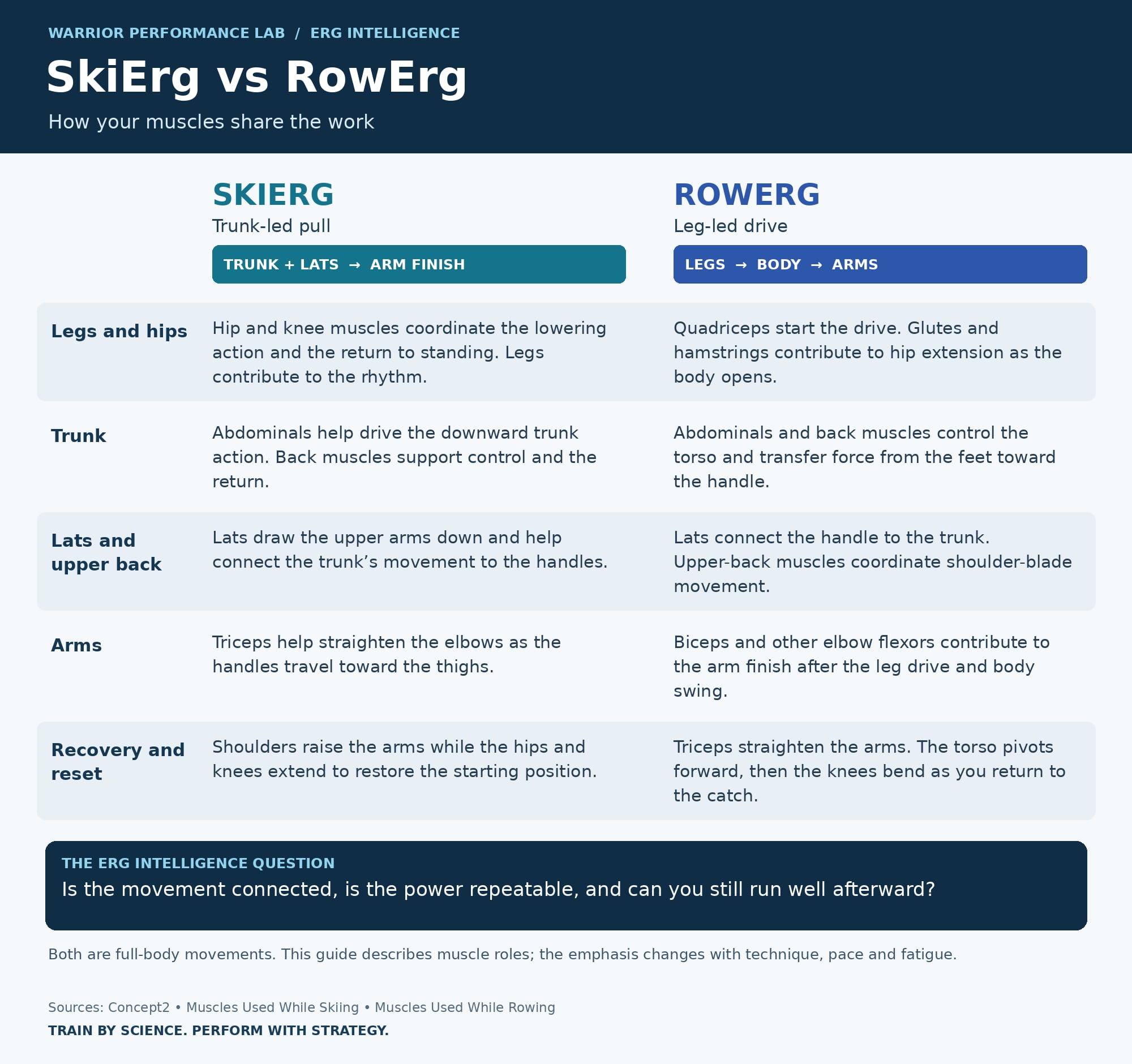
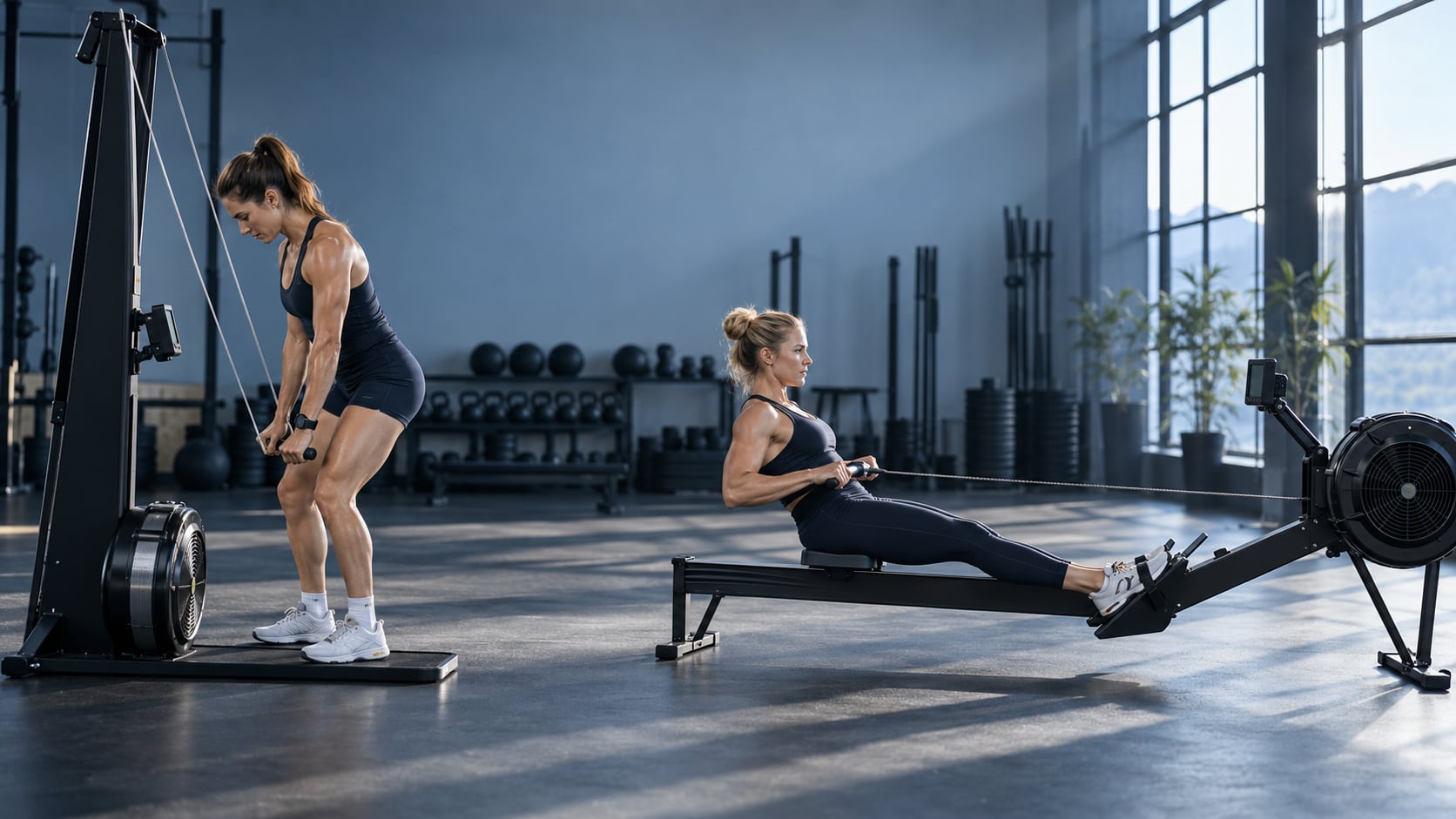
| Movement | Standing double-pole action with coordinated trunk, hip, and arm movement. | Seated stroke led by leg drive, followed by body swing and the arm finish. |
| Force transfer | Connect the trunk and lats to the handles; let the arms complete the pull. | Transfer pressure from the feet through the trunk to the handle. |
| What I watch | Pull timing, recovery rhythm, and whether the athlete starts relying on the arms. | Catch position, leg-to-handle connection, and whether the slide becomes rushed. |
| HYROX context | Station 1, after Run 1. Early pacing affects the running and sled work ahead. | Station 5, after Run 5. You arrive with more accumulated race work. |
Both stations cover 1,000 meters in HYROX Singles. Movement guidance: Concept2 [1, 2]. Race format: HYROX [5].
Create power through a connected movement
On the SkiErg
Begin tall in a comfortable athletic position. Connect your trunk to the pull, hinge through the hips, and allow the arms to finish toward the thighs. Let the knees contribute without turning every repetition into a deep squat. Return smoothly so you can organize the next pull. [1]
My coaching cue is simple: connect the body to the handles. If the arms are doing most of the work, pulling harder may only make them fatigue sooner. I would first look at the timing of the trunk, hips, and handles, then check whether the drag and rhythm suit the athlete.
On the RowErg
Press through the feet to begin the drive. Follow with the body swing and then the arm finish. On the recovery, send the hands away, bring the body forward from the hips, and let the knees bend once the handle has cleared them. Keep the catch within a position you can control. [2]
I want the leg drive to reach the handle. If the seat moves away while the handle barely accelerates, the stroke needs a closer look. More effort will not automatically improve that connection. A short technique set may tell us more than another exhausting interval.
Your damper setting needs a purpose
The damper lever changes airflow into the flywheel housing. Drag factor is the monitor’s measure of how quickly the flywheel slows between strokes. Temperature, elevation, and machine condition can change the drag produced by a particular lever position. [3]
A damper setting of 5 is therefore not a universal workload, and copying it from the rower to the SkiErg does not reproduce the same experience. The PM5 uses flywheel deceleration to account for drag when calculating output; the lever itself does not prescribe intensity. [3]
At WPL, I call the useful range your match zone: a combination of drag, stroke rate, movement quality, and output that you can repeat at an acceptable race cost. A heavy pull is useful only if it helps you achieve the task.
The current 2026–27 HYROX Singles rulebook specifies a starting damper setting of 6 on both ergs and allows racers to adjust it. Treat that as the event setup, not your personal prescription. Recheck the applicable rules before racing. [5]
Read the monitor alongside the athlete
Pace tells you how quickly the meters are accumulating. Watts describe the mechanical power reported by the monitor. Stroke rate tells you how many strokes you take each minute. Together, these numbers help explain the performance; they do not tell the whole story.
For example, if stroke rate rises while watts fall, average output per stroke has fallen. That is a useful signal to investigate. It does not, by itself, identify weak muscles, poor fitness, or a particular metabolic limitation.
I also ask athletes to separate local muscular effort from breathing effort. Are the triceps tiring first? Does the lower back feel overloaded? Is breathing the main challenge? Those answers guide what we examine next, alongside video, pacing, and training history.
A few seconds can require a substantial power increase
| Pace per 500 m | Approximate power | Continuous 1,000 m |
| 2:10 | 159 W | 4:20 |
| 2:05 | 179 W | 4:10 |
| 2:00 | 203 W | 4:00 |
Calculated from Concept2’s pace-to-watts formula. Moving from 2:10 to 2:00 per 500 meters saves 20 seconds over 1,000 meters but requires approximately 27% more displayed mechanical power. That does not mean 27% more oxygen use or physiological strain. [4]
I want that extra power to earn its place in your race plan. In an illustrative example, saving 10 seconds on the erg and losing 25 seconds on the next run leaves you 15 seconds behind across the two segments. We then test whether the erg effort actually caused the slower run; terrain, congestion, pacing, and other fatigue can also affect it.
Keep physiological targets specific to the machine
Both ergs can provide demanding conditioning. The useful training dose depends on your technique, familiarity, muscular endurance, and the session you are trying to complete. A SkiErg interval can be limited by local fatigue even when breathing feels manageable; a rowing interval can also become locally demanding.
In a study of 55 healthy young men, heart rate was lower during rowing than treadmill running at matched blood lactate concentrations. This supports caution when transferring heart-rate targets between activities; it does not establish a SkiErg-to-RowErg conversion or a fixed adjustment for every athlete. [6]
I set benchmarks for running, rowing, and skiing separately. Matching a split, watts, or heart rate across different movements does not establish equal physiological effort. A monitor cannot measure your lactate concentration, identify your VLamax, or explain the cause of fatigue. We need the appropriate assessment for those questions.
Use the five Erg Intelligence lenses
When I review an erg performance, I connect five parts of the picture before deciding what should change in training.
| Lens | The question I want to answer |
| Mechanics | Where does force begin, how does it reach the handles, and what changes as fatigue builds? |
| Output | How do pace, watts, stroke rate, and each 250-meter segment change across the effort? |
| Transfer | What can you reproduce after a controlled entry run or other race-relevant work? |
| Downstream cost | What happens to pace, effort, and movement in the following kilometer and station? |
| Context | How do strength, movement capacity, fueling, recovery, and race execution affect the result? |
Suppose an athlete rows well when fresh but loses pace after running and burpees. I would compare the entry workload, stroke sequence, and local effort before adding more all-out rowing. The priority might be repeatability under fatigue, better pacing before the row, or a technical adjustment. The result tells us where to investigate.
For another athlete, the SkiErg rhythm may deteriorate well before breathing becomes the main challenge. I would review force transfer and the drag-rate combination, then test whether targeted muscular endurance or strength work is warranted. I would not prescribe the same solution simply because both athletes recorded a slow split.
Give the next session a clear job
For technique, use short controlled pieces with one movement focus and enough recovery to reproduce it. For sustainable output, use repeatable intervals at a pace that preserves the intended rhythm. For race transfer, add a standardized entry workload and track the following run.
Choose the machine according to the session goal. If you substitute one erg for the other because of equipment access, use a sensible time and effort target rather than assuming equal meters or watts create an equivalent session. Keep that substitution separate from your station-specific benchmarks.
Then retest the same task. Better training should show up as something useful: steadier output, a more repeatable stroke, less reported effort at the same pace, or better running afterward. One improved session is encouraging; repeated results make the decision stronger.
Find a match you can reproduce
Use this short comparison as a starting point on one erg at a time. It is a coaching exploration, not a validated physiological test or a race-pace prescription.
Start with a controlled baseline
Warm up progressively for 6–8 minutes. Choose a pace you can hold comfortably at roughly 5 out of 10 effort. Keep the machine, warm-up, effort duration, and recovery consistent. Note your usual drag factor and stroke rate.
Compare drag first
Try three practical drag factors around your usual setting. Complete 60–90 seconds at each, with 60–90 seconds of easy recovery. Hold the same target pace and a similar stroke rate so the comparison is useful. Record where the pull stays connected and where local effort begins to climb.
Then explore rhythm
Keep the most controllable drag factor unchanged. On a separate set, compare small changes around your natural stroke rate at the same target pace. A change of about 2 strokes per minute on the RowErg or 3 on the SkiErg is a starting example, not a required cadence.
Confirm under matched conditions
Repeat the strongest combinations after recovery or in another session, reversing their order to reduce the influence of accumulating fatigue. Short pieces narrow the options; they do not prove what will work over 1,000 meters.
Build the leading option into a longer controlled effort, then repeat it after a standardized race-relevant entry load. Include the following run. Compare the whole sequence before deciding which setup belongs in your race plan.
Record damper position, drag factor, average pace or watts, stroke rate, local muscular effort, breathing effort, movement quality, and the next run’s pace and effort. Keep the two effort ratings separate on a 1–10 scale. Note any change in sleep, fueling, or prior training that could affect the comparison.
Make the split work for your race
On the SkiErg, settle into the pace you have practiced and leave ready for Run 2 and the sled work ahead. On the RowErg, rebuild your rhythm after the earlier stations and protect the work still to come. Sitting down does not make the rowing station a recovery break.
My goal is to help you produce a strong station and keep racing well afterward. Bring the split, the stroke, and the next kilometer into the same conversation. That is where the data starts to become a useful training decision.
Test • Analyze • Train • Retest
Explore WPL Erg Intelligence to see how we connect mechanics, output, fatigue transfer, and race context.
Sources and further reading
The movement and equipment explanations draw on Concept2 guidance. Race details follow the current HYROX Singles rulebook. The five-lens interpretation and comparison drill describe WPL coaching practice; they are not a validated diagnostic instrument.
2 Concept2 Indoor Rowing Technique
3 Concept2 All About Damper Setting and Drag Factor
4 Concept2 Pace and Watts Calculators
5 HYROX Singles Rulebook 2026–27
See SkiErg on page 26 and rowing on page 30. Rules checked October 1, 2026.
6 Yoshiga and Higuchi 2002 Heart rate is lower during ergometer rowing than during treadmill running