HYROX® Race Shoe Matrix: How to Choose the Perfect Shoe for Your Strength–Speed Profile
At the elite level, your race shoe isn't just something comfy to run in. It's a performance tool. The right model can help you push heavier sleds, run faster with less braking, and keep your ankle and knee mechanics predictable deep into the pain cave. The wrong one can turn every station into a fight.
This guide breaks down HYROX® shoe selection from a performance and equipment perspective, with a special focus on the Puma HYROX® lineup and how it compares with other top hybrid models.
Why Your HYROX Shoe Matters
HYROX uniquely blends:
- 8 km of running at threshold or just above
- Heavy sled push and pull
- Lunges, wall balls, and other loaded patterns
- Constant transitions on carpet, rubber, and polished surfaces
Your shoe has to do everything well enough:
- Transfer power horizontally into the sled without the midsole folding
- Run efficiently at a high heart rate without feeling like a brick after 30–40 minutes
- Stay stable in split-stance patterns like lunges and under overhead load for wall balls
- Grip consistently across different floor types without feeling sticky or sketchy
- Resist fatigue so Station 8 feels as predictable as Station 1
If your shoe compromises too much in any of these, you'll pay for it somewhere in the race.
Competition Demands (and What Your Shoe Must Do)
1. Sled push and pull power transfer
You want a shoe that stays rigid enough under the heel and midfoot so that when you drive horizontally into the sled, the force goes forward instead of disappearing into a squishy midsole. Look for a flatter, firmer platform and minimal “mush” under the heel.
2. Running economy over 8 km
You're not just jogging between stations; you're running long threshold intervals. Your shoe should roll smoothly from midfoot to toe, feel light enough to keep cadence snappy, and avoid over-cushioning that makes it feel dead later in the race.
3. Lunge and wall ball stability
With load on your back or arms overhead and a flexed knee, you need confidence in your base. That means controlled ankle wobble, a secure lockdown through the midfoot and heel, and an upper that stops your foot sliding around.
4. Traction and change of direction
HYROX venues can include carpeted sled lanes, rubber flooring, and polished concrete or wood. Your outsole has to grip when you're driving the sled but shouldn't feel sticky when you're turning or changing direction.
5. Fatigue resistance
By Station 6–8, you shouldn't feel like your shoes have collapsed. The midsole should still feel similar to the start, with no sudden loss of stability as the foam heats and compresses.
The Puma HYROX® Lineup – Which Model Fits You?
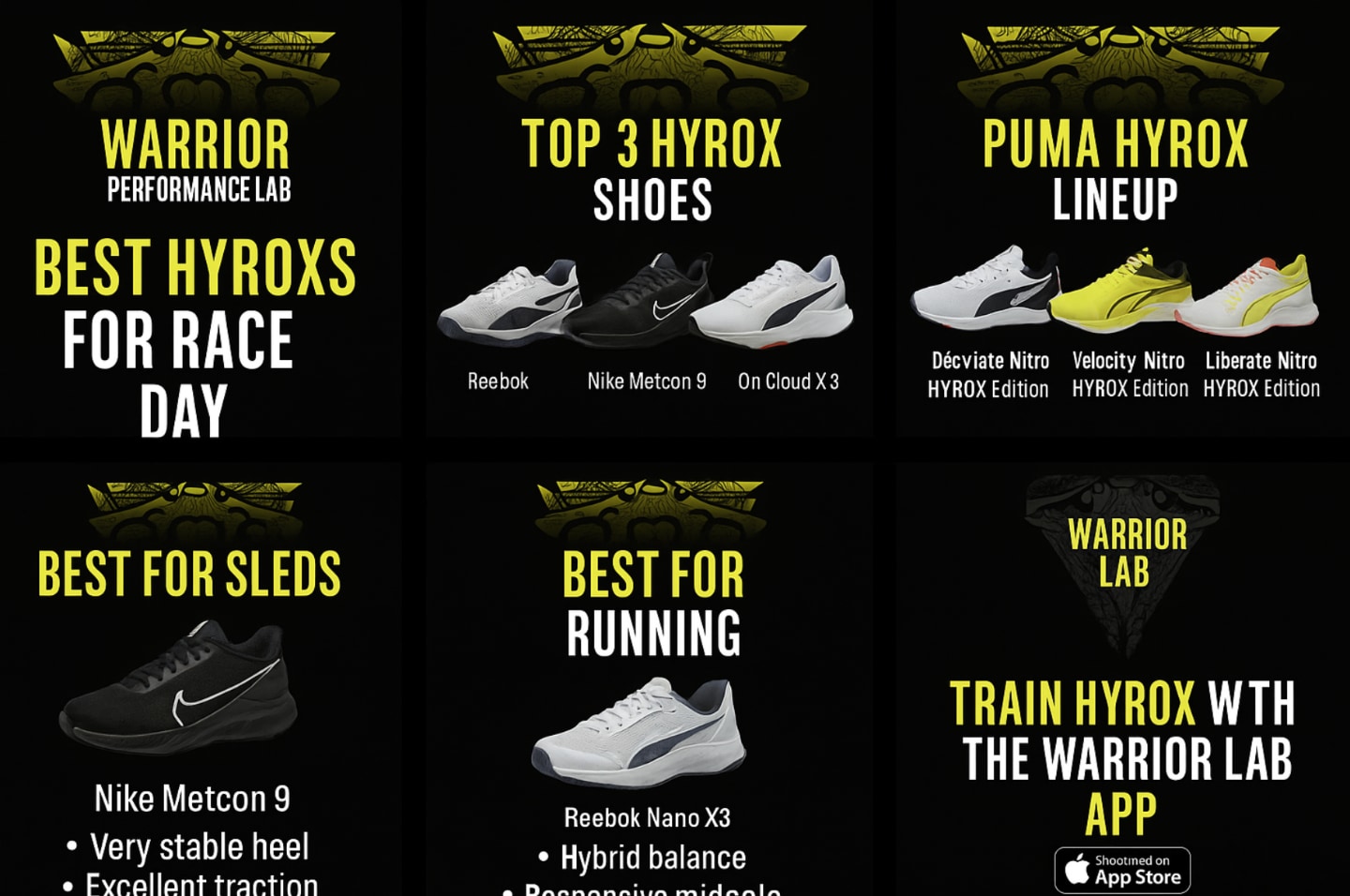
Puma have developed a HYROX-focused lineup that covers different athlete profiles, from pure speed machines to balanced hybrid workhorses.
Puma Deviate Nitro HYROX Edition
Type: Carbon-plated hybrid trainer–racer
Best for - Fast, efficient runners and sub-elite or elite athletes who prioritise running speed and already have strong lower-limb stiffness.
What it does best
- Excellent running economy at race pace
- Snappy, propulsive feel from the plate and Nitro foam
- Lightweight upper that almost disappears on the foot
Where it's less ideal
- Less stable under maximal sled push loads
- Narrower forefoot may not suit wider feet or heavier lifters
Summary: Choose this if you're a speed-dominant athlete whose main weapon is fast, efficient running and you're technically solid on sleds and lunges.
Puma Velocity Nitro HYROX Edition
Type: Neutral cushioned hybrid trainer
Best for: Balanced athletes who want more cushioning than a classic CrossFit-style shoe but still need better stability than a pure plated racer.
What it does best
- Smooth, cushioned ride for the full 8 km
- More stable platform than Deviate Nitro for stations and lateral work
Where it's less ideal
- Still softer than very firm CrossFit-style models (e.g. Metcon / Nano) under very heavy sled loads
Summary: This is the “hybrid sweet spot” in the Puma HYROX range for many athletes – enough cushion to protect your legs, enough stability to not hate life on the sleds.
Puma Liberate Nitro HYROX Edition
Type:Lightweight tempo / race trainer
Best for: Athletes who love a very light shoe, have excellent lower-limb stiffness, and strong mechanics in lunges and sled work.
What it does best
- Feels extremely light and quick – great for high-pace racing
- Perfect if you want to feel fast in every run segment
Where it's less ideal
- Minimal structure for lunges and sleds
- Demands good alignment and control; not forgiving if your technique is loose
Summary: Think of this as the “race flat” of the HYROX lineup – incredible for speed, but only if your mechanics are robust.
Puma Twitch Runner HYROX Edition
Type: Budget-friendly hybrid option
Best for: Athletes who want an accessible shoe mainly for training and occasional racing, or those new to HYROX.
What it does best
- Comfortable and grippy for mixed training sessions
- More affordable entry point into HYROX-specific footwear
Where it's less ideal
- Less sophisticated midsole
- Less stability and responsiveness for maximal race efforts
Summary: A solid everyday option to train in and test HYROX-style sessions, but not the first choice for peak performance on a championship race floor.
Quick Comparison: Puma HYROX Models
Deviate Nitro HYROX
Plated hybrid racer | High cushion, lower stability | Fast, efficient runners | Prioritise running performance; be cautious with heavy sleds.
Velocity Nitro HYROX
Cushioned hybrid trainer | Balanced cushion and stability | Balanced hybrid athletes | Safe choice if you want more support during stations.
Liberate Nitro HYROX
Lightweight tempo shoe | Lower cushion, lower structure | Light, elastic runners | Great for speed; demands good sled and lunge mechanics.
Twitch Runner HYROX
Budget hybrid | Moderate cushion, moderate stability | Training & entry-level racing | Good everyday option; not ideal for elite A-race day.
How Other Top Shoes Fit the Picture
From testing and athlete feedback, here's how some other popular models stack up in practice:
- Best sled push power transfer:** Nike Metcon 9, TYR CXT-1, Reebok Nano X3
These are firm, flat, and brutally stable – brilliant for heavy sleds, but some athletes find them harsh for the full 8 km of running.
- Best running economy: Puma Deviate Nitro HYROX, HOKA Mach X, On Cloud X 3
These shine when the run is your weapon. They keep cadence high and reduce energy cost at speed, with the trade-off being less absolute stability under max loads.
- Best hybrid balance for most elite athletes: Reebok Nano X3, Puma Velocity Nitro HYROX
These split the difference – stable enough for sleds and lunges, yet not so brick-like that you dread every run lap.
Matching Your Shoe to Your Strength–Speed Profile
When you choose a HYROX shoe, start with your athlete profile, not the brand hype.
Strength‑dominant athletes
You usually crush sleds and heavy work and lose more time on the runs.
- Prioritise: Stability, firm platform, predictable heel
- Good starting points: Nano-style shoes, TYR CXT-1, or the more stable end of hybrid trainers (e.g. Puma Velocity Nitro HYROX)
- Watch out for: Super high-stack, soft racing shoes that feel amazing on easy runs but collapse under sled load
Speed‑dominant athletes
You win on the run and want to protect that edge without getting bullied by the sled.
- Prioritise: Running economy, snappy feel, moderate stability
- Good starting points: Puma Deviate Nitro HYROX, HOKA Mach X, lighter hybrid racers
- Watch out for: Overly soft or unstable midsoles that fold when you lean into the sled or lunge deeply
Balanced hybrids
You sit somewhere in the middle – decent sleds, solid running, no glaring weaknesses.
- Prioritise: Balanced cushion and support
- Good starting points: Puma Velocity Nitro HYROX, Reebok Nano X3, other stable-but-runnable trainers
- Watch out for: Going too extreme in either direction – pure racing flats or ultra-firm gym bricks
How to Test Your HYROX Shoes Before Race Day
Don't wait until race day to find out you chose wrong. Use this simple testing framework:
1. Race-sim session
–2 km warm-up run
–2 rounds of:
- 1 km run at race pace
- Sled push + pull (or closest gym alternative)
- Walking lunges with load
- Finish with wall balls
Ask yourself: Do your feet feel as stable and predictable at the end as they did at the start?
2. Grip & surface test
- Run and push on the actual surfaces you'll race on if possible: carpet, rubber, polished floor
- Look for: No slipping on sled drive, no sticking when turning or changing direction
3. Fatigue feel
- After 40–50 minutes of HYROX-style work, ask:
- Does the midsole feel mushier or less stable?
- Are your ankles working overtime to stabilise?
If a shoe fails on sled stability or late-race predictability, it's a red flag – even if it feels amazing on a fresh 5 km run.
Race-Day Shoe Checklist
Before you step into the start chute:
- Shoes are fully broken in, but not destroyed (ideally 30–80 km of mixed use)
- Laces locked in – no slipping, no over-tight hot spots
- Socks tested in training (no blisters, no seams causing pressure)
- Outsole wiped clean so you get maximum grip on sled carpets
- If in doubt between two pairs: choose the more stable option for HYROX – the race is long enough that instability will cost you.
Final Word – and Your Next Step
Shoe choice won't replace smart training, but at the HYROX level you're competing in, it is a performance variable. Get it right, and your footwear disappears – you just execute. Get it wrong, and every station reminds you.
So: which shoe are you racing in this season?