How do I start training for my first HYROX?
Build a repeatable week of running, strength and station learning before adding demanding combinations.
Read answer
Warrior Performance Lab · Resources Hub
Practical answers for HYROX training, fueling, recovery, and race day—with steps you can use and sources you can check.
Train by Science. Perform with Strategy.
A useful place to begin
Choose a question. Take one practical step. Check what changes.
Build a repeatable week of running, strength and station learning before adding demanding combinations.
Read answerTest the station and the following run together; a faster station is only useful if the combined effort holds up.
Read answerThe plates are only part of sled resistance; compare the surface, sled and movement, then record the setup.
Read answerStart with familiar carbohydrate food, then adjust the portion and timing to your session and stomach.
Read answerUse changes in your usual sleep, energy, soreness, and movement to adjust the session.
Read answerReduce accumulated fatigue while keeping brief, familiar practice and your race logistics organized.
Read answerFind your next focus
Clear guidance, useful actions, and the evidence behind them.
18 answers
Build a repeatable week of running, strength and station learning before adding demanding combinations.
Read answerBuild around the sessions that matter most, then adjust the surrounding work so you can complete them well.
Read answerDevelop running and strength with available equipment, then arrange specific practice for the unfamiliar race tasks.
Read answerTest the station and the following run together; a faster station is only useful if the combined effort holds up.
Read answerKeep both in the plan, then prioritize the task that repeatedly limits a controlled session.
Read answerUse repeatable station–run practice to choose an opening effort, then adjust for the actual race conditions.
Read answerThe plates are only part of sled resistance; compare the surface, sled and movement, then record the setup.
Read answerChoose repeatable valid sets and planned breaks, then compare total time rather than the size of your first set.
Read answerFind a repeatable legal rhythm and judge the station together with the run that follows it.
Read answerStart with familiar carbohydrate food, then adjust the portion and timing to your session and stomach.
Read answerReview regular eating opportunities and changes in health and training response; symptoms alone cannot diagnose under-fueling.
Read answerRehearse familiar food and fluid access during comparable training, then adjust one detail at a time.
Read answerUse changes in your usual sleep, energy, soreness, and movement to adjust the session.
Read answerResume from your current capacity and available week; do not stack missed sessions onto the plan.
Read answerRestore ordinary movement and recovery routines, then add training demands according to your response.
Read answerReduce accumulated fatigue while keeping brief, familiar practice and your race logistics organized.
Read answerPlan each station around both partners’ abilities and the running that follows, then practise the exchanges.
Read answerUse splits and your race notes to choose one testable training priority, without treating a slow segment as a diagnosis.
Read answerTry a broader term such as “running,” “fueling,” or “recovery,” or clear the topic filter. This search covers the curated answer library.
Put it on paper
Three existing public resources to help you plan, practise, and reflect.
Use the planning sheet on page 14 and packing checklist on page 15 to record your race plan, backup decisions and race-morning essentials.
Open PDF : First-race plan and race-day checklistView resource detailsComplete the partner profile, agree on a shared running plan, then use the printable team race card on page 11 to record roles, cues and backup decisions.
Open PDF : Doubles team plan and race cardView resource detailsUse the benchmark-and-record section on page 4 to compare runs, stations and transitions, and note where pace changed or route errors occurred.
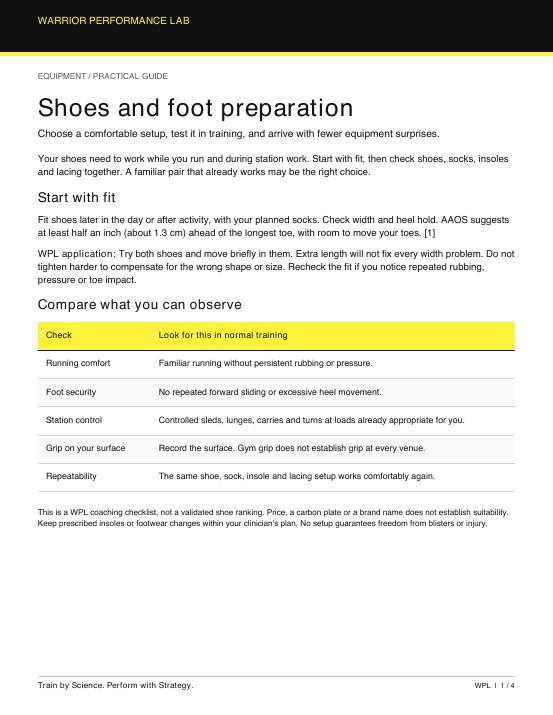
Open PDF : Running and Roxzone review guideView resource detailsCheck shoe fit, lacing, socks and your complete race setup. Use the printable checklist before race week.
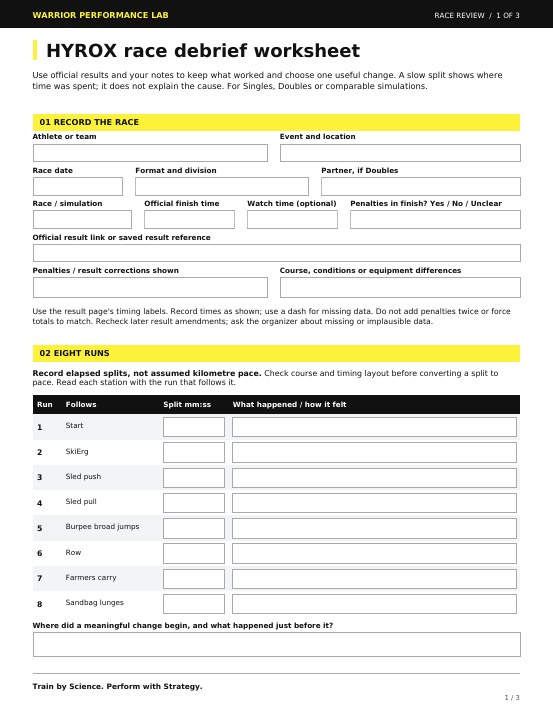
Open PDF : Shoes and foot preparationView resource detailsRecord runs, stations, transitions and context, then choose one useful change to test. Download and save your own fillable copy.
Download worksheet View resource detailsThese are coaching resources with printable planning pages or recording prompts. Example sessions and targets need individual scaling. For race standards, use the current official rulebook and your event briefing.
The Resources Hub is public and free. Browse its answers and resources without registration.
Explore Station Intelligence and Erg Intelligence for practical station tools and guides.
The Resources Hub collection is public and free, with no registration required. Youngstars is age-specific; check current youth guidance. The rulebooks collection includes WPL commentary and compiled references.
When you want more support
Explore structured training and tools to follow your progress. Start with the app overview to see the current options and download details.
Explore Warrior Lab Already use Warrior Lab? Open your installed app for your training and account.Individual training, nutrition, or coordinated support shaped around your schedule and feedback. For beginners and experienced racers who want personal guidance.
Explore 1:1 coaching
HYROX Performance Coach & Master Trainer
A.S. in Integrative & Sports Nutrition
Each answer separates official rules, research, and coaching applications. References explain what the evidence can—and cannot—tell you.
Training & getting started · Public answer
Start with the training you can repeat and recover from: running at a manageable effort, basic strength work, and learning the stations. You do not need to prove you can complete a full race simulation on day one. Your first priority is a workable routine matched to your starting point, equipment and race date.
Write down your available days, current comfortable run or walk–run duration, and familiar strength exercises. Choose a starting week close to what you already tolerate; leave space for recovery.
Keep easy running, controlled strength practice and station learning identifiable. Begin unfamiliar movements while fresh, using a manageable load. Read the current rulebook for your entered division before rehearsing race standards.
Once separate sessions feel repeatable, pair a short station effort with a familiar run. Record the work, effort and next-day response. Change one feature at a time rather than adding speed, load and volume together.
Repeat a familiar session and check whether you can complete it with controlled movement and recover well enough for the next planned session.
If you are new to running, begin with walk–run practice. If your race is close, seek an individual plan rather than compressing a long build into a few exhausting weeks.
Source labels describe the type of evidence, not a certainty score. Practical steps are coaching applications unless stated otherwise.
The race combines running and prescribed station work.
A-01 · Check the separate rulebook for your entered division.
Concurrent aerobic and strength training can develop both capacities.
A-03 · General training evidence; not a tested first-race plan.
Progressive resistance training can improve muscle function.
A-04 · Healthy-adult evidence does not determine individual readiness.
Start near tolerated work, separate session purposes and progress one feature at a time.
A-03, A-04 · A practical starting framework, not a validated HYROX prescription.
Before race week, use the shoe and foot preparation guide to check your complete setup.
Training & getting started · Public answer
Running and strength can coexist in a useful training week. The challenge is fitting the total work to your recovery and protecting the quality of important sessions. Give each workout a purpose, count mixed sessions as training load, and avoid making every day a demanding race rehearsal. There is no single best schedule for every athlete.
List your available training days and the running, strength or station skill you most need to develop. Place the key sessions first, with easier work or rest where you tend to need it.
If a demanding lower-body workout repeatedly spoils your next important run, reduce that workout or move it. When combining modes in one session, begin with the quality you need to practise best that day.
A station circuit may tax the same legs as your strength session and run intervals. Record session duration, effort and completed work. Replace existing work when adding a demanding mixed session rather than automatically stacking it on top.
Check whether key sessions are completed with the intended quality and whether fatigue is manageable across the week. Adjust the recurring problem before adding more training.
Beginners usually need a simpler week. Experienced athletes prioritizing explosive strength may benefit from separating demanding modes when practical. Shift the balance with your training phase and recovery capacity.
Source labels describe the type of evidence, not a certainty score. Practical steps are coaching applications unless stated otherwise.
Concurrent training can preserve maximal-strength and muscle-size gains, with more concern for explosive strength.
A-03 · Average findings do not eliminate individual fatigue or prescribe a HYROX schedule.
Session order can matter for strength adaptation, while aerobic-capacity differences were not clear.
A-09 · Different populations and protocols; no universal order is established for HYROX.
Place priority sessions first in the plan and adjust overlapping work from the training log.
A-03, A-09 · Individual scheduling guidance, not a trial-tested weekly template.
Training & getting started · Public answer
You can build useful fitness without owning every race machine. Keep developing running, strength and repeatable effort with the equipment you have, while planning occasional access to the actual stations. A substitute trains selected qualities; it does not prove you can manage a race sled or reproduce a SkiErg score.
Continue your planned running and manageable strength work. Select familiar squat, hinge, push, pull and carry exercises according to available equipment and current ability. Record the resistance and completed work.
For a missing SkiErg, use an available rower or bike for the intended conditioning effort, and practise pulling strength separately. Without a sled, develop controlled leg strength and pulling work. Do not invent a metres-to-repetitions conversion.
Arrange access to race-style equipment early enough to learn without rushing. Start with short, controlled trials and check the current rules. Use these sessions to learn setup, movement and pacing rather than repeatedly testing the whole race.
Check that the substitute achieves its intended training purpose and is repeatable. Assess actual station confidence separately when the equipment becomes available.
If equipment access remains limited near the race, seek help judging preparation gaps. Avoid improvised sled or rope setups unless the space and equipment are designed for that use.
Source labels describe the type of evidence, not a certainty score. Practical steps are coaching applications unless stated otherwise.
Resistance-training benefits are possible with different equipment types.
A-04 · General fitness adaptations do not establish equivalent station performance.
A substitute cannot be assigned a universal sled-load equivalence.
A-05 · The friction study shows context dependence; it did not test these substitutes.
Use available training modes and arrange separate practice of the actual race task.
A-01, A-04 · No direct HYROX trial validates this substitution plan.
Explore deeper coaching methods and research
← Back to the answer libraryPermanent answer linkRunning & endurance · Public answer
A difficult run after a station is a clue to investigate, not a diagnosis of poor fitness. The station may have cost more effort than you can recover from while running, or your running target may be too ambitious for the combination. Test a calmer station effort before deciding you need harder workouts.
In a familiar session, note which station precedes the slowdown, how the station felt, and how quickly a comfortable running rhythm returns. Keep the running route and distance consistent.
Repeat a manageable station–run pairing on another recovered day. Use the same station work but a calmer pace or earlier planned break. Keep the following run controlled and compare total pairing time.
Start the run at an effort you can settle into rather than chasing a fresh-running split immediately. Add repetitions only while movement and pacing stay controlled; retain separate easy running and strength work.
Look for a more repeatable run and a better overall station–run combination, not just a faster station. Record whether the later repetitions remain manageable.
Heat, poor sleep or unfamiliar loading can complicate comparisons. If running changes because of persistent pain, stop using pace experiments and seek an appropriate clinical assessment.
Source labels describe the type of evidence, not a certainty score. Practical steps are coaching applications unless stated otherwise.
HYROX imposes substantial physiological demands across stations and running.
A-02 · A small simulation cannot explain an individual slowdown.
Retaining both aerobic and strength training is reasonable.
A-03 · No specific station–run progression was tested.
Compare a calmer station with the following run under similar conditions.
A-02 · A practical comparison, not a validated limiter test or guaranteed improvement.
Running & endurance · Public answer
Keep both running and strength in your plan, but give extra attention to the skill or capacity that repeatedly limits useful training. Running deserves preparation because it is a substantial race component. That does not mean every athlete needs more running, or that a slow station proves a strength deficit. Look at repeatable observations before changing the balance.
Record a familiar standalone run and controlled station practice on recovered days. Note whether difficulties appear while fresh, only under fatigue, or mainly with unfamiliar technique. Use the same setup when comparing sessions.
If running is difficult even when fresh, build running consistency while retaining strength. If a station is repeatedly unmanageable, review technique and appropriate strength preparation. If both work separately, investigate pacing when combined.
Give the priority session a place where you can perform it well. Within a combined workout, practise the priority first when practical. Keep enough of the other mode to maintain regular exposure and track whether it deteriorates.
Repeat the original task under similar conditions. Look for better control or repeatability without sacrificing the other training; one unusually good day is not enough to establish a trend.
Race proximity, injury history and training experience change the decision. A coach can help distinguish technique, pacing and preparation gaps; an online checklist cannot diagnose your physiology.
Source labels describe the type of evidence, not a certainty score. Practical steps are coaching applications unless stated otherwise.
Running deserves preparation as a substantial HYROX component.
A-02 · A small simulation does not identify every athlete’s priority.
Running and strength can be developed together.
A-03 · Training balance and recovery still need adjustment.
Strength-first ordering can favor some lower-limb strength outcomes.
A-09 · This does not establish the best order for all goals or athletes.
Use repeatable task observations to select a temporary training priority.
A-02, A-09 · A practical decision process, not a validated diagnostic test.
Running & endurance · Public answer
Choose an opening effort from repeatable training that includes stations, then adjust as the race unfolds. Your best fresh running pace is useful context, but it is not automatically your HYROX pace. Treat any fixed adjustment to a 5 km or 10 km pace as an estimate that needs rehearsal.
Review recent runs that you completed with controlled effort, along with any comparable station–run sessions. Use your current preparation rather than a personal best from a different training period.
On a recovered day, combine familiar station work with repeated runs. Begin conservatively and record run splits, station time and effort. Shorten the session if technique deteriorates; this does not need to be a full race simulation.
Plan how to respond if the opening effort feels harder than rehearsed: settle the run, control the next station, and reassess. Use course markers and effort together; follow the event’s lap instructions rather than chasing a watch reading.
A useful starting pace lets you repeat the combination without an escalating loss of control. Compare the whole session and later runs, not just the opening split.
Heat, course layout and station resistance affect execution. Doubles partners should rehearse together. A first race can use a flexible effort plan rather than a rigid finishing-time target.
Source labels describe the type of evidence, not a certainty score. Practical steps are coaching applications unless stated otherwise.
Running pace can decline across a HYROX race.
A-08 · Twenty-four PRO men at one event; the study does not prove that any specific opening pace is best.
Follow the event’s running course and lap instructions.
A-01 · Section 7.2; venue instructions must be checked separately.
Use rehearsed station–run effort and adjustment cues instead of a universal road-race pace conversion.
A-08 · A practical planning method, not a validated formula or guaranteed finish-time prediction.
Stations & technique · Public answer
Matching the plate weight does not guarantee matching resistance. Friction between the sled and surface affects the force needed to move it, and equipment and your approach also matter. Treat each gym setup as its own training reference. A difficult sled at one venue does not, by itself, show that you have lost fitness.
Log the sled, added plates, surface, distance, shoes and whether you are pushing or pulling. Keep these consistent when checking progress. Remember that official sled loads include the sled itself.
Warm up with lighter practice and build only while you can start and move the sled with controlled positions. Choose the load for the intended session instead of forcing a plate number from another gym.
Rehearse starts, steady movement and turns with the equipment available. When possible, gain supervised experience on race-style equipment and check the current lane and movement rules for your division.
Compare time, stops and effort on the same setup. Progress is more interpretable when the surface and equipment stay consistent.
There is no reliable universal gym-to-race weight conversion. If footing slips or the surface creates an unsafe setup, change the load or location. Do not use a painful technique to keep the sled moving.
Source labels describe the type of evidence, not a certainty score. Practical steps are coaching applications unless stated otherwise.
Surface friction changes sled-towing demands.
A-05 · Four sports surfaces and sprint towing, not HYROX race carpet.
Effective resistance can vary with sled speed.
A-06 · A mechanical towing experiment, not a race-load conversion.
Official Singles sled weights include the sled.
A-01 · Season 26/27, sections 8.2 and 8.3; division-specific values are intentionally omitted.
Standardize the setup and use a controlled trial to select training load.
A-05, A-06 · A monitoring approach, not proof that a particular gym matches race conditions.
Stations & technique · Public answer
Choose a set size you can repeat with valid movement, then practise the restart. There is no universal best wall-ball split. An impressive opening set is not helpful if it leads to long stops or missed repetitions. Test a simple plan that preserves accuracy while accounting for the time spent resting.
Practise while fresh with the appropriate ball and target for your division. In the current Singles rules, squat depth (hips below knees) and contact with the correct target matter. Ask a knowledgeable partner or coach to check your repetitions.
On separate recovered sessions, compare smaller planned sets with your usual approach using the same total manageable work. Record valid repetitions, missed repetitions, break duration and total time. Stop each set before accuracy becomes unreliable.
Once technique is consistent, practise after familiar running or station work. Use a clear restart cue and keep the ball reset consistent with the rules. Reduce set size if the final repetitions repeatedly lose control.
Keep the approach that produces reliable valid work with manageable breaks. A faster total with fewer missed repetitions matters more than completing the largest opening set.
Scale practice volume or ball load when learning. Check your own division’s standards before race rehearsal. Persistent pain with squatting or throwing needs assessment rather than repeated attempts to push through.
Source labels describe the type of evidence, not a certainty score. Practical steps are coaching applications unless stated otherwise.
Valid Singles wall balls require prescribed squat depth and contact with the correct target.
A-01 · Season 26/27, section 8.8; this short answer is not the complete movement standard.
Redistributing rest can reduce acute fatigue during resistance exercise.
A-07 · Not a HYROX wall-ball trial; adding rest may increase total time.
Compare planned set sizes using valid work, missed repetitions and total time.
A-07 · No particular repetition split or break duration is validated here.
Stations & technique · Public answer
Aim for a rhythm you can repeat with valid movement, rather than the longest possible jump on every repetition. Start with technique you can control, then practise how that rhythm affects your next run. A slightly calmer station may be worth testing if your usual approach produces repeated stops or a difficult transition.
The current Singles rules permit stepping or jumping out of the burpee, but the broad jump requires both feet to take off and land together. When stepping or jumping up, do not bring your feet past your fingertips. Check the full hand-placement and movement rules.
Mark a short practice section. Use a controlled descent, a steady return and a jump distance you can repeat. Record time, stops and movement faults; rest before trying another section if control deteriorates.
When the movement is consistent, follow a manageable section with an easy-to-control run. On another recovered day, compare a calmer burpee rhythm using the same work. Record total combination time and how the run feels.
Look for fewer unnecessary stops, valid repetitions and a steadier following run. Covering more distance per jump is not a useful improvement if the whole sequence becomes less repeatable.
Begin with shorter sections and avoid forcing jump distance while learning. If pain changes your landing or floor movement, stop and seek assessment. Training modifications are not automatically permitted race modifications.
Source labels describe the type of evidence, not a certainty score. Practical steps are coaching applications unless stated otherwise.
Singles permits a step or jump out of the burpee and requires simultaneous broad-jump take-off and landing.
A-01 · Season 26/27, section 8.4; additional hand, foot and boundary rules also apply.
HYROX combines demanding stations with running.
A-02 · The simulation did not compare burpee strategies.
Test repeatable jump rhythm against the following run.
A-02 · No tested universal cadence, jump length or performance guarantee.
Fueling & hydration · Public answer
Choose a familiar carbohydrate-containing meal or snack that leaves you comfortable when running and bending. The best option depends on the time available, session demands, and what you tolerate. A long or demanding session needs more planning than a short easy one. Use training to test your choice before race day.
With a few hours available, try a normal meal such as rice with a familiar protein. With less time, try a smaller snack such as toast or a banana. These are options to test, not required foods.
If your stomach feels unsettled, reduce the portion or move it earlier. A lower-fibre, lower-fat choice may sit better close to exercise. Sip fluids beforehand instead of rushing a large drink at the start.
Before a comparable workout, record the food, approximate portion, timing, hunger, and stomach comfort. Change one feature on the next attempt so you can identify what helped.
Look for comfortable movement and enough energy to complete the planned session. Compare similar workouts rather than judging one unusually good or bad day.
For an early start, test a small snack and plan breakfast afterwards. Medical dietary restrictions or recurrent gut symptoms need individualized advice.
Source labels describe the type of evidence, not a certainty score. Practical steps are coaching applications unless stated otherwise.
Familiar carbohydrate foods and tolerance guide pre-exercise choices.
B-01 · Not tested as a HYROX-specific prescription.
Nutrition should match training demands and individual needs.
B-02 · Not tested as a HYROX-specific prescription.
Compare a familiar meal or snack across similar sessions.
B-01, B-02 · Examples are practical options, not a tested HYROX protocol.
Explore deeper coaching methods and research
← Back to the answer libraryPermanent answer linkFueling & hydration · Public answer
Start by comparing your eating routine with your training demands and how you have been feeling. Persistent fatigue, declining performance, or repeated illness can have several causes, including insufficient fueling. Neither a body-weight reading nor a calorie estimate answers the whole question. This is a practical check, not a test for REDs.
Write down when meals, snacks, work, travel, and training actually happen. Look for skipped meals, long gaps, or a demanding session followed by no convenient food. You do not need to count calories.
Prepare an accessible meal or snack for the gap you identified. For example, pack a sandwich and fruit for after an evening session. Make room for eating when training volume increases instead of simply extending the same routine.
Record unusual fatigue, recovery difficulties, recurrent illness or injury, and menstrual changes where applicable. Bring persistent changes to a clinician and a qualified sports dietitian rather than trying to diagnose the cause yourself.
Review whether meals now fit your schedule and whether energy and session recovery are improving. Feeling better does not rule out a health problem; ongoing symptoms still need assessment.
If food tracking causes distress, skip the diary and seek support. Menstrual changes, repeated injuries, or persistent symptoms deserve assessment without waiting for another training block.
Source labels describe the type of evidence, not a certainty score. Practical steps are coaching applications unless stated otherwise.
Energy inadequacy can affect health and performance; REDs requires clinical assessment.
B-09 · Not tested as a HYROX-specific prescription.
Persistent changes warrant assessment rather than self-diagnosis.
Map eating opportunities and address a missed meal or snack.
B-02, B-16 · This routine check neither estimates energy availability nor confirms adequate intake.
Explore deeper coaching methods and research
← Back to the answer libraryPermanent answer linkFueling & hydration · Public answer
Build a plan you can tolerate and execute while moving. Practise your pre-race food, any carbohydrate you intend to use during the race, and realistic drinking opportunities. Needs depend on duration, conditions, and individual response. Rehearsal may improve tolerance, but there is no single gel schedule or fluid volume that suits every athlete.
Choose a familiar carbohydrate food, drink, or gel and record its portion and timing. Match the rehearsal to your likely race duration and start time. Practise opening, carrying, and consuming anything you intend to use.
Begin in a controlled session before adding harder running and stations. Record intake, thirst, stomach comfort, and conditions. Avoid forcing large fluid volumes; both too little fluid and overdrinking can create problems.
For singles and doubles, the 26/27 rules require personal nutrition to be carried from the start and prohibit spectator hand-ups. Confirm your event’s aid-station arrangements rather than assuming a particular sports drink will be available.
Repeat a comparable session with one change if needed. Look for manageable thirst, comfortable digestion, and a plan you can carry out without disrupting movement.
Persistent gut symptoms need individual assessment. Hot conditions, longer race times, and medical fluid restrictions need a tailored plan. Keep familiar choices close to race day; do not force a high intake you have not practised.
Source labels describe the type of evidence, not a certainty score. Practical steps are coaching applications unless stated otherwise.
Hydration should avoid both insufficient intake and overdrinking.
B-10 · Not tested as a HYROX-specific prescription.
Repeated feeding practice may improve tolerance, with variable results.
Personal nutrition and hand-ups are regulated.
A-01, B-07 · Both rulebooks: section 10.5, checked 2026-10-18.
Progress from controlled practice to race-like movement.
B-11, B-12 · No HYROX trial establishes this exact rehearsal progression.
Explore deeper coaching methods and research
← Back to the answer libraryPermanent answer linkRecovery & readiness · Public answer
Look for a pattern across how you feel, recent training, and ordinary movement. One poor night or one low readiness score cannot decide the session for you. If several signs are worse than usual, reduce the demand or rest. If you feel generally well with mild fatigue, begin conservatively and reassess.
Before training, note sleep quality, energy, soreness, and stress as usual, better, or worse. Add yesterday’s training and any travel or unusually demanding workday; a simple note is enough.
If generally well, start with easy movement and the first light practice sets. Keep the planned session only if movement and effort feel normal. Otherwise shorten it, lower the load, or choose rest.
Write down what you actually completed and how you felt later that day. Protect a regular sleep opportunity and normal meals; do not use the easier day to add another hard workout.
Check whether energy and ordinary movement are returning toward your usual pattern by the next session. Repeated worsening calls for reviewing the week, not repeatedly testing your limit.
Illness symptoms, persistent unexplained fatigue, or pain that changes movement warrant clinical advice. A warm-up, wearable score, or low effort rating does not provide medical clearance.
Source labels describe the type of evidence, not a certainty score. Practical steps are coaching applications unless stated otherwise.
Changes in subjective wellbeing can help monitor training response.
B-03 · Not tested as a HYROX-specific prescription.
Protect habitual sleep and consider travel and training demands.
B-04 · Not tested as a HYROX-specific prescription.
Illness requires separate clinical consideration.
B-05 · Respiratory-illness consensus does not diagnose other causes of fatigue.
Use the baseline, conservative start, and follow-up sequence.
B-03, B-04 · No validated pass/fail threshold or clearance test is claimed.
Explore deeper coaching methods and research
← Back to the answer libraryPermanent answer linkRecovery & readiness · Public answer
A missed session is a scheduling adjustment, not a debt to repay. If you are otherwise well, return with a manageable session and rebuild your usual rhythm. After a longer interruption, reassess the plan before restoring all its demands. The reason you stopped matters as much as how many days you missed.
Separate a busy week from illness, injury, or accumulating fatigue. For a scheduling issue, identify the next realistic training slots. For a health-related break, follow the relevant return guidance before using a general training plan.
Keep the purpose of the week in view. Resume a familiar session with fewer intervals or sets if needed, rather than combining missed running and lifting into one exhausting catch-up workout.
Record session effort and how you feel afterwards and the next day. If the response is normal, restore one demand at a time, such as duration before adding more hard work. Keep recovery space between demanding sessions.
Check whether you can complete the revised week with normal movement and recovery. If the same schedule keeps failing, reduce the planned commitments rather than repeatedly catching up.
After illness, ongoing symptoms require medical guidance; after injury, follow your clinician’s return plan. Race proximity may require revising expectations. An easy effort rating alone is not clearance to resume.
Source labels describe the type of evidence, not a certainty score. Practical steps are coaching applications unless stated otherwise.
Training-cessation effects vary with duration and context.
B-13 · Not tested as a HYROX-specific prescription.
Return after respiratory illness needs individualized consideration.
B-05 · Not tested as a HYROX-specific prescription.
Do not stack missed work; restore manageable demands progressively.
B-13, B-05 · No study here tests this exact catch-up rule; illness and injury decisions require their own clinical guidance.
Explore deeper coaching methods and research
← Back to the answer libraryPermanent answer linkRecovery & readiness · Public answer
Let your response to the race guide your return. Soreness, fatigue, travel, and sleep disruption vary, so a fixed number of rest days cannot suit everyone. Begin with basic recovery and comfortable daily movement. Resume training gradually when ordinary activities feel normal, without using a hard workout to prove you have recovered.
Have familiar meals and snacks available after the event and during travel. Drink regularly according to your needs, and protect sleep opportunities. An easy walk is optional if it feels comfortable; complete rest is also a valid choice.
Notice walking, stairs, and comfortable unloaded movements before planning running or lifting. When these feel normal, try a short easy session with familiar movements. Stop if pain changes your movement or symptoms worsen.
If the session and the following day are well tolerated, build duration or load gradually. Leave harder running, demanding station combinations, and heavy lifting until easier work is consistently manageable. Record what you did and the next-day response.
Compare energy, movement, and effort with your normal baseline. Persistent deterioration calls for reassessment rather than continuing to increase training.
Pain that persists or changes movement needs clinical assessment. Follow existing injury guidance. If another race is close, review the calendar with your coach; a short turnaround does not guarantee recovery.
Source labels describe the type of evidence, not a certainty score. Practical steps are coaching applications unless stated otherwise.
Recovery needs vary with competition and other life stress.
B-14 · Not tested as a HYROX-specific prescription.
Regular nutrition, appropriate fluids, and sleep support recovery.
B-02, B-10, B-04 · Not tested as a HYROX-specific prescription.
Progress from comfortable daily movement to easy training and then harder demands.
B-14 · A cautious coaching sequence, not a clinical test or evidence for a fixed recovery period.
When you are ready to review your race, download the fillable race debrief worksheet. Save a copy to record your observations and one change to test.
Explore deeper coaching methods and research
← Back to the answer libraryPermanent answer linkRace day & doubles · Public answer
Race week should let you arrive prepared and less fatigued. Usually that means less total training while keeping some brief, familiar movement and pace practice. The exact reduction depends on your recent workload and recovery. Do not try to create missing fitness with a final demanding simulation or unfamiliar strength session.
Review your usual week and shorten sessions or remove sets and repetitions. Retain small amounts of familiar race-pace work if you are recovering well, finishing before it becomes a demanding workout.
Use an easy session to check shoes, clothing, a few station repetitions, and your practised breakfast or snack timing. For doubles, confirm the start plan and communication cues without turning the rehearsal into a race.
Check your official event information for start wave, arrival instructions, course briefing, and current division rules. Pack familiar kit and food, plan travel, and leave room for a regular sleep routine.
Use your usual easy warm-up as a comparison: movement should feel comfortable and fatigue should not keep accumulating. Adjust remaining training if you are still carrying substantial soreness.
Your taper may need to begin before race week. A previously successful routine is useful context; endurance-study averages are not an exact HYROX formula. Do not cram missed sessions into the final days.
Source labels describe the type of evidence, not a certainty score. Practical steps are coaching applications unless stated otherwise.
Reducing training volume before competition can improve endurance performance.
B-06 · Not tested as a HYROX-specific prescription.
Keep routine sleep opportunities around travel and competition.
B-04 · Not tested as a HYROX-specific prescription.
Shorten HYROX practice and organize event logistics.
B-06 · Taper studies were predominantly running and cycling, not HYROX; no universal reduction is prescribed.
Use the shoe and foot preparation checklist with the familiar setup you have already tested.
Explore deeper coaching methods and research
← Back to the answer libraryPermanent answer linkRace day & doubles · Public answer
Build a station-by-station plan around both partners’ sustainable work, communication, and running response. An equal split is only one option to test. The aim is a coordinated whole race, including the next run. Agree on a starting plan and a fallback before fatigue makes decisions harder, then practise both under the current rules.
In practice, each partner completes a manageable block of the same station. Record time, movement quality, and the following easy run. Use that information to propose starting shares without automatically assigning every strength task to one person.
Choose clear changeover words and a backup cue for unexpected fatigue. Practise planned work blocks and legal swaps during a short station-and-run session. Include the time spent changing partners when comparing options.
The 26/27 doubles rules require running together and entering and leaving stations together. The resting partner must remain standing in the designated area. Check each station’s movement and exchange requirements before finalizing your plan.
Compare the complete station-plus-run sequence, including transitions. Keep the plan that both partners can execute consistently, rather than choosing only the fastest isolated station.
Use your registered division’s loads and standards. If one partner needs substantially more running recovery, adjust the previous station share and test again. Rules checked 18 October 2026; confirm current event instructions before racing.
Source labels describe the type of evidence, not a certainty score. Practical steps are coaching applications unless stated otherwise.
Togetherness and resting-position requirements apply.
B-07 · Sections 7.2–7.3; station-specific standards also apply.
Test shares, communication, and exchange cost across station-plus-run practice.
B-07 · An editorial strategy within the rules, not an experimentally established optimal split.
Explore deeper coaching methods and research
← Back to the answer libraryPermanent answer linkRace day & doubles · Public answer
Race splits show where time was spent; they do not, by themselves, explain why. Read running, stations, transitions, and any penalties together, then add your recollection of effort, congestion, and technique. Look for a repeated pattern that you can test in training instead of rebuilding your programme around one unusually slow segment.
Use your official result and note timing gaps, penalties, and the event layout. Save brief race notes while you remember them: where effort rose, where you stopped, and what happened immediately before a slower run.
Read each station beside the run that follows it. Separate time spent working, resting, changing equipment, or navigating where you can. Compare with your own previous races cautiously when venue or division differs.
For example: an aggressive sled effort may have contributed to the following slowdown. In a later training session, try a more controlled station effort and compare the combined time and perceived effort. Keep the other conditions as similar as practical.
Look for the same pattern in a repeat practice or another comparable race. A useful adjustment should improve the overall sequence without producing a new problem elsewhere.
Running segments and venue layouts need context; do not convert every split blindly into exact kilometre pace. A single race cannot establish a physiological limiter. Doubles analysis should include partner shares and exchanges.
Source labels describe the type of evidence, not a certainty score. Practical steps are coaching applications unless stated otherwise.
Running pace declined across segments in one official HYROX Pro men’s event.
A-08 · Observational study of 24 men at Madrid 2025; not causal evidence or a universal pacing target.
Venue layout and lap structure need consideration when interpreting splits.
A-01 · Season 26/27 section 7.2; the result display and event briefing still require checking.
Pair station and run data, then test one change.
A-08, A-01 · Splits do not independently diagnose an energy-system or strength limitation.
Download the fillable race debrief worksheet to record your eight runs, eight stations, Roxzone, penalties and context. Save your completed copy for your next review.
Explore deeper coaching methods and research
← Back to the answer libraryPermanent answer linkResource library













{{ modalAsset13Options.audienceLabel }}
{{ websiteLeadCaptureSuccessState.message }}