
HYROX vs CrossFit: What Is the Difference in Workouts and Training?
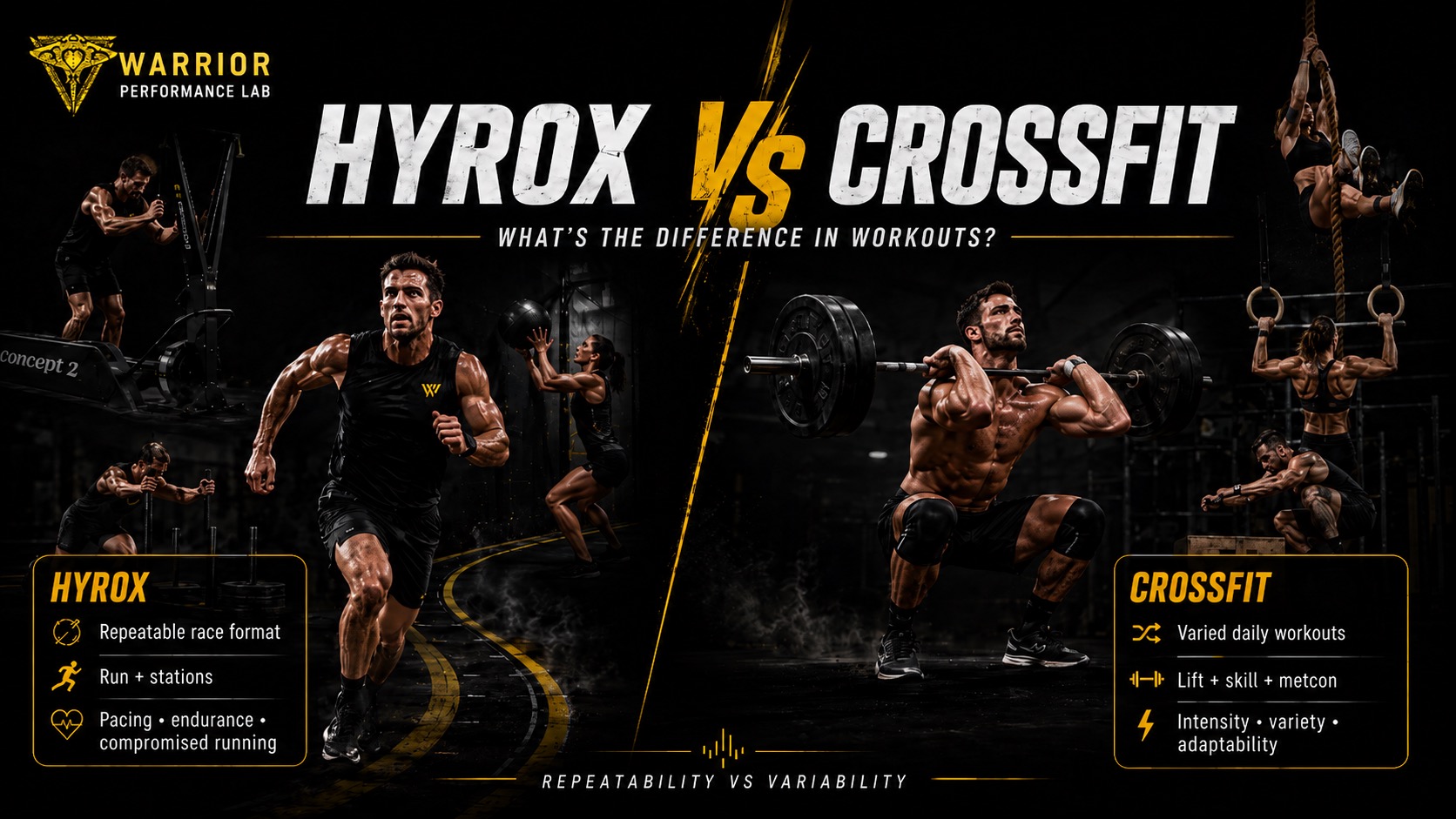
HYROX and CrossFit live in the same neighborhood, but they are not the same house.
Both can make you strong. Both can humble your engine. Both use functional movements, intensity, and a community atmosphere that makes hard work feel electric. But if you are training for a HYROX race, doing random CrossFit workouts and hoping it transfers perfectly is not a strategy. It is a gamble.
CrossFit officially describes its methodology as constantly varied functional movements executed at high intensity. HYROX, on the other hand, is a fixed fitness race: 1 km run, one workout station, repeated eight times. The difference is right there: CrossFit rewards broad adaptability; HYROX rewards repeatable race execution.
Simple version:
CrossFit asks, "How well can you handle the unknown?" HYROX asks, "How well can you repeat known work under growing fatigue?"
HYROX vs CrossFit at a glance
| Category | HYROX | CrossFit |
| Primary structure | Standardized race format: 8 x 1 km runs plus 8 stations. | Constantly varied workouts, skills, loads, time domains, and formats. |
| Goal | Fastest total race time with efficient pacing and transitions. | Broad fitness, high-intensity capacity, skill development, and work capacity. |
| Running demand | Central and predictable: 8 km total running in repeated 1 km segments. | Variable: may include running, rowing, biking, skipping, or no monostructural work. |
| Movement complexity | Lower skill complexity but high repetition under fatigue. | Can include high-skill gymnastics and Olympic lifting. |
| Main limiter | Aerobic capacity, compromised running, strength endurance, pacing. | Skill, strength, power, conditioning, gymnastics, and workout-specific strategy. |
| Programming need | Specific progression toward race format. | General physical preparedness and constant variance. |
The biggest difference: repeatability vs variability
HYROX is repeatable. The station order is known: SkiErg, Sled Push, Sled Pull, Burpee Broad Jumps, Row, Farmers Carry, Sandbag Lunges, and Wall Balls, with a 1 km run before each station. That means you can test, practice, and refine the exact demands of the event.
CrossFit is intentionally varied. One week may include heavy cleans, toes-to-bar, bike sprints, handstand push-ups, rowing intervals, rope climbs, or a long hero workout. The point is broad capacity across many tasks, not rehearsal of one fixed race sequence.
Neither approach is better in every context. They simply solve different problems.
What the physiology tells us
The 2025 Frontiers in Physiology study on simulated HYROX described the sport as a running-focused form of high-intensity functional training. Participants spent more time running than performing stations, but stations were more intense per unit of time. Faster performance was associated with aerobic capacity and endurance training volume.
That matters because many CrossFit athletes already have high-intensity tolerance, strength, and movement confidence. But HYROX asks you to sustain output for a longer, more predictable race. The problem is not whether you can suffer. The problem is whether you can avoid wasting energy for 60-90+ minutes while moving from one known demand to the next.
Movement differences
HYROX movements are accessible, but they are not easy. CrossFit movements can be more technical, but the workout may be shorter or structured differently. This creates different coaching priorities.
| HYROX movements | Common CrossFit movements | Training implication |
| Sled push and sled pull | Cleans, snatches, deadlifts, thrusters | HYROX needs heavy horizontal force repeated under race breathing. |
| Burpee broad jumps | Burpees, box jumps, gymnastics transitions | HYROX rewards sustainable cadence and distance management. |
| Farmers carry | Kettlebell carries, deadlifts, farmer holds | Grip endurance matters, but so does posture after running. |
| Sandbag lunges | Front rack lunges, walking lunges, step-ups | Lunge quality must survive fatigue and breathing stress. |
| Wall balls | Thrusters, med-ball work, squat endurance | Planned sets beat emotional max sets at the end of a race. |
| 8 x 1 km running | Variable running or monostructural work | HYROX requires predictable run volume and compromised running practice. |
What CrossFit athletes bring to HYROX
CrossFit athletes often arrive with a useful toolbox. They are usually comfortable with intensity, mixed-modal training, transitions, and functional movement. That is a major advantage.
- Strength and power for sleds, carries, lunges, and wall balls.
- Experience working while breathing hard.
- Mental familiarity with uncomfortable workouts.
- Good exposure to rowing, SkiErg, kettlebells, wall balls, and burpees.
- Confidence entering a competitive fitness environment.
What CrossFit athletes usually need to add
The missing piece is often not toughness. It is specificity. A CrossFit athlete may be very fit and still lose huge time because the race asks for predictable, repeatable output rather than a new challenge every day.
- More controlled aerobic work: Easy Zone 2 work builds the base that lets you recover between hard segments.
- More structured running: HYROX has 8 km of running. You need specific running exposure, not accidental running once in a while.
- More compromised running: Practice running after sleds, burpees, carries, lunges, and wall balls.
- More pacing discipline: CrossFit can reward redline intensity. HYROX punishes redline timing if it happens too early.
- More station economy: The movements are known, so there is no excuse not to make them efficient.
Can CrossFit be part of a HYROX build?
Yes, but it needs a job. If HYROX is the A-goal, CrossFit-style training should support your strength, mobility, power, and skill without stealing recovery from the sessions that matter most for race day.
| Training priority | Best use of CrossFit-style work | What to avoid |
| HYROX-primary | 1-2 supportive sessions for strength, skill, or short intensity. | Random hard WODs that interfere with running and sled sessions. |
| CrossFit-primary | Use HYROX-style work as conditioning variety. | Expecting peak HYROX performance without run-specific preparation. |
| Balanced hybrid | Rotate priorities by block: aerobic base, strength, race-specific, deload. | Trying to improve everything maximally at the same time. |
The CrossFit-to-HYROX transition
A smart transition does not mean abandoning CrossFit. It means changing the target. You are moving from constantly varied readiness to predictable race execution.
- Replace two random conditioning days with planned aerobic work. One easy aerobic session and one running-quality session can change your HYROX trajectory fast.
- Keep strength, but make it race-useful. Use squats, hinges, split squats, carries, sled patterns, trunk work, and wall-ball capacity.
- Practice station-to-run sequences. A strong station is only useful if you can run after it.
- Track splits instead of only effort. CrossFit often celebrates intensity. HYROX needs repeatability.
- Rehearse transitions. Know how you will breathe, move, pick up equipment, and begin the next task.
Sample 30-day CrossFit-to-HYROX shift
Use this as a framework. Adjust volume and intensity based on your current running tolerance, race timeline, and recovery.
| Day type | Example | Goal |
| Easy engine | 40-60 min Zone 2 run, row, ski, bike, or incline walk | Build aerobic capacity without frying recovery. |
| Strength + station skill | Front squat, RDL, split squat, carries, wall-ball technique | Keep strength and improve HYROX movement quality. |
| Run quality | 5-8 x 600 m or 3-5 x 1 km at controlled pace | Build repeatable 1 km rhythm. |
| CrossFit maintenance | Short skill or strength-biased WOD | Maintain CrossFit qualities without hijacking the week. |
| Compromised session | Sled or lunge pattern + 400-1000 m run repeats | Train the exact problem HYROX creates. |
| Recovery | Rest, mobility, walking, easy flush | Adapt instead of accumulating fatigue. |
The mistake: training hard but not specifically
Hard work is not the issue. CrossFit athletes know how to work hard. The issue is whether the work is solving the right problem.
- If you never run on tired legs, HYROX running will surprise you.
- If every station becomes a max effort, your next run will collect the bill.
- If you skip easy aerobic work, you may have intensity but poor repeatability.
- If you never practice wall balls at the end of fatigue, the final station becomes a negotiation.
So which one should you choose?
Choose CrossFit if you love variety, skill development, broad physical preparedness, and the challenge of not knowing exactly what is coming next. Choose HYROX if you love measurable race execution, endurance-strength strategy, and the satisfaction of improving a fixed test over time.
And if you love both? Perfect. Just be honest about the season you are in. When HYROX is close, train like the race is close. When CrossFit is the focus, train for the broad skill set CrossFit demands.
Want a clearer CrossFit-to-HYROX path?
Start inside the Warrior Lab app to track your training, station PRs, run progress, readiness, and race prep. If you want more personalization, Elite 1:1 HYROX® & Hybrid Coaching can help you convert your current fitness into a specific race plan.
Start with the Warrior Lab App
Explore Elite 1:1 HYROX® & Hybrid Coaching
Finally;
CrossFit builds broad capacity. HYROX demands repeatable capacity. There is overlap, but the best race-day results come when your training reflects the actual race.
Keep your strength. Keep your grit. Add the pacing, running, and station-specific rhythm HYROX requires.
FAQ's
Is HYROX harder than CrossFit?
It depends on the athlete. HYROX usually feels longer, more rhythmic, and more endurance-dominant. CrossFit can be more technical, more varied, and more skill-dependent. The harder sport is the one that exposes your current limiter.
Can CrossFit prepare me for HYROX?
CrossFit can build a strong base of strength, work capacity, and functional movement confidence. But HYROX race performance needs specific preparation: repeated 1 km running, station pacing, sled tolerance, transitions, and movement economy under predictable fatigue.
What should CrossFit athletes add for HYROX?
Add easy aerobic volume, structured running, station-to-run intervals, and race-flow simulations. You do not need to abandon CrossFit, but you do need to stop relying on random intensity as your only preparation.
Does HYROX include Olympic lifting or gymnastics?
No. HYROX does not include Olympic lifts, pull-ups, handstand push-ups, muscle-ups, or rope climbs. The stations are fixed and accessible, but they become extremely demanding because they are repeated with running and cumulative fatigue.
Can I train for HYROX and CrossFit at the same time?
Yes, but one should be the priority during a race build. If HYROX is the goal, CrossFit-style sessions should support strength, mobility, and power without stealing recovery from running, sleds, and race-specific work.
References & Further Learning
1. HYROX. The Fitness Race: official race format, stations, divisions, weights, distances, and repetitions. HYROX official race format
2. CrossFit. Defining CrossFit, Part 1: Functional Movements. Official CrossFit description of constantly varied functional movements executed at high intensity. CrossFit official page
3. Brandt, T. B., Ebel, C. E., Lebahn, C. L., & Schmidt, A. (2025). Acute physiological responses and performance determinants in Hyrox - a new running-focused high intensity functional fitness trend. Frontiers in Physiology, 16, 1519240. Frontiers article
4. Feito, Y., Heinrich, K. M., Butcher, S. J., & Poston, W. S. C. (2018). High-intensity functional training (HIFT): definition and research implications for improved fitness. Sports, 6(3), 76. PMC record
5. Dominski, F. H., et al. (2022). Functional fitness training, CrossFit, HIMT, or HIFT: what is the preferred terminology? Frontiers in Sports and Active Living, 4, 882195. Frontiers article
6. Stöggl, T. L., & Sperlich, B. (2015). The training intensity distribution among well-trained and elite endurance athletes. Frontiers in Physiology, 6, 295. Frontiers article
7. Llanos-Lagos, C., Ramirez-Campillo, R., Moran, J., & Sáez de Villarreal, E. (2024). Effect of strength training programs in middle- and long-distance runners economy at different running speeds: a systematic review with meta-analysis. Sports Medicine, 54, 895-932. PubMed record