
Knee Injuries in Hybrid Athletes: Clinical & Coaching Perspectives
Introduction
Hybrid fitness competitions (e.g. HYROX events) uniquely combine cardiovascular endurance (running) with repeated high‐intensity functional movements (sled pushes, lunges, wall balls, etc.)[1]. These events place repetitive and heavy loads on the knees from both endurance (repeated 1 km runs) and strength tasks, making knee health and injury management paramount for performance and longevity. In elite hybrid athletes, understanding knee anatomy, common injury patterns, and evidence-based management is essential. This report integrates clinical anatomy, pathomechanics, rehabilitation protocols, and prevention strategies with coaching insights, drawn from sports medicine and physiotherapy literature (e.g. JOSPT, BJSM). It is intended for high-performance coaches, physiotherapists, and athletes preparing, training, or rehabbing in hybrid modalities.
Clinical Knee Anatomy
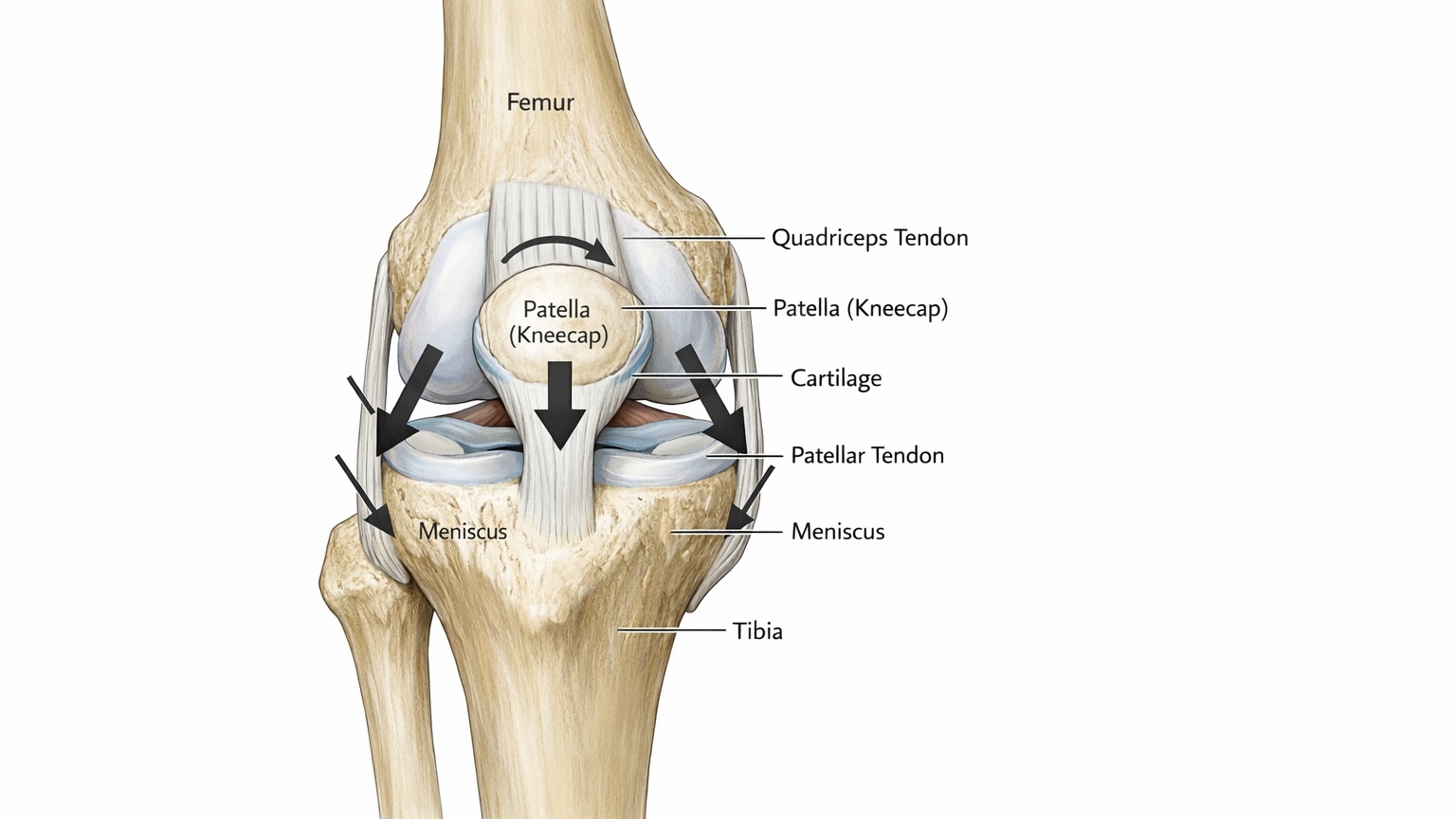
The knee is a complex hinge joint comprising the tibiofemoral and patellofemoral articulations, stabilized by bones, cartilage, ligaments, and musculotendinous units. Key structures (Figure 1) include:
- Bony Landmarks: The distal femur has medial and lateral condyles; the proximal tibia has corresponding plateaus and tibial eminence. The patella is a sesamoid bone in the quadriceps tendon. The joint surfaces are covered by articular cartilage for load distribution[2].
- Menisci: Medial and lateral menisci are fibrocartilage rings between femur and tibia. They deepen the joint, absorb shock, distribute load, and stabilize the knee. Damage to the meniscus (e.g. tears) disrupts load distribution and is strongly linked to osteoarthritis risk. Deep squatting and pivoting (common in lunges and wall balls) increase meniscal stress[3].
- Ligaments: The ACL (anterior cruciate ligament) runs from the posteromedial aspect of the lateral femoral condyle to the anterior tibial plateau. It resists anterior tibial translation and rotational forces[2]. The PCL (posterior cruciate ligament) resists posterior tibial translation. Collateral ligaments (MCL, LCL) provide medial/lateral stability. In functional movements, the ACL and PCL are critical to knee control. Non-contact ACL injuries (e.g. deceleration and cutting) involve valgus and internal rotation forces[4]. The PCL is typically injured by a direct posterior force on a flexed knee (e.g. fall on bent knee), much less common in hybrid sports.
- Muscles and Tendons: The quadriceps (vastii, rectus femoris) attach via the patellar tendon to the tibia; they extend the knee and stabilize the patellofemoral joint. The hamstrings flex the knee and counteract anterior tibial translation (protecting the ACL). Strong hip abductors/gluteals help control knee valgus. The iliotibial band (ITB) crosses the lateral knee and can contribute to lateral knee pain (ITB syndrome) in runners. Imbalances (weak hip/gluteus medius or quadriceps) affect patellar tracking and knee kinematics.
Figure 1 (not shown here) would illustrate knee structures. From a training standpoint, anatomy informs injury risk: e.g. deep knee flexion (>60°) greatly increases patellofemoral compressive force[5][6], and excessive valgus at the knee stresses the ACL. Conversely, maintaining alignment (knees over toes rather than caving inward) and moderate squat depth can reduce injurious loads[6].
Common Knee Injuries in Hybrid Athletes
Hybrid athletes combine running and loaded movements, so the knee injuries often mirror those seen in runners, jumpers, and lifters. The most common conditions include:
- Patellofemoral Pain Syndrome (PFPS): A chronic overload of the patellofemoral joint causing anterior knee pain. Symptoms are worse with running, stairs, squatting, or after sitting (the “theater sign”). In hybrid athletes, high-rep squatting (wall balls, deep lunges) and repeated running can inflame the patellar cartilage. PFPS is linked to maltracking: excessive knee flexion beyond 60°, knee translation past toes, or thigh muscle imbalance can overload the patellofemoral joint[7]. For example, deep squat movements in training produce high patellofemoral stress at 60–90° knee flexion[7]. Management emphasizes quadriceps and hip strengthening to stabilize the patella, running gait modification, and load management.
- Meniscal Tears: The medial or lateral meniscus can tear via twisting or compression. In hybrid sports, meniscal injury often occurs during a misstep, rotational movement, or deep squat under load. Risk factors include deep squatting, pivoting, or direct compression on a flexed knee[3]. Repeated lunges or heavy squat jumps may also stress the posterior horns. Acute tears cause joint line pain, swelling, and “locking” or catching.
- ACL Injuries: The ACL is frequently injured in sports. Most ACL tears in athletics are non-contact: rapid deceleration, cutting, or landing from a jump can rupture the ACL[4]. A Hyrox athlete might tear an ACL during an awkward lunge or if fatigued and poorly aligned on landing. ACL injuries produce a sharp “pop”, rapid swelling, and instability. Females have higher risk (2–9 times) likely due to anatomical and hormonal factors[8].
- PCL Injuries: Less common in sport, PCL injuries usually need a large force (e.g. fall on flexed knee). In hybrid training, PCL injury is rare but possible with heavy barbell or sled impacts to the shin. Symptoms include posterior knee pain and feeling of knee “giving way” when walking downhill.
- Patellar Tendinopathy (“Jumper's Knee”): Overuse injury of the patellar tendon at its attachment (inferior pole of the patella). Caused by repetitive high loads (jumping, heavy squats). In hybrid events, repeated deep squat thrusts (wall balls, burpees) or large-volume plyometrics can overload the tendon. Patients have localised tendon pain that worsens with loading; passive stretching often reproduces pain. Rehab emphasizes gradual tendon loading (isometrics, then eccentric loading) and addressing kinetic chain deficits[9].