
Luke Greer's 54:43 at HYROX Barcelona
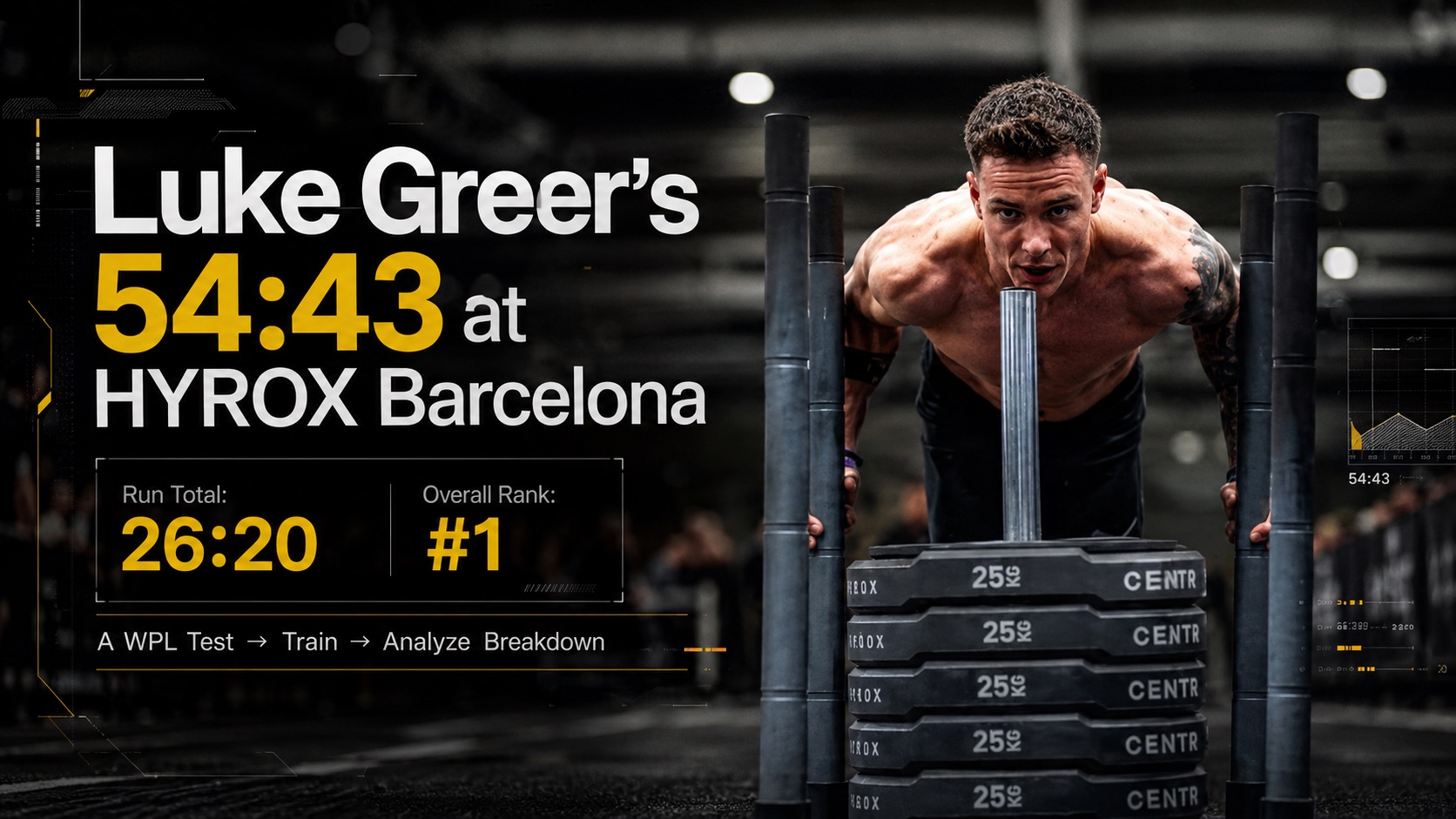
A Test -> Train -> Analyze breakdown for coaches and HYROX athletes
| 54:43 TOTAL TIME | 26:20 RUN TOTAL | #1 OVERALL RANK | #1 AGE-GROUP RANK |
Luke Greer's 54:43 at HYROX Barcelona: A WPL Test-Train-Analyze Breakdown
Luke Greer's 54:43 at BIOTHERM HYROX Barcelona was more than a fast Pro Men result. It was a clean example of why HYROX coaching needs more than generic hard sessions.
The headline is simple: Greer won the Pro Men field and finished first in his age group. The coaching lesson is more useful: his split profile shows a race built on run dominance, enough station capacity to keep the race moving, and transition discipline that protected the overall time.
Through the Warrior Performance Lab lens, this is exactly where the Test -> Train -> Analyze model becomes useful. The aim is not to copy an elite athlete's exact paces. The aim is to understand what the race data says, identify the limiter, then build training that changes the next result.
The Result
| Metric | Result | Coaching read |
| Event | BIOTHERM HYROX Barcelona 2026 | Pro Men field, high-performance benchmark |
| Athlete | Luke Greer | Official result PDF lists Greer, Luke |
| Division | HYROX PRO - Friday | PRO loads and full individual race demand |
| Overall time | 00:54:43 | Race-winning total time |
| Rank | #1 overall / #1 AG | Result confirms field-leading performance |
| Run total | 00:26:20, place 1 | Primary separator |
| Roxzone time | 00:03:30, place 4 | Transition control supported the win |
The Split Profile
| Run segment | Time | WPL read |
| Run 1 | 3:03* | Opening split; note source also lists best run lap as 3:14 |
| Run 2 | 3:14 | Fast reset after SkiErg |
| Run 3 | 3:22 | Still controlled after sled push |
| Run 4 | 3:21 | No major crash after sled pull |
| Run 5 | 3:21 | Stable after burpees |
| Run 6 | 3:19 | Rebounds after row |
| Run 7 | 3:19 | Maintains pace after farmer carry |
| Run 8 | 3:25 | Final kilometer still strong after lunges |
*Data note: the official summary lists Running 1 as 3:03 and Best Run Lap as 3:14. For coaching purposes, the strongest takeaway is the 26:20 run total and the stability of the later run sequence.
| Station | Time | Place | WPL read |
| 1000m SkiErg | 3:58 | 14th | Strong enough, not the main separator |
| 50m Sled Push | 2:46 | 14th | Work capacity plus controlled exit mattered |
| 50m Sled Pull | 3:23 | 4th | Major station strength point |
| 80m Burpee Broad Jump | 2:26 | 12th | Solid enough to protect the next run |
| 1000m Row | 3:59 | 6th | Strong station output |
| 200m Farmer's Carry | 1:22 | 10th | Good carry speed without run collapse |
| 100m Sandbag Lunges | 2:48 | 14th | Contained fatigue before final run |
| Wall Balls | 4:17 | 30th | Possible optimization gap, but did not cost the win |
The WPL Lens: Engine First, Not Engine Only
WPL's coaching philosophy starts with a simple idea: HYROX is not run-only and not strength-only. The coach's job is to find the missing link and bias training toward it.
In Greer's Barcelona result, the clearest separator was the run. A 26:20 run total ranked first, and the later run sequence held together after multiple stations. That does not mean strength was irrelevant. It means the station work was controlled enough that the engine could keep expressing itself.
That is the difference between running fast in a vacuum and racing fast in HYROX. The stations do not need to be first-place splits in every case, but they cannot create a run collapse. Greer's station results were not all field-leading, yet they were good enough to keep the race moving and allow the run total to dominate the outcome.
TEST: What Did Barcelona Test?
Barcelona tested whether Greer could keep returning to speed after different forms of interference: upper-body pulling on the SkiErg, leg drive and trunk pressure on the sleds, global fatigue from burpees, cyclic endurance on the row, grip and posture under the farmer's carry, then leg fatigue from lunges before the final kilometer and wall balls.
The race data suggests he passed the biggest HYROX test: the stations did not break the run. After the row, he hit a 3:19 run. After the farmer's carry, he hit another 3:19 run. After the lunges, he still came back with 3:25. That is the signature of a race where the engine remains available under fatigue.
The test also exposes a useful coaching question. If an athlete has a 30th-place wall-ball split but still wins, is wall-ball strength the main limiter? Maybe not for that race. But if the athlete is chasing Elite-level margins, that final station becomes a clear opportunity for refinement without sacrificing the run weapon.
TRAIN: What Should Coaches Copy?
Do not copy the finish time. Copy the logic.
For an athlete with this profile, the training bias would protect run quality while tightening station execution. That means threshold running, compromised running, VO2 exposures, station density, and task-specific strength must be sequenced with purpose. The key is not more suffering. The key is choosing which quality gets protected each week.
If the athlete is engine-limited, protect threshold and compromised running. If the athlete is strength-limited, protect task-specific strength and position quality. If the athlete is mixed-profile, which most HYROX athletes are, use the race data to decide where two or three weekly sessions must point.
- Run durability: Use threshold intervals and controlled 800m to 1km repeats so race pace is repeatable, not heroic.
- Compromised running: Practice returning to pace after sled, burpee, row, carry, and lunge stressors.
- Station control: Build enough strength and skill that stations do not become near-max efforts.
- Wall-ball finish: For this profile, wall balls are a likely optimization target because the final station ranked lower than the run and transition profile.
- Sequencing: Do not bury the key run under junk fatigue when run quality is the main performance weapon.
ANALYZE: What Should Coaches Review After This Race?
| Question | What the Greer data suggests | Coach action |
| Did the run fade? | Later runs stayed highly competitive, with 3:19, 3:19, and 3:25 to close. | Keep protecting threshold and compromised run quality. |
| Which station hurt the next run? | No obvious collapse after row, carry, or lunges. | Station fatigue was contained; maintain exposure. |
| Where was time leaked? | Wall Balls: 4:17, 30th place. | Improve wall-ball efficiency without overloading fatigue. |
| Was transition time a problem? | Roxzone: 3:30, 4th place. | Keep transition discipline as a race weapon. |
| What is the main lesson? | Run dominance plus station tolerance won the race. | Train the engine, but do not remove station-specific strength. |
The Coaching Takeaway
Luke Greer's 54:43 at HYROX Barcelona shows the WPL principle in action: test the limiter, train with bias, then analyze whether the next result proves the adaptation.
For Greer, the split profile points to a race won through run dominance, controlled station exposure, and transition discipline. The stations did not have to be perfect because the overall system was stable. That is the difference between being fast and being race-fast.
For most athletes, the lesson is not to chase a 26:20 run total. The lesson is to stop guessing. Find out whether the athlete is engine-limited, strength-limited, or struggling with both. Then build the week around the missing link and review the next race or simulation with the same honesty.
That is WPL's Test -> Train -> Analyze model in one sentence: race data tells the truth, training should answer it.
Want your HYROX training to stop being random hard work? Warrior Performance Lab helps athletes identify the missing link, train it with purpose, and analyze race data so the next block actually moves the needle. warriorperformancelab.com & warrior lab app