Why Elite Athletes Are Eating More Carbs

And What HYROX Athletes Should Learn From It
Main Takeaways:
1- Higher carbohydrate intake is not just about eating more; it is about tolerating and absorbing fuel at race intensity.
2- Hydrogel-style fueling may help some athletes, but the strategy still has to be trained.
3 -HYROX athletes should translate the lesson through pre-race fueling, conservative race-day execution, and simple options they have already tested.
4 -Carbs, fluid, and sodium work together. Do not copy elite numbers without your own gut-training process.
Fueling is having a moment - not because carbohydrates suddenly became new, but because elite athletes have become more sophisticated about how they deliver, tolerate, and use them while the race is already uncomfortable.
For years, many endurance conversations centered on caution: take enough carbohydrate to avoid the late collapse, but not so much that the stomach pushes back. That advice still matters. But the modern conversation has shifted. In marathon running, cycling, and long-course racing, more athletes are practicing higher carbohydrate intakes in training so race-day fueling becomes a repeatable skill rather than a stomach gamble.
HYROX athletes should pay attention. HYROX is not a marathon, but it is a race of sustained output: repeated running, high-force stations, bracing, breathing, sweat, and fatigue. Energy availability matters. Gut tolerance matters. Simplicity matters.
Do not chase elite grams per hour. Chase better fueling tolerance, cleaner execution, and a plan your body already recognizes.
The elite marathon story is a signal, not a script
Recent reporting around Sabastian Sawe, Maurten, and elite marathon fueling pushed hydrogel-style carbohydrate delivery into the wider coaching conversation. The Guardian reported a race-day protocol averaging about 115 g of carbohydrate per hour, practiced over months of gut training. The number is attention-grabbing, but it should not be copied blindly. It is a signal that elite fueling is becoming more planned, more rehearsed, and more individualized.
That is the lesson for HYROX: not that every athlete should force 100 g per hour, but that nutrition is no longer a loose race-day detail. It is part of performance preparation.
Why higher carbohydrate intake became possible
The body has limits to how quickly carbohydrate can move through the gut and be oxidized during exercise. Older practical guidelines often focused on 30-60 g per hour during prolonged exercise. Later work on multiple transportable carbohydrates - commonly glucose or maltodextrin paired with fructose - showed that using different intestinal transport pathways can increase exogenous carbohydrate oxidation and, in some settings, reduce gastrointestinal distress compared with relying on a single carbohydrate source.
This is one reason endurance recommendations evolved toward higher intakes for longer events, especially when athletes use mixed carbohydrate sources and practice the strategy. The key phrase is practice the strategy. More carbohydrate is only useful when the athlete can tolerate it, absorb it, and keep performing.
Where hydrogel fueling fits
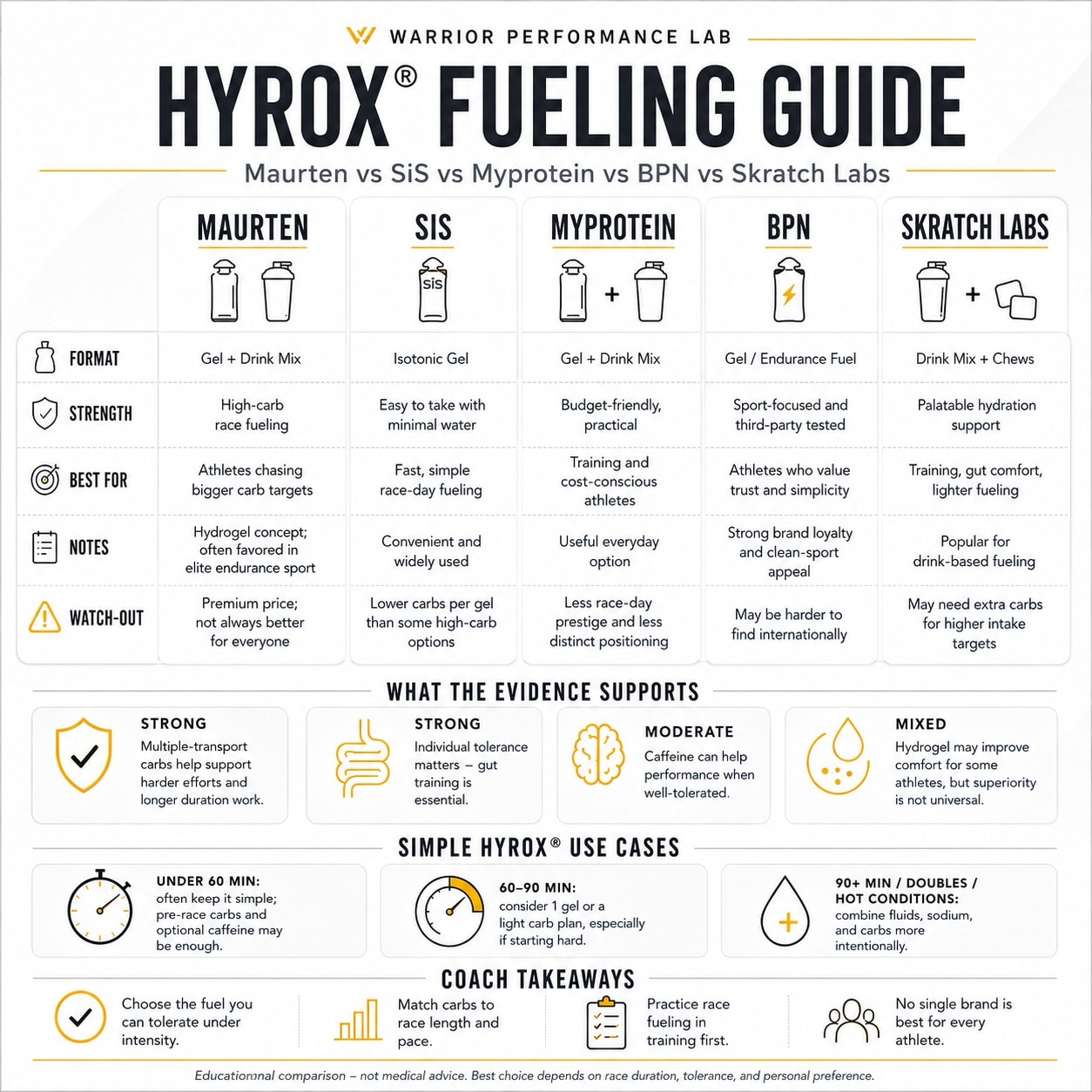
Hydrogel-style products, popularized by Maurten, are designed to form a gel-like matrix in the stomach and help deliver concentrated carbohydrate more comfortably toward the small intestine. For some athletes, this can make higher carbohydrate intake feel easier. For others, the difference may be small or inconsistent.
The respectful way to talk about hydrogel fueling is balanced: it is a useful tool, not magic. Some studies support aspects of the concept, such as improved gastric emptying or higher exogenous carbohydrate oxidation with certain formulations. Other reviews and trials note that performance and GI benefits over traditional carbohydrate fluids are not yet clearly demonstrated across all conditions. Product choice can help, but product choice does not replace training the gut, timing the intake, and matching fuel with fluid and sodium.
The gut can be trained
The most important practical idea is that the gut is adaptable. Repeated exposure to carbohydrate and fluid during training can improve comfort, gastric emptying, absorption, and confidence. This is why elite fueling protocols are rehearsed for weeks or months, not improvised at the start line.
For HYROX athletes, gut training should not only happen in easy long runs. It should also happen in sessions that resemble the race: running at effort, transitions, bracing, sled work, lunges, wall balls, heat, sweat, and fatigue. A gel that feels fine during an easy jog may feel very different after burpee broad jumps and a sled push.
What this means for HYROX
HYROX combines a 1 km run followed by one functional workout station, repeated eight times. That structure creates two realities for fueling. First, the pre-race window is critical because many athletes do not have easy, calm opportunities to take fuel once the race starts. Second, any during-race fueling has to be simple enough to use under movement, intensity, and stress.
For faster athletes, a strong pre-race carbohydrate plan and a small top-up may be enough. For longer race times, Doubles, or athletes who consistently fade late, a small amount of tested carbohydrate during the race may help. But the goal is not to recreate a marathon fueling plan inside HYROX. The goal is to avoid energy drop-off without creating stomach chaos.
A practical coach framework
- Build the pre-race plan first. A familiar, carbohydrate-focused meal several hours before the race is often more valuable than trying to take large amounts of fuel during HYROX. Keep fat, fiber, and novelty low if the athlete is GI-sensitive.
- Use a small pre-start top-up. Many athletes do well with a tested gel, drink mix, or easily digested carbohydrate source 30-60 minutes before the start. Practice this before hard sessions.
- Treat during-race fueling as optional and strategic. Athletes with longer race times or repeated late-race fading can test small doses, such as sips of carbohydrate drink or a gel split across the race. Do not force it if the race is short or the gut is not ready.
- Train tolerance before increasing intake. Start with conservative carbohydrate amounts in longer sessions. Build gradually only when symptoms stay manageable.
- Pair carbohydrates with fluid and sodium. Higher carbohydrate strategies work best when hydration is not ignored. Sodium needs vary with sweat rate, heat, race duration, and individual physiology.
A simple gut-training progression
Use this as a starting framework, not a prescription. Increase only when symptoms stay manageable and performance does not suffer.
| Phase | Training focus | Fueling practice |
| Week 1 | Longer aerobic or mixed session | Practice 30-45 g carbohydrate per hour. Log timing, product, fluid, symptoms, and perceived energy. |
| Week 2 | Longer session with harder run segments | Build toward 45-60 g per hour if Week 1 was comfortable. Keep the product type consistent. |
| Week 3 | HYROX-style race simulation | Practice 60-75 g per hour only if already tolerated. Pair with a realistic fluid and sodium plan. |
| Week 4 | Race rehearsal | Use the exact pre-race meal, top-up, and optional during-race fuel you plan to use. No new products. |
For many HYROX athletes, especially those finishing quickly, the most useful race-day fueling may still happen before the start. The protocol above is for training tolerance, not an instruction to force fuel during the race.
Sodium is part of the system
Carbohydrate delivery does not happen in isolation. Fluids and sodium influence hydration, plasma volume, stomach comfort, and perceived effort. The mistake is to think of fuel, fluid, and electrolytes as separate decisions. They are one race-day system.
This does not mean every athlete needs aggressive sodium loading. Sweat rate and sweat sodium concentration vary widely. Some athletes need more sodium support, especially in heat or longer events; others need a more modest plan. The safer coaching principle is to observe sweat losses, avoid over-drinking plain water, and test sodium-containing fluids or electrolytes in training before relying on them in competition.
Common race-day mistakes
- Copying elite marathon carbohydrate numbers without the same training history or race context.
- Trying a new gel, drink mix, or sodium product for the first time on race day.
- Taking fuel too late, when the athlete is already fading and the gut is already stressed.
- Increasing carbohydrate intake without enough fluid or an appropriate sodium strategy.
- Making the plan too complicated for a race that already demands constant movement and decision-making.
Conclusion
Elite athletes are eating more carbs because modern fueling has become more deliberate. They are not simply throwing more sugar at the problem. They are using better formulations, mixed carbohydrate sources, hydration strategies, and months of gut training to turn fuel into usable race energy.
HYROX athletes should translate that lesson carefully. Test in training. Start conservative. Pair carbohydrates with sodium and fluid. Keep the race-day plan simple. The best fuel is not the one with the loudest marketing. It is the one your body can actually use when the race gets ugly.
Coach takeaways
| Test in training | Do not wait for race day. |
| Start conservative | Build tolerance before you push intake. |
| Pair carbs with sodium | Fuel, fluid, and electrolytes work together. |
| Keep it simple | Use a plan your gut already knows. |
References
Thomas, D. T., Erdman, K. A., & Burke, L. M. (2016). Position of the Academy of Nutrition and Dietetics, Dietitians of Canada, and the American College of Sports Medicine: Nutrition and Athletic Performance. Journal of the Academy of Nutrition and Dietetics, 116(3), 501-528. https://doi.org/10.1016/j.jand.2015.12.006
Jeukendrup, A. E. (2014). A step towards personalized sports nutrition: carbohydrate intake during exercise. Sports Medicine, 44(Suppl 1), S25-S33. https://doi.org/10.1007/s40279-014-0148-z
Jeukendrup, A. E. (2010). Carbohydrate and exercise performance: the role of multiple transportable carbohydrates. Current Opinion in Clinical Nutrition and Metabolic Care, 13(4), 452-457. https://pubmed.ncbi.nlm.nih.gov/20574242/
Wilson, P. B. (2015). Multiple transportable carbohydrates during exercise: current limitations and directions for future research. Journal of Strength and Conditioning Research, 29(7), 2056-2070. https://doi.org/10.1519/JSC.0000000000000835
Wilson, P. B. (2025). A narrative review of the high-carbohydrate fueling revolution (>= 100 g/h) in the professional peloton. Sports Medicine, 56(2), 295-313. https://pmc.ncbi.nlm.nih.gov/articles/PMC12982284/
Jeukendrup, A. E. (2017). Training the gut for athletes. Sports Medicine, 47(Suppl 1), 101-110. https://doi.org/10.1007/s40279-017-0690-6
Martinez, I. G., Mika, A. S., Biesiekierski, J. R., & Costa, R. J. S. (2023). The effect of gut-training and feeding-challenge on markers of gastrointestinal status in response to endurance exercise: A systematic literature review. Sports Medicine, 53(6), 1175-1200. https://doi.org/10.1007/s40279-023-01841-0
Sutehall, S., Galloway, S. D. R., Bosch, A., & Pitsiladis, Y. (2020). Addition of an alginate hydrogel to a carbohydrate beverage enhances gastric emptying. Medicine & Science in Sports & Exercise, 52(8), 1785-1792. https://doi.org/10.1249/MSS.0000000000002301
Pettersson, S., Ahnoff, M., Edin, F., Lingstrom, P., Simark Mattsson, C., & Andersson-Hall, U. (2020). A hydrogel drink with high fructose content generates higher exogenous carbohydrate oxidation and a reduced drop in dental biofilm pH compared to two other, commercially available, carbohydrate sports drinks. Frontiers in Nutrition, 7, 88. https://doi.org/10.3389/fnut.2020.00088
King, A. J., Rowe, J. T., & Burke, L. M. (2020). Carbohydrate hydrogel products do not improve performance or gastrointestinal distress during moderate-intensity endurance exercise. International Journal of Sport Nutrition and Exercise Metabolism, 30(5), 305-314. https://doi.org/10.1123/IJSNEM.2020-0102
Sawka, M. N., Burke, L. M., Eichner, E. R., Maughan, R. J., Montain, S. J., & Stachenfeld, N. S. (2007). American College of Sports Medicine position stand: Exercise and fluid replacement. Medicine & Science in Sports & Exercise, 39(2), 377-390. https://pubmed.ncbi.nlm.nih.gov/17277604/
Viribay, A., Arribalzaga, S., Mielgo-Ayuso, J., Castaneda-Babarro, A., Seco-Calvo, J., & Urdampilleta, A. (2020). Effects of 120 g/h of carbohydrates intake during a mountain marathon on exercise-induced muscle damage in elite runners. Nutrients, 12(5), 1367. https://doi.org/10.3390/nu12051367
Context
The Guardian. (2026, May 16). Sawe's secret sauce: inside the lab that fuelled historic sub-two hour marathon. Used as journalistic context for the current elite-marathon fueling conversation. The Guardian article
Reuters. (2026, April 26). Kenya's Sawe shatters elusive two-hour marathon barrier to win in London. Used as event context. Reuters article
HYROX. (n.d.). The Fitness Race. Used to verify the official race format of 1 km running followed by one functional workout station, repeated eight times. Accessed May 17, 2026. HYROX official race page
Maurten. (n.d.). Hydrogel Technology and Fuel Guides. Used as product-category context; not treated as independent proof of performance benefit. Accessed May 17, 2026. Maurten official education page
Disclosure: I personally use Maurten products; this article is not sponsored Maurten is discussed as one example of hydrogel-style carbohydrate delivery. This article is educational and should not replace individualized guidance from a qualified clinician.