
How to Balance Running and Strength Training for HYROX
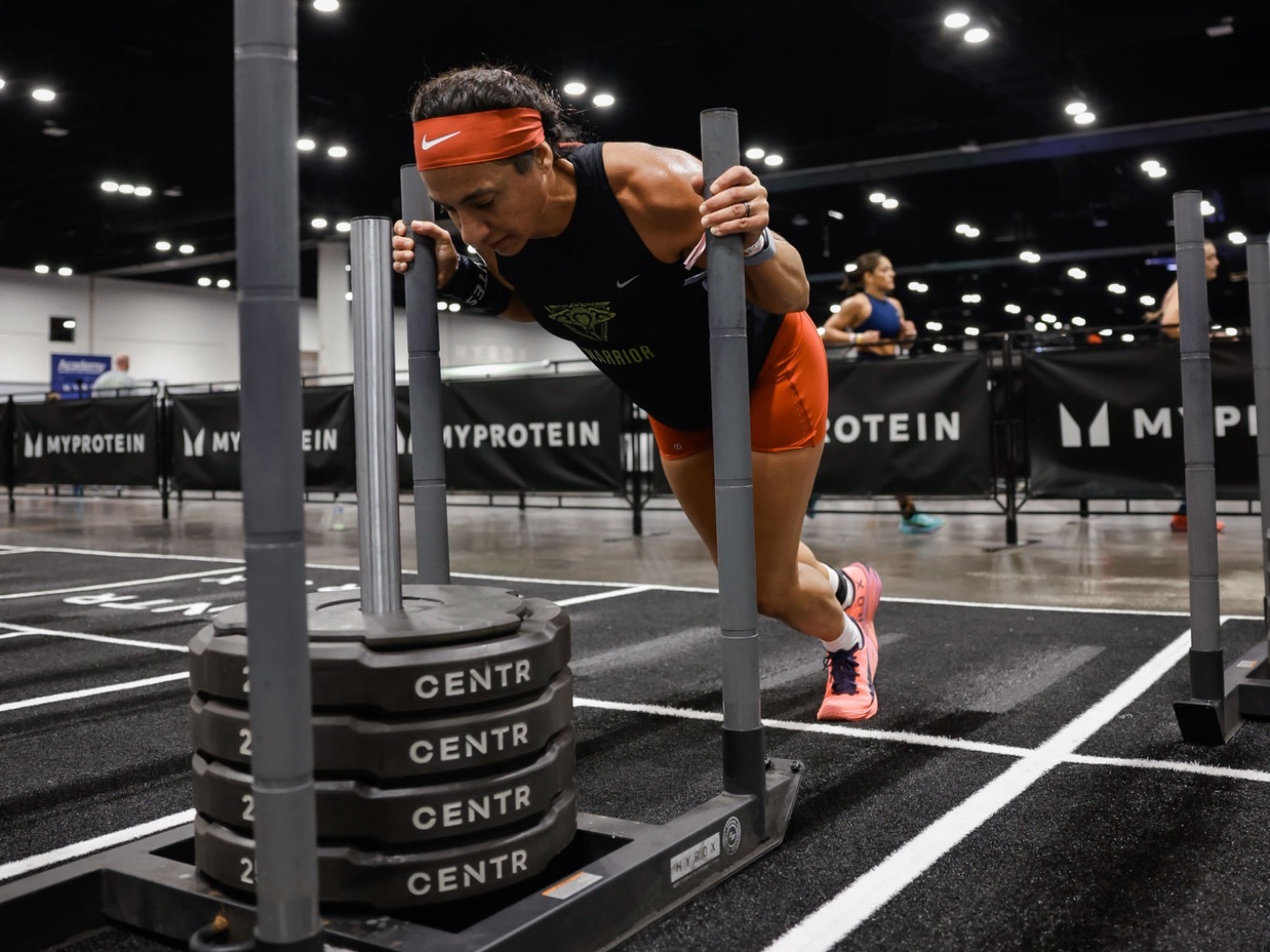
Your sled split and the kilometre that follows can tell you which part of your week deserves more attention.
By Ayda Page, HYROX Performance Coach and founder of Warrior Performance Lab
Suppose you push the sled ten seconds faster than you did last week. Before I’d call that a better race effort, I’d want one more split. How much time passed between finishing the push and finishing the next kilometre?
Illustrative times from two hypothetical sessions. The second split starts when the sled crosses the line.
The steadier push gives up ten seconds and earns back twenty. I’d repeat that comparison before changing the athlete’s race plan. I’d also hold off on prescribing more intervals. The athlete may already have the running fitness to go faster if they spend a little less of it on the sled.
In his WOD-Science video on hybrid training, Gommaar D’Hulst suggests giving one quality more training time when progress stalls and the week is already full. For HYROX, the choice starts with the race itself. Across nearly 40,000 Pro and Elite results, running accounted for roughly half of race time. Strength-heavy stations also cost slower finishers more time. I’d look at both splits before choosing what to train. [1] [2]
Will running interfere with lifting?
Training strength and endurance in the same programme is called concurrent training. In a review of 17 meta-analyses, people who trained both generally improved aerobic capacity about as much as those who trained endurance alone. Average strength and muscle gains were broadly similar to lifting alone. Most of the evidence comes from recreationally trained people. For an athlete with four training days, that makes keeping both in the week a reasonable starting point. [3]
Give each hard session a purpose
Heavy legs on Tuesday tell you what Monday’s squats cost that day. They tell you little about whether your running has improved over six weeks. One quality worth protecting is explosive strength, the ability to produce force quickly. A review of 43 studies found modestly smaller gains in explosive strength when athletes combined aerobic work and lifting, especially in the same session. [4]
If you want to improve your broad jump, practice a few jumps while you’re fresh and can give each takeoff a full effort. If you want to learn how fast you can run after pushing a sled, put the run immediately after the push. Both sessions belong in a HYROX plan. Their order follows the question you’re trying to answer.
What the 11 minutes of intervals actually measured
One of the studies D’Hulst discusses compared high-intensity interval training with continuous moderate exercise across 69 randomized trials. Across weeks of training, sessions of about 11 minutes were associated with 80% of the maximum VO₂max improvement the researchers predicted for intervals. VO₂max measures the highest rate at which your body can use oxygen. The 11 minutes included recovery between hard efforts and excluded warm-up and cooldown. The estimate was also imprecise, with a 95% confidence interval of roughly 10 to 40 minutes. [5]
That distinction matters when you write a workout. Four 3-minute efforts with a 2-minute jog between them give you 12 hard minutes and 18 minutes from the first effort to the end of the last. I’d use intervals when the goal is to challenge aerobic capacity and keep the conversational run for accumulating time on your feet. To find out whether either is helping your race, time the kilometre after the sled again.
Count the strength work you want to improve
D’Hulst offers six to eight weekly sets per muscle group as a starting point for newer lifters. Pelland and colleagues found that more weekly sets generally produced more muscle growth and strength, with progressively smaller returns, especially for strength. For an athlete working on the sled, I’d log squat load and reps, then log sled distance, surface and stops separately. A stronger squat and fewer stops are both worth tracking. Seeing which one changes helps me choose the next session. [1] [6]
Choose the next four weeks from your splits
For an athlete who already trains four days a week, I’d use one of these three patterns to choose a block. Four weeks gives us a date to retest. It’s a coaching choice, and we can extend the block if it’s working.
If you’re slow on fresh runs as well as race runs, protect one quality run and one easy run. Use a third day for full-body strength and the fourth for controlled station-to-run practice. At the end of the block, repeat the same fresh run and check whether the improvement carries into the run after the station.
If the sled repeatedly stops even when you’re fresh, watch a push from the side. Check foot grip, body position and whether you can keep the sled moving on the same lane. If technique is repeatable and producing force is still the difficulty, give two days to lifting and short sled work. Keep an easy run and a quality run. Compare stops and total pushing time at the original load.
If you run well fresh and lose pace only after the sled, try a pacing change first. On two comparable days, use the same sled, lane, load, shoes and approach pace. Change how hard you push. Let the clock run through the exit and the following kilometre, and write down where you lost pace. Did your legs feel heavy from the first step, or did your breathing force you to ease off further down the track? If the steadier effort repeatedly wins on combined time, you have a race strategy you can practice within your current week.
Whichever pattern fits, keep one familiar check on the quality getting less time. Research on maintenance suggests that people can often hold fitness for a period with less work when relative intensity is preserved. Evidence in competitive athletes is limited. If your usual squat feels harder for several sessions at the same load and reps, check how recovered you were and whether the block still includes enough lifting. [7]
Bring your coach the station split and the next run split, along with one sentence about where your pace first changed. That’s where I’d start your next training block.
For more HYROX training resources, explore the Warrior Performance Lab Resources Hub.
The video and research
[1] Gommaar D’Hulst, WOD-Science (2026). The 2026 guide to building strength and endurance
[2] Rappelt et al. (2026). Seven seasons of Pro and Elite HYROX race results
[3] Held et al. (2026). An umbrella review of adaptations to concurrent training
[4] Schumann et al. (2022). Concurrent training, muscle size and explosive strength
[5] Mattioni Maturana et al. (2026). Exercise duration and VO₂max after interval or continuous training
[6] Pelland et al. (2026). Weekly set volume and frequency for muscle size and strength
[7] Spiering et al. (2021). The dose of training needed to maintain endurance and strength